
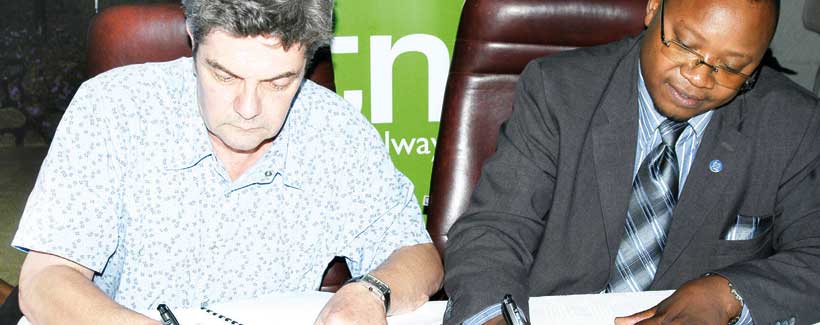
TNM’s Super League sponsorship, which ended on Tuesday, represented financial stability that was, unfortunately, if not taken for granted then treated with contempt by the very same teams that were benefiting from it.
With globalisation bringing sponsorship football practices at the teams’ finger tips, they had reasons to compare and grumble over a somewhat non-progressive and restrictive clause in the sponsorship agreement that spanned 10 years.
Likewise, TNM had valid commercial interests to protect through a clause of exclusivity that denied other mobile phone service providers entry into domestic elite football sponsorship.
However, both sides approached the matter with utter insensitivity, which was not helped by Super League of Malawi’s (Sulom) failure to avert the crisis that had, for many years, been looming on its door step.
Somehow, Sulom hoped that the worst would not happen. Unfortunately, it did, with The Competitions and Fair Trading Commission triggering it all by condemning the agreement and urging Sulom and TNM to revisit the clause when renewing the contract.
“The commission found that the restrictions on access to football sponsorship that the agreement imposes on football teams, and the overarching nature of the restrictions, would likely have negative effects on football development in Malawi. The commission then ordered TNM Limited to follow the best international practices in its sponsorship of the Super League,” read in part the commission’s findings after receiving complaints from firms such as Beta Television.
Now with TNM out of the picture, there are mixed reactions from the very same teams who are staring at 2017 season which is wrapped in uncertainty.
From 2006 when TNM announced their arrival on the domestic football scene with an annual package of K60 million, there were teams that questioned the clause on exclusivity to marketing, branding, imaging and naming rights of the league.
“No other person, firm, company, corporation or other body involved or concerned in the operation, sale or distribution of products and services related or similar to TNM’ products and services, shall be allowed to sponsor, promote, advertise or have similar rights associated with the sponsorship,” reads in part clause 10.1 of the sponsorship agreement.
The teams had a point over the above clause as elsewhere, in South Africa’s Absa Premier Soccer League (PSL) for example, Vodacom-sponsored Orlando Pirates are allowed to compete in MTN Top8 Cup.
Indeed, PSL title sponsor, Absa Bank, has no qualms with Nedbank Cup.
However, the case in South Africa does not represent any international football sponsorship practice as the commission claimed.
However, there are limits even in South Africa where MTN sponsored teams such as Bloemfontein Celtic cannot wear the sponsor’s branded jersey when playing in Vodacom Cup. Companies are not in football for charity.
In Malawi, Sulom accepted such conditions because, back then in 2006, they were beggars with no choice.
This was the case as the previous season, the league had experienced a sponsorship drought and the government had to step in with K12 million to cater for prizes.
Now with the romance between Sulom and TNM over there are some who have lashed at the mobile phone service provider for acting like a baby.
Others say it is good riddance and that many companies are willing to step in.
But as Sulom General Secretary, Williams Banda, noted, “a bird in the hand is worth two in the bush.”
Malawi’s elite league is heading for an uncertainty as apart from Gillet Nacet, which sponsored the league from inception in 1986 up to 1999, there is no other sponsor who has been faithful to any sport beyond four consecutive years.
Not that there was much at stake with TNM on board, but there was stability.
Fighting for K15 million prize money for the entire season did not make economic sense, considering that teams such as Nyasa Big Bullets have K100 million as their annual sponsorship.
However, teams such as Bullets were able to earn over K40 million per season from gate collections. Local clubs’ inability to secure shirt sponsors meant that TNM also provided uniforms, hence for 10 years, the company spent over K2.6 billion.
Therefore, the teams should have treated TNM’s sponsorship as a mere basic meal of the day. Of course, the desserts and the fruits were not there but, at least, the teams did not sleep on any empty stomach.
Leave a Reply