
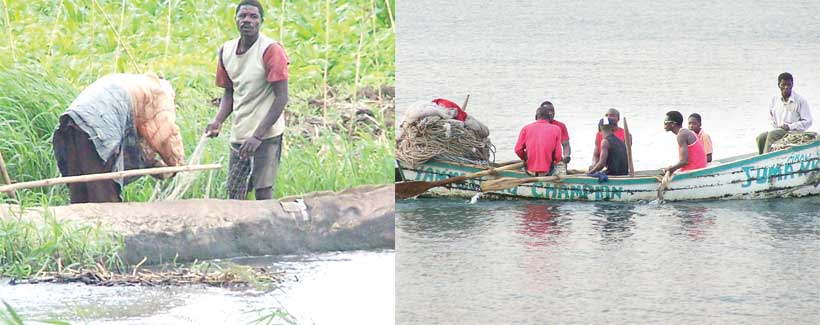
Despite fisheries making significant contribution towards household food security, economic growth and poverty reduction, latest statistics point to a decline in general fish catch by 18 percent on average every year.
Indeed, there is a substantial decline in per capita consumption from 14 kilograms to less than 5.4 kilogramme of fish per individual per year.
Abdul Masanga, 50, from Mpima Village on the edge of Lake Malombe in Mangochi District, observes that the type and quality of fish being caught and consumed by most households is low.
“Today, due to the change of fortunes, choosing the kind of fish one wants to eat has become a privilege for a few,” he observes.
Due to non-adherence to practices of sustainable fisheries, species of less economic value have taken the centre stage in filling the gap. It is estimated that 900 fish species exist in Lake Malawi.
Mangochi, by virtue of having three major water bodies, namely, lakes Malawi, Malombe and Upper Shire River, is considered the heart of fisheries in Malawi. Unsurprisingly, it has over 40,000 inhabitants who eke a living through fisheries.
It is these communities who are on the knife edge as a downward spiral in production has seen harvests of high-value fish species decline from 23,000 tons per year in the early 1990s to about 5,500 tonnes of late. While Chambo was the primary target specie contributing more than 90 percent of the total catch, currently small haplochromines cichlids comprising Usipa and Kambuzi are dominating the catch.
Experts have attributed the trend to a metamorphosis in biological patterns of littoral and mid water environments necessitating a gradual but significant shift in breeding patterns of fish hence a surge in Kambuzi and Usipa.
There is also a complete change in lakes microphatic structures. Anthropogenic activities in the lakes catchment area have led to silt overload above 12 tonnes per year. Pollution of waters from upland agro–chemicals and a significant rise in water temperatures are partly to blame for the situation.
A number of studies have recommended a multi-sectoral and holistic approach in managing Lake Malawi and Malombe ecosystems, taking into consideration environmental, socio-economic and governance factors to ensure a sustained fishery for social economic development.
Of late, cases of fishing in potential fish breeding grounds, cultivating within the shorelines, unwanted dumping of refuse in water bodies and total defiance of set environmental protection regulations have become rampant, contributing to rapid deterioration of the lake ecosystem and biodiversity.
There is also rampant harvesting of immature stocks, despite law requiring fishers to throw back into the waters any fish whose size is less than 15 centimetres.
It is not only Lake Malawi that is facing the blues, the same applies to Lake Malombe where the fishery has undergone dramatic change in terms of catch, but also gear utilisation and species composition. Annual catches have dwindled to less than 200 tonnees.
An annual census of fishing vessels and fishers (frame survey) Fisheries Department conducted in 2013 revealed a 4 percent increase in the number of fishing crafts from 15,341 to 15,968.
Motorised plank boats increased by 22 percent, from 1003 crafts to 1225 while non-motorised plank boats registered a marginal 0.9 percent increase with 2601 registered boats.
This increase also triggered a corresponding rise in gear ownership to over 12,000 individuals. Crew members increased to 45,000 while actual fishers increased to 58,432 representing a 6 percent rise.
Despite open access water bodies, entry into fishery is regulated by license issued by the Department of Fisheries based on biological assessment of available biomass. But, in a liberalised business environment, it is difficult to exercise control as pair trawlers and boats continue being constructed en mass regardless of the need to limit entry and shed off excesses.
While expressing concern on the same, Chief Fisheries Officer responsible for extension services, Orton Kachinjika, says pair trawler operators are meant to be spread all over designated fishing zones of Lake Malawi especially the northern part, which has a lot of unexploited stocks requiring heavy duty deep-water fishing vessels.
However trends indicate that most trawler operators scramble for the southern tip of Lake Malawi on the premise of high productivity and easy access to markets.
It is this rush for high productivity fish that is depleting Malawi’s water resources dry.
Leave a Reply