
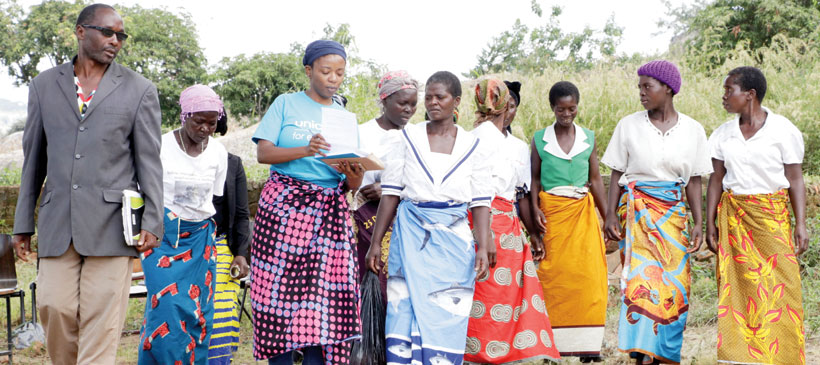
 The mockery that Linda Banda [not her real name] encountered at school during her monthly periods was, in her line of thinking, enough justification to drop out of school.
She was a Standard Five at Kampini Primary School when she experienced her first period. In fact, she menstruated while in class and could not stand the derision of her peers.
She bowed out of school
“I failed to bear the insults and withdrew from school immediately. It was only during my first days at home that parents yelled at me but the situation changed in the course of time as I was helping them with chores. Days culminated in months and a year.
“Later on, a group of women approached my family and I was persuaded to go back to school,” Banda says.
She is now in Standard Six at Kampini Primary School and harbours the ambition of becoming a teacher of English one day.
Kampini Mother Group Treasurer, Rose Yendayenda, says the group works hard to ensure that both girls and boys remain in school.
“We make sure that we provide necessary learning materials and, on the part of girls, we give them sanitary pads. We make the pads on our own,” Yendayenda says.
Yendayenda says the group produces 30 sanitary pads a day, with each member making three of them. The group meets weekly.
“We use local materials, including a sewing machine, in producing these washable sanitary pads that we make available to adolescent girls in order to support them in their quest to attain education goals,” she says.
The group, based in the area of Traditional Authority (T/A) Kaphuka, has a membership of 10 people.
 The roots of the group can be traced back to 2009 when Creative Centre for Community Mobilisation established the group with the aim of encouraging girls to go to school and remain there.
The group is also engaged in piece works to raise funds for buying uniforms and school learning materials for needy children.
“We carry out a number of activities. For example, we invite role models from various professional fields in order to inspire school goers to work hard in class. There is no one who is going to develop this area except ourselves; hence, our goal to ensure that these children remain in school for them to become productive citizens in the future,” Yendayenda says.
Head Teacher at Kampini Primary School, Emmanuel Mabwera, says, since 2014, the school’s enrollment has improved.
He attributes this to a training by the United Nations Children’s Fund (Unicef), which trained mother groups in how to promote education among children.
Mabwera cites poverty and children’s involvement in selling merchandise along the M1 Road as some of the factors fuelling cases of school dropout ,.
The children flock to Chimbiya and Linthipe 1 trading centres, where they sell merchandise.
“In the past, we used to register high school dropout rates especially on the part of girls. But since Unicef trained the mother groups, the situation has changed for the better, and it is the same organisation that is playing a key role in controlling cases of child abuse by introducing suggestion boxes in schools. Reported cases are investigated and proper action is taken in order to put a stop to practices perpetuating the vice,” Mabwera says.
Kampini Mother Group is just one of the 247 mother groups spread across Dedza District.
Dedza District Desk Officer, Solly Mwale, says mother groups are trained using resources provided to them under the School Improvement Plan Programme.
“The issue of high school dropout rates had been a problem for some time. However, with the help of mother groups, partners and other stakeholders, the situation is improving. The dropout rate is down from 7 percent to 6.3 percent, especially among girls. We, therefore, intend to work with local leaders to make sure that they do not allow girls to get married at a tender age, so that the dropout rate can further go down to 4 percent in the near future,” Mwale says.
Joint Programme on Girls Education Policy Officer for Dedza District, John Moyo, says they have plans to economically empower mother groups to ensure that they are able to help girls meet their education goals.
“The whole programme has the aim and vision to reduce levels of poverty by improving the quality of education, especially for girls. We realise that poverty is an issue and we intend to train mother groups in business and entrepreneurship. We will then give them seed money to be invested in businesses and profits realised from the businesses will be used to support girls that are coming from families that cannot afford to buy school materials,” Moyo says.
In recent times, Senior Chief Kachindamoto of Dedza has wowed the world by waging a fight against perpetrators of child marriages.
The chief, who is described as the terminator of child marriages, has broken over 2,549 child marriages in her area, and sent those involved to school. She has also dethroned about 18 traditional leaders who facilitated child marriages.
But is infrastructure in the district enough to support efforts being coordinated to keep the girl-child in school?
Dedza District Education Manager, George Ngaiyaye, says there is more work to be done.
“Yes, infrastructure is one of the areas we need to work on so that schools can become more favourabe to girls than before. Pit latrines and changing rooms for girls are other issues to be addressed because, biologically, girls require such facilities more than boys. So, we need to put up more infrastructures that will encourage girls to remain in school,” Ngaiyaye says.
Despite making efforts to retain girls in school, there are pockets of parents, especially women ,who, influenced by culture, force their pregnant daughters to marry.
For instance, some women in the districts of Dedza, Ntcheu and Mangochi have been accused of forcing their pregnant daughters to marry as a formal way of getting them into marriage.
Felix Thamangani of Machira 2 Village, T/A Kwataine, in Ntcheu District, confesses that his wife, Rhoda, in 2015 pushed their daughter, Esnart, into marriage.
Esnart was impregnated by her classmate while in Form Four at Madzunje Community Day Secondary School.
She did not perform well when she sat Malawi School Certificate of Education (MSCE) examinations and chalked 37 points.
In Mangochi, in T/A Bwananyambi’s area, Enifa Kasungu also forced her then 14-year-old daughter to marry after she got pregnant.
Members of the mother group at Kampini Primary School say cases like these show that they have work to do.
“We, sometimes, meet angry parents who stand their ground in support of child marriages. We, therefore, first report our findings to traditional leaders. The chief then gives us the go-ahead to help out and take the child back to school. We counsel the parents on the merits of sending children, especially girls, to school. We have examples of families from this area which managed to educate their children and are living a better life,” Yendayenda says.
Unicef Communications Officer, Naomi Kalemba, says they are aware of challenges children, including girls, face due to lack of parenting skills.
“Unicef is supporting Care for Child Development programmes which build parents’ capacity on parenting skills. We also sensitise, and build the capacity of local community leaders, to the importance of educating the girl,” Kalemba says.
She says there is need to adopt a multi-sectorial approach to make sure that girls attain their education goals and become productive citizens in the future.
Leave a Reply