
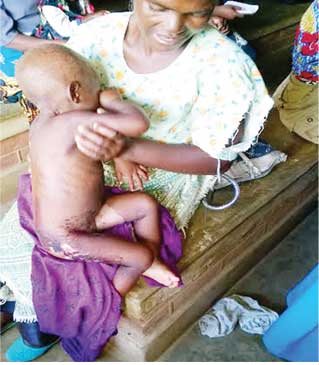
At a time some politicians are busy dipping their fingers in the public pot, 42 out of every 100 under-five children are at risk of dying due to diet deficiencies that lead to severe malnutrition.
The Malawi Development Goals Endline Survey 2014 says, at national level, 17 percent of children under five years are moderately or severely underweight and four percent are severely underweight while 42 percent of children are severely or moderately stunted.
Nutritionists believe that good nutrition is the bedrock of child survival and child development. Medics say if left unattended to, malnutrition can be detrimental to development.
It seems some selfish politicians and civil servants have their own definition of how a child survives as evidenced in their actions on prioritisation to accumulate individual wealth over the health of children who are touted as future leaders.
For a visibly skinny and frail looking Catherine Benard, a three-year-old child from Traditional Authority Likoswe in Chiradzulu, her bedrock for survival and development is clearly not nutrition because she is severely malnourished.
Catherine, born in 2014, looks breathless asher grandmother Zione Gressan awaits their turn to be screened for nutrition at Bangwe Health Centre in Blantyre. There are 22 more women with their children who are frail waiting for their turn too.
The screening officer weighs and screens Catherine and confirms that she is severely underweight; too thin and too short for her age as she only weighs 9 kilogrammes, which is the weight of a one-month-old baby.
The screening officer at the health centre Maria Mission says the population of malnourished children visiting the facility is increasing.
“We admit three to four children daily and we attend to about 20 cases every day. Today alone, I recorded 26 cases of children suffering from malnutrition,” Mission says.
She says Catherine’s condition is at life-threatening, which cannot be handled at a small facility. She refers Catherine to Queen Elizabeth Central Hospital’s Nutrition Rehabilitation Unit (NRU) for supplementary feeding programe. She adds that malnutrition is easily treatable.
“Malnutrition is very treatable in children. I am optimistic that she will be well by next week, of course, we will monitor her and continue with supplementary feeding and counselling to her guardian,” she says.
Mission says the increase of malnutrition cases is due to several factors ranging from drought and food shortages that hit the country last year, practices, beliefs and lack of knowledge among parents.
She says major signs and symptoms of malnutrition in children are increased susceptibility to infections, delayed and prolonged healing of even small wounds and cuts, swelling of legs and loss of weight.
Gressan attests to the sentiments of the health personnel pointing at the wounds of her grandchild that are failing to heal.
She feels obliged to seek medical care for Catherine after noticing alarming signs and symptoms of malnutrition in the child and neglect by her mother who is also nursing a five months old baby at home.
“As you can see, there is little or no fat or flesh left beneath the skin. The face appears creased like an old man. Hair is sparse or brittle. She has burns-like sores in her bottoms and ears,” she says.
The baby is visibly irritable, sluggish and cried excessively although she lacks strength and energy to cry loud.
One would think that the baby is poured with hot boiling water, looking at her burnt bottom.
Gressan says although the baby is three, she can neither sit nor crawl as her weight does not correspond with her age and height.
According to Gressan, the baby’s mother lives with Catherine’s stepfather and cannot manage to provide the recommended six food groups that necessitate growth in children.
Ministry of Health recommends the six food groups which are energy giving foods such as nsima, legumes like beans and peas, meat and meat products, fruits and vegetables.
Most of the mothers who brought their children to the health centre cited poverty as the underlining factor for malnutrition in most households.
A mother with a malnourished child from Thyolo, Nancy Kakhuta, says she would only feed her child porridge and believes that her child lacks essential nutrients for growth.
“My child had excessive diarrhoea and used to weigh 5 kilogrammes but after she was referred to supplementary feeding programme, she now weighs about 10 kilogrammes,” Kakhuta says.
She advises women to make sure that they wash hands before feeding babies and ensure exclusive breastfeeding for babies less than six months.
According to United Nations Children’s Emergency Fund (Unicef) Communications For Development Specialist Chikondi Khangamwa, his organisation and the Ministry of Health have embarked on a door-to-door screening drive to screen as many children as possible.
“The screening campaign has been actively identifying children who are malnourished or at risk of malnutrition and referring them to appropriate services including supplementary feeding programmes, Outpatient Therapeutic Programme (OTP) and Nutrition Rehabilitation Unit (NRU),” he says.
He says the mass screening campaign is being implemented in all the districts of Malawi. He adds that screening can only be done by nutrition experts. He says parents are only required to take their children to public or Christian Health Association of Malawi health facilities for screening every month.
Malnutrition results from a diet deficient in vital nutrients, vitamins and minerals. Over short or long term, this may lead to severe debility and damage to the vital functions of the body.
In the long term, malnutrition results in irreversible negative health outcomes which may also be linked to cognitive development deficits. Undernutrition in children can also cause direct structural damage to the brain and impairs infant motor development and exploratory behaviour.
Leave a Reply