
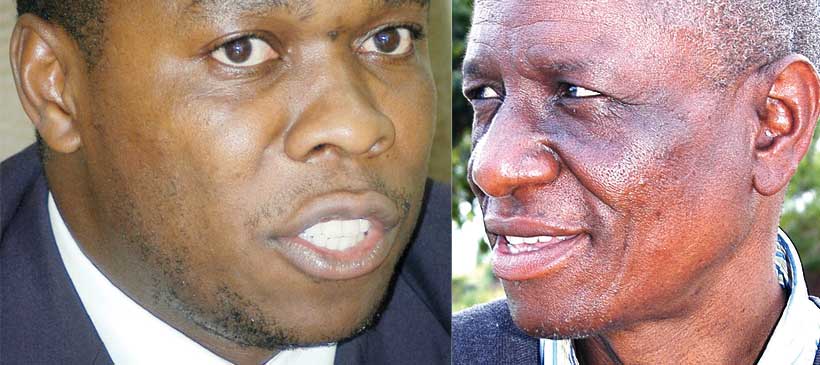
A human rights activist, Ken Williams Mhango, has observed that court injunctions have been abused and brought into question the concept of separation of powers between the Executive, the Legislature and the Judiciary.
Recently, Parliament passed a bill that seeks to break up the Electricity Supply Corporation of Malawi into a number of entities, but it transpired that some workers had sought a court injunction preventing such a process in Parliament.
“Sometimes, injunctions have stopped, temporarily, processes in, say, the Legislature. This is good, because the three branches are checking and balancing each other, but it also raises questions of overlaps in the exercise of power of the three branches. From a layman’s point of view, it becomes confusing,” said Mhango in an interview.
Mhango added that injunctions have, to some extent, become a way of generating funds for the courts and lawyers.
“You see, in a democracy, everything goes. So, it is injunctions, injunctions, injunctions. An injunction costs a lot of money, and both the courts and lawyers—who are supposed to be paid by their clients—get money out of the process. It is unfortunate that democracy has become a case of injunctions, injunctions, injunctions, but that’s democracy anyway,” said Mhango.
However, in an email response Malawi Law Society president, John Suzi Banda, says there is nothing wrong with injunctions.
“There’s nothing evil or sinister about an injunction. An injunction is simply an order granted by a court requiring someone to do or cease from doing something. It is an equitable remedy. The effectiveness of an injunction, both as a final or temporary order, cannot be overstated.
“For example, many citizens of this country and organisations dedicated to the entrenchment of democracy have benefited from injunctive reliefs against unlawful actions of the government,” said Banda.
Banda observed that Malawi’s Constitution accords citizens the right to effective remedy to protect and enforce their rights, describing an injunction as one of such remedies.
He said Malawians should be proud of the progress they have made in this regard, considering the country’s chequered history.
“As Malawi Law Society, we shall resist any attempt by anybody, including the government, to limit citizens’ rights to effective remedy
including injunctive reliefs. The past two decades of democracy are replete with examples of how government has been stopped from implementing blatantly unlawful decisions.
“The jurisprudence we have developed over the years is very rich and commendable. As Malawi Law Society, we are proud of the role our members and the courts have played in developing this enviable wealth of jurisprudence. But beyond this, even among private citizens, injunctions have helped secure rights of the most vulnerable among us,” added Banda.
On perceptions that Malawi has become a country of “injunctions” Banda said the courts were the best judges in this regard.
“Regarding the abuse of injunctions by litigants, it’s ultimately up to a court to decide whether to grant an injunction or not—whether as a temporary order or as a final order. As is always the case, if any litigant is aggrieved with a court decision, they have a right of appeal to a higher court.
“If it’s later decided that the injunction ought not to have been granted in the first place, there are consequences including payment of damages to the other party. In our considered opinion, therefore, the issue of abuse does not arise. It’s neither here nor there. To argue otherwise would be tantamount to questioning the wisdom of our courts,” he said.
He said, contrary to Mhango’s perception that injunctions might have become a money-making machine, “Malawians do acknowledge the legal profession’s contribution in this regard”.
During his second term, the former president, the late Bingu wa Mutharika, was prevented by the courts signing into the Civil Procedure (suits by or against government or public officers) Act Amendment Bill—famously known as the ‘Injunctions Bill’— which outlawed ex parte (one side) injunctions and directed that the government legal representative would always be present when an injunction application is being held.
A report by the Human Rights Watch in 2011 observed that injunctions in Malawi had sometimes been used to stifle citizens’ rights, cited the indefinite postponement of civil society organisations’ planned demonstration slated for August 17 and 18 2011 to commemorate the death of those killed during the July 20 demonstrations the same year.
Human rights lawyer, Justin Dzonzi, said access to the courts was a constitutional right.
“The Constitution guarantees the right to judicial remedies. That is why the proposed limitation was shot down. People should readily access the courts,” said Dzonzi.
On the issue of perceptions that injunctions are abused, Dzonzi said he has not encountered a scenario where the process had been abused by some parties. He said the process of seeking and obtaining injunctions was a matter guided by procedures.
“In fact, the procedure for application has inbuilt mechanism to sieve frivolous ones,” said Dzonzi.
However, Mhango maintained that there is need to clarify the extent to which one government branch stops another from fulfilling its constitutional mandate.
Leave a Reply