
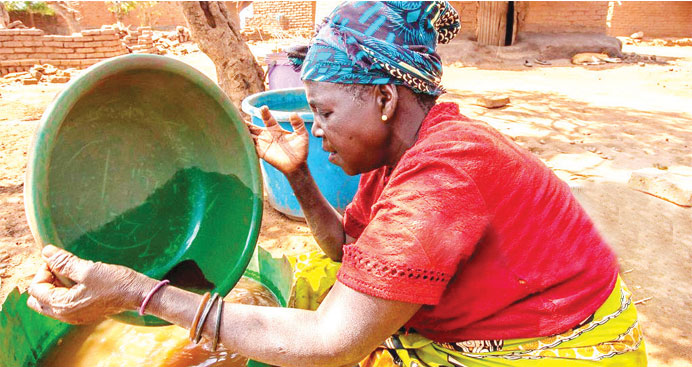
THERE is a gold rush in Nathenje, Lilongwe and women are in the fore front.
It is only four months old but already there are thousands of prospectors digging, shovelling and sifting soil in the age-old search for a nugget that will transform their lives.
Traders from neighbouring countries have been paying up to $34 (MK24,820) a gram for the gold, according to one local official.
“Iyi, iyi,” (“Here, Here!”) is the cry when an excited miner spots any speck of the precious metal and others eagerly gather round at the site, 20 kilometres south of Lilongwe.
But first you have to find it. And much of the hard work done here, in scorching temperatures, brings only disappointment.
The miners head back down the deep holes dug on the riverbanks of Nathenje river.
This is what is keeping people in this area busy and slowing down development work because people would mine gold than participate in activities to benefit the communities.
Early this year, Malawi Electoral Commission (Mec) chairperson, Jane Ansah, bemoaned the low numbers of people registering to vote in the areas rumoured to have gold deposits.
“The turn-out is not very encouraging in this area…what is affecting voter registration is the ongoing gold mining and they are not registering,” she said.
Even when Mec tried to entice with a K1,000 payment to go register, the numbers did not improve because people still went mining.
Most of them are women. They emerge with buckets on their heads and, after the silt has been trucked a short distance to drier ground, carefully pour the wet dirt onto a sieve to wash away sediment and examine the remains for signs of gold.
Tandizeni Natani barely knew what gold was when she and her fellow villagers left their fields to join in the sudden mining boom.
“All I knew was that it was a precious stone,” the mother of five children, the youngest of whom is three, told AFP.
“On the first day, I made K25,000 and I have made about K100,000 so far, which has enabled me to buy school items for my children.”
Another villager, Fatima Chikalipo, said she bought a plot of land measuring about 5 by 10 metres for $7. So far, she had experienced mixed fortunes.
“The first days were good but now sometimes we dig on days and we don’t find anything. So, I have not seen any tangible benefits yet,” she said.
“And the price of the gold has gone down. We used to sell for K25,000 per gram. Now the buyers are offering K20,000.”
Underground riches
Using rudimentary picks and shovels, villagers from the nearby settlements of Lumwira and Dzondi have been joined by other Malawians from across the country, more experienced in gold panning.
An informal system of bosses and employees has also sprung up, alongside a makeshift collection of plastic shelters offering basic accommodation.
“It’s a lot of work,” said local man Misheck Chilayison, who bought a plot of land for K40,000
“We pay women who carry the dirt and pay Lorries to drive the sand from the riverbanks to the labourers who wash the soil to look for the gold.”
Chilayison said the gold rush began as news spread that an Indian man living in Lilongwe had arrived in Nathenje and started digging, apparently armed with geological research.
“After a while he ran away because the police were hunting for him as he did not have a work permit. But he left two of his men here who brought in a couple of their friends,” he told AFP.
Traditional village head Katondo — who only uses one name — told AFP that the discovery of gold was a blessing for the area.
“This is a huge relief for us, that is why all of are flocking there because this year the harvest was bad,” he said.
“There was going to be serious hunger. Now people make money and they can buy maize to feed their families.”
But illegal gold mining is a dangerous enterprise, and the government wants to regulate the industry to generate income.
“Government is in the process of formalising illegal mining,” said Jalf Salima, the government’s director of mining, adding that licensing would be introduced and illegal miners evicted.
Calls for regulation
Salima said the quality of gold at Nathenje and five other gold-rush sites in Malawi was not known, and more exploration was needed as the gold in the river silt had been washed downstream from its source.
British colonial rulers undertook a geological survey in 1960, shortly before Nyasaland — as it was then known — became independent Malawi, but little surveying has been done since.
Percy Maleta, chairman of the Nyasa Mining Cooperative, said the authorities had to end illegal gold mining and develop a long-term strategy to exploit the reserves successfully.
“We have been lobbying government to train local miners so that they can form cooperatives or mining clubs. This will ensure that they are better equipped and able sell the gold on the formal market,” he said.
“Buyers smuggle the gold out of the country using illegal routes so Malawi is losing a lot of our gold.”
He said buyers were mostly from neighbouring Mozambique, Tanzania, Zambia and Zimbabwe, buying the gold at K17,520 to K24,820 per gram.
For now, Damino Matenga, an intermediary buyer who came to Nathenje from southern Malawi, wants things to continue just as they are.
“Business is so good that I am able to feed my family and send my children to school,” he said.
“This is genuine gold and we do not have any problem with international buyers.”
Leave a Reply