
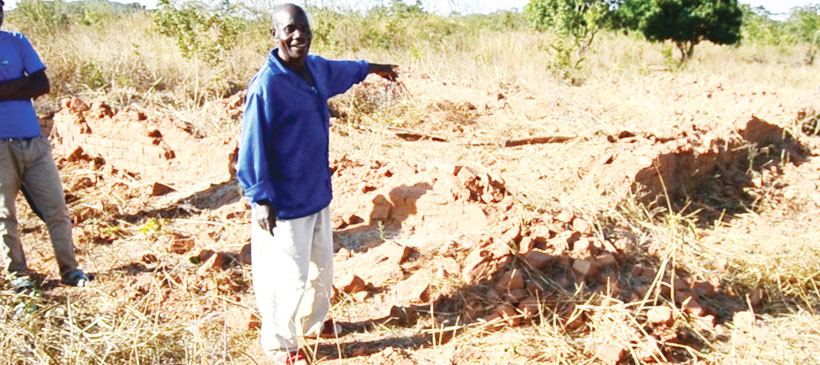

In today’s Times Shaker, MANDY PONDANI exposes the impact of the government’s uncaring attitude towards boundary re-demarcations with neighbouring countries such as Zambia and how this has left people of Jakapo Village, Traditional Authority (T/A) Chindi, in Mzimba District destitute after their property got destroyed by Zambians who attacked them claiming they encroached on their territory.
As the Government of Malawi is yet to resolve the Lake Malawi boundary wrangle with Tanzania and settle the Mangochi and Dedza boundary line issue with Mozambique, tension is simmering between Malawians and their Zambian counterparts in Jakapo Village, T/A Chindi, in Mzimba District.
Owing to a boundary re-demarcation exercise which happens periodically, Malawians in the area have slowly become strangers in their own land.
Ruthless communities from Zambia have, so far, taken over farms and destroyed property initially owned by Malawians, accusing them of encroaching on their land.
“We are an isolated and neglected people. No one seems to care about our welfare. We have been left to suffer at the hands of brutal Zambians who claim ownership of this territory,” said Brazio Langwani, counsel to Village Head Jakapo.
The bone of contention, according to District Commissioner (DC) for M’mbelwa District Council Thomas Chirwa, is the fertile land in vast estates previously owned by Press Trust.
The land has changed hands and is in the hands of locals.
A visit to the area last weekend attested to the harassment and provocation the locals are suffering at the hands of their Zambian counterparts.
In a latest incident, residents of Jakapo had a rude awakening on November 17 2017 when people from Zambia’s Bingu Kumwenda Village in Chama District terrorised the area and demolished learning blocks at Byembya Junior Primary School.
Over 112 children aged between seven and 11 years have been rendered destitute.

Making matters worse, the Malawian children are constantly being blocked from attending school on the Zambian side.
The nearest Mbalachanda Primary School is located at a distance of about 10 kilometres, which is too far for the young learners, thereby raising concern of violation of their right to basic education.
“We are devastated and it’s a big setback for us and our children. The school was an initiative of the community; over K400,000 was spent on construction works. Today, blocks have been reduced to rubble, and teachers and our children have been left helpless,” Langwani said.
Head teacher for the school, Jackson Jere, had no kind words for government officials who he accused of failing to intervene in a matter which has affected people’s lives in the area.
“The future of every country lies in education and, if these people are tampering with our education facilities, it means their intention is to kill the future of our community. It is our prayer that authorities will take this matter seriously and protect people,” Jere said.
Apparently, a makeshift junior primary school has been erected about 200 metres into Malawi from the previous site but security is not guaranteed for the learners.
One would not need an engineering background to ascertain that the wall-less grass-thatched structures are a death trap for innocent lives whose sin is to seek a bright future.
From the look of things, however, if nothing is done in time, the country might, again, witness a tragedy similar to that of Nantchengwa Primary School in Zomba District, where six learners died after walls of a classroom block fell on them.
Apparently, new villages are being created around the original site of the destroyed junior primary school.
One of the Zambians, Nelson Mbewe of Mwendakuzuwa Village, spoke in defence of their action, challenging that they have instructions from their local leaders to safeguard the new boundary— which is a road— which has been diverted by about 100 metres from the original beacons.
The Malawi area is the only one affected by the exercise.
“They were told not to operate a school here but they never took heed of that piece of advice. Zambian chiefs then instructed [us] that the school should be demolished,” Mbewe said.
Meanwhile, Traditional Authority Chindi has lamented the security lapse in the area, a development that has led to a rise in cross-border crimes.
“Cases of people smuggling goods, including banned substances, are on the rise. There is need for borderline patrols; that way, the Zambians will stop terrorising my people anyhow,” Chindi said.
Chirwa said on Tuesday his office is aware of the conflict and that various interventions are being made to find an amicable solution to the problem.
He echoed Langwani’s sentiments that, while being hostile, the Zambians are timid to be involved in any interaction.
Citing the example of the arrest of renowned politician Yeremiah Chihana, who owns an estate on the borderline, Chirwa said it is apparent that the Zambians are after grabbing farms owned by Malawians.
“Not long ago, they pounced on Mr Chihana and incarcerated him in one of their cells at a police station. So, if such an influential person can be victimised like that, obviously things are worse for ordinary villagers. We, as an office, sympathise with the people and have engaged our Zambian counterparts several times on the matter,” Chirwa said.
Chirwa said government officials from both sides are to blame.
He said, after a decision was made in 2004 to re-demarcate the boundary between the two countries, officials from both sides met several times to sensitise each other to ensure that the exercise did not affect people’s livelihoods.
“It was foreseen that, due to the exercise, some people who were in Malawi may end up being in Zambia, vice versa. But, then, they were advised that no one should be more excited or worried about it.
“When we met for the first time in Chama, the resolution was that the two surveyor generals should help us sort out this issue by coming up with a position on the matter. Unfortunately, they have not yet met; that’s why fresh issues keep cropping up, especially whenever there is change of officers on the other side,” he said.
Ministry of Lands, Housing and Urban Development spokesperson, Charles Vintulla, speaking on behalf of the Surveyor General, contradicted Chirwa in an interview on Tuesday, saying there has never been a re-demarcation exercise between Malawi and Zambia since the boundary of the two countries i s a watershed line which divides waters flowing into Luangwa on the Zambian side and Lake Malawi on the Malawian side.
He said, in the meantime, the two governments are in the process of putting in place a joint international boundary treaty which will define the boundary line between them.
“The treaty will also hint on how to handle matters arising from hotspots along the boundary area on both sides. However, there are joint State institutions, such as Joint Permanent Commissions (JPCs), that are set up to deal with matters of various aspects,” Vintulla said.
When contacted on progress of the JPCs, spokesperson of the Ministry of Foreign Affairs and International Cooperation, Rejoice Shumba, asked for a questionnaire, which she has not responded to as we went to bed.
Meanwhile, Human Rights Defenders Coalition, through its Northern Region Chapter Chairperson Happy Mhango, has condemned what he called a laissez-faire attitude by government officials to serve marginalised communities such as those in border areas.
He wonders why there was no prior assessment and preparation of the locals on how the exercise would affect them, thereby providing alternatives.
“We are dealing with a system which does not understand what should be a priority or not. Assuming the re-demarcation was a diplomatic decision by the two nations as the DC puts it, then they should have had the time to prepare alternatives for the people in the area in terms of [the provision of] social services such as education, especially when they are fully aware that the people on the other side are the violent type.
“This should be treated as an emergency; let’s not shift the blame to the Zambian officials when we have done very little to safeguard [the rights of] our children and people at large. It is our plea that children of Jakapo should start enjoying their right to education like any other children in the country,” Mhango said.
This comes at a time the government is failing to come out strongly and decisively on the long-standing border wrangles such as the Malawi- Tanzania Lake dispute and Mozambique-Malawi [Makanjira] border row.
Unfortunately, while those who have been entrusted with the responsibility of making decisions on behalf of the people are busy flipping papers in offices, changing tune and playing a blame game, it is the locals on the ground that are bearing the brunt of such indecisiveness.
But Section 25 of the Republic Constitution provides that “all persons are entitled to education”.
The same Constitution, on protection of the people of Malawi, says: “This Constitution shall bind all executive, legislative and judicial organs of the State at all levels of Government and all the peoples Malawi are entitled to the equal protection of this Constitution, and laws made under it.”
Leave a Reply