
BY SAM BANDA JNR:
It is rare to see women holding top positions, especially in the male-dominated creative industry.
It is even rare to see women driving festivals, especially in Africa, where their chances are slim.
In Malawi, for instance, a significant number of festivals are led by men, with women holding other lower positions.
But one Hilde Bjorkum has shown that women have what it takes to organise festivals and run them without any problems.
Bjorkum, who visited the country in 2016 on a Talent Programme, has been at the helm of Forde Traditional and World Music Festival for 29 years.
She has since bowed out this year, after presiding over the last festival, which run from July 4 – 8 2018.
She bows out with her head held high, as she has managed with colleagues to create a festival that is today recognised in the world.
Forde Festival has become an important arena for artists from all over the world to present themselves and their music to a Scandinavian audience and to international media and music professionals.
Forde is a small town situated in beautiful surroundings in the fjord region on the western coast of Norway, about 150 km north of Bergen, which is a popular city in Norway.
But, despite being a small town, Forde has become popular as every year people from different parts of the world come to appreciate the festival that brings the best of traditional music.
Malawi has festivals but it does not have a fiesta that highlights the beauty of traditional instruments.
A festival that sees artists from different countries come with their beautiful and unique instruments some of which are part of their culture.
Probably the country needs to borrow a leaf from this festival and create one specifically to showcase the beauty of its traditional instruments such as Kaligo, Malimba and Pango most of which are played by the old generation and risks being lost.
Of course there is Ethno Malawi driven by Music Crossroads, which has come in handy to give a platform to the playing of traditional instruments but there is room for more of such gatherings.
Bjorkum, the now former artistic and managing director said Forde Festival started in 1989 and that it has not been an easy road to put this festival where it is today.
“It has been exciting to work with fantastic musicians from across the world, approximately 7,000 artists from almost 140 countries,” she said.
Bjorkum said it was not easy for people to accept the festival in such a small town but now things have completely changed such that every year, people look forward to watching different musicians.
Having been to other festivals in Europe and America, Bjorkum and team thought of creating their own in Forde to bring the world to this small town.
“In radio channels in Norway you listen mainly to Norwegian music but we miss out because there is a lot of different music out there. So we thought having a festival would give an insight into other genres of music,” she said.
Bjorkum also said through the festival they wanted to get the Norwegian music to the world.
“We have so many world music festivals but for us we wanted to give an arena for musicians who play traditional music and showcase the traditional instruments which produce quality sound,” the former artistic director said.
She added:
“Over the years, I have had this idea that maybe a Norwegian singer should collaborate with a musician from Malawi for instance”.
As a woman, she knows the dominance by men in the creative industry but feels there are more female leaders out there, who need to come out and drive festivals.
But for her, for now she wants to take a different direction having worked very hard for 29 years and she feels it is enough.
“I will still be out there using my competence in special projects,” the fiddler and dancer said.
She said she intends to help the new director to open new international networks and that she has some ideas for some of the projects that they did not follow up.
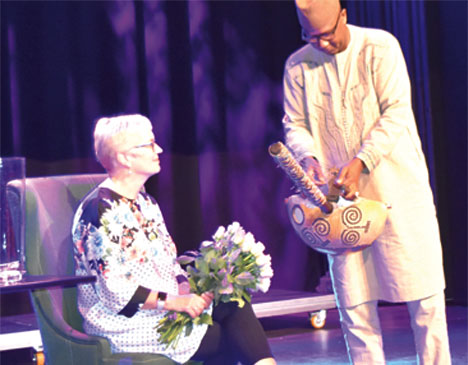
Bjorkum said she has a passion for African music because it has so many different expressions and that when she first heard of the Kora, she fell in love with it.
The Kora is a 21-string lute-bridge-harp used extensively in West Africa, where artists have embraced it, using it during their performances; it has such a beautiful sound.
Infact a musician from West Africa, Ablaye Cissoko had to play the Kora for her during a gathering of volunteers appreciating the work she has done.
“There so much talent in Africa and the dancing as well like the one I saw in Malawi is amazing. So in Africa they have talented musicians and dancers and there are special instruments but the Kora stands out as my favourite,” she said.
On the Talent project which brought her to Malawi and saw three young artists from Malawi – Thokozani Mdoko, Asante Maulidi and Patrick Chimbewa star at the festival in 2016 alongside counterparts from Kenya, she said they wanted to continue but they have faced hiccups.
“The Norwegian Ministry of Foreign Affairs stopped the agreements with many Norwegian players and cut the budget and that affected the project. It’s a pity in that I have seen a lot of positives in terms of giving young musicians a platform,” Bjorkum said.
She said they will try other ways to finance it.
In Malawi, Bjorkum said they had had an amazing experience including participating in the Pakhonde Ethno Music Camp in Ntchisi now known as Ethno Malawi.
They had a concert at Ntchisi Prison where they performed to inmates and to her, this was special.
This year the theme for the festival was ‘The Dance in the Music, the Music in the Dance’ where there was no Malawian act but Africa was well represented in groups such as Timbila Muzimba from Mozambique.
“In folk music, the dance is inseparable from the music, and we celebrate the world’s fantastic forms of dance expression and driving dance music both from our own country and from abroad,” Bjorkum said.
She said traditional music is very much connected to dance and that is important to enjoy the dance as in most cases the focus is much on the concert.
“We need to show the dance and that is why we had dance workshops which people enjoyed,” Bjorkum said.
She described music as her life.
“Music is my life, it’s all about music and dance. I love it and I learned how to dance at a very tender age,” Bjorkum said.
She said “If we can make meeting places and meet each other, we can grow better as a society”.
Leave a Reply