
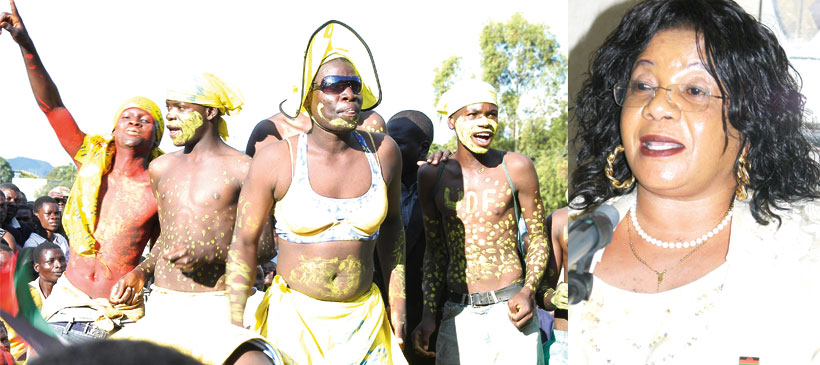
United Democratic Front and Democratic Progressive Party governments will score highly among political parties that collided or collide with religious leaders that speak out on the evils taking place in government.
Memories are still fresh of how former president Bakili Muluzi and his henchmen could go to town on Catholic bishops, Church of Central Africa Presbyterian reverends and pastors.
He would spend time on the podium accusing men of God of meddling in partisan politics for denouncing evils such as corruption and nepotism taking root in the system.
Lately, President Peter Mutharika and his henchmen have collided with the quasi-religious boy, Public Affairs Committee, for standing with poor Malawians on various ills in his government or in the political circles.
In their wisdom, Muluzi and Mutharika think the bishops and pastors need to confine their services to the pulpit and desist from commenting on anything political.
Similarly, a decision by former head of Malawi Assemblies of God Church, Reverend Lazarus Chakwera, to join active politics sparked controversy and drew mixed reactions from Malawians.
Conservative Christians condemned Chakwera for “abandoning his spiritual call in search of earthly wealth”.
Martin Chikafa, a Blantyre-based Pentecostal Christian, says people who were called to serve God as pastors or any priestly position are not supposed to join active politics.
Chikafa argues that by joining active politics, men of God demonstrate that they had all along been nursing lust for wealth.
“We need to know that politics has the capacity to corrupt people’s mind. Are we sure pastors can serve political parties without corrupting their mind?” he asks.
An American writer, Sharon Angle, seems to agree with Chikafa when she wrote: “We’ve become a country entrenched in idolatry and that idolatry is the dependency upon our government. We’re supposed to depend upon God for our protection and our provision and for our daily bread, not for our government.”
Angle believes that politics makes people depend on government rather than God for their survival.
“To cut the story short, God has no place in politics,” she writes.
But a Luchenza-based Pentecostal Christian, Teresa Mateyu, differs.
Mateyu believes there is nothing wrong with pastors and priests joining active politics as long as they do not forget their initial call.
“I believe that pastors in active politics can play a critical role in ensuring there is righteousness and social justice in the world,” she says.
Phalombe North Member of Parliament (MP) Anna Kachikho once told her constituents after retaining her seat in the 2014 Tripartite Elections that God or indeed religious leaders and politics are inseparable.
Kachikho said no politician can achieve his or her ambitions without the help of the Creator.
“Religious leaders should play a role on the political scene and do have a place. Sadly, these days, it is put on the back burner and turned off. People long forget that our country was founded in an image of God,” she said.
The MP attributed corrupt practices in politics these days to a lack of religion.
Kachikho said without religion, one loses his sense of morals and values and sins at will without discretion, without fear of consequence or what is right.
“Without religion, money, power and greed become the driving forces, all of which represent everything that is evil and corrupt. Religion does and needs to be brought back to the political scene, all of which has long since become an act of smoke and mirrors,” she said.
Yet, others still argue that candidates on both the opposition and the ruling politicians are often infected with immorality, including but not limited to extramarital affairs, gambling, taking bribes, corporate partisanship and shady deals on their own behalves.
From these two schools of thought, one can easily deduce how divided believers are on whether God or indeed men of God have a place in politics. .
Reverend John Chilembwe was a Baptist pastor and educator, who trained as a minister in the United States of America.
Chilembwe returned to Malawi (then Nyasaland) in 1901. And despite being a man of God, Chilembwe led resistance to colonialism.
He opposed both the treatment of Africans working in agriculture on European-owned plantations and the colonial government’s failure to promote the social and political advancement of Africans.
Chilembwe used the pulpit to preach the values of hard work, self-respect and self-help to his congregation and, although as early as 1905, he used his church position to deplore the condition of Africans in the protectorate.
Of course, he initially avoided specific criticism of the government that might be thought subversive.
However, by 1912 or 1913, Chilembwe had become more politically militant and openly voiced criticism over the state of African land rights in the Shire Highlands and of the conditions of labour tenants there, particularly on the A. L. Bruce Estates.
It is said Chilembwe was angered by Livingstone’s refusal to accept the worth of African people, and also frustrated by the refusal of the settlers and government to provide suitable opportunities or a political voice to the African “new men”, who had been educated by the presbyterian and other missions in Nyasaland or, in some cases, had received higher education abroad.
A number of such men became Chilembwe’s lieutenants in the uprising.
In one of his sermons, Catholic Church’s Reverend Father Martin Mthumba of the Archdiocese of Lilongwe challenged professing Christians to rally behind their religious leaders in the struggle for just, transparent and accountable government.
Said Mthumba: “Politics requires selfless leaders so that they can effectively serve the poor. And unless selfless Christians join politics, the poor can as well forget of ever achieving their social and economic dreams.”
He also stressed the need for Christians to actively participate in politics if Malawi is to achieve Chilembwe dream of dealing away with politics of vengeance and bickering that, in the end, does not serve its purpose of uplifting the living standards of the poor.
The Episcopal Conference of Malawi Secretary General Reverend Father Henry Saindi stresses that Chilembwe did not break any Christian or spiritual values to use the church to denounce the ills that were taking place at the time.
Saindi says, in the same vein, latter-day faith leaders are called to check against and condemn the ills happening in society as well as government.
But Saindi emphasises that this points to one fact: religious leaders were not commissioned to serve the interests of those in power but to denounce the ills that each government commits against its people, particularly the poor.
He, however, stresses that the Catholic Church does not allow its faithful to use the church or pulpit in advancing personal political ambitions, opinions and preferences.
Leave a Reply