
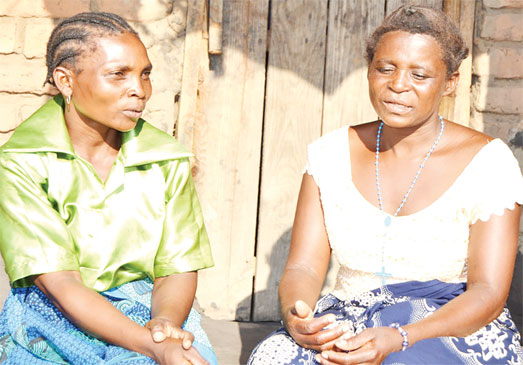
Esther Enock, 40, had hardly acquired skills to enable her to read, write and calculate when her parents withdrew her from school.
Enock, who comes from Matchipitsa Village in Traditional Authority Malili in Lilongwe, was in the second year of her primary education at the time she was dropping out of school.
But make no mistake! Enock was not oblivious to the importance and value of education when she was dropping out.
Rather, circumstances forced her to.
“My parents were too poor to afford school fees, the cost of notebooks and uniform. I, therefore, dropped out to save my parents from shame as teachers would chase me every day over either fees or for not wearing uniform,” she recalls.
However, this decision did not bring any difference to the family as parents still bore a huge responsibility to provide for the then tender-aged Enock and her siblings.
And it was tough for the parents, Enock admits!
Ambitions and dreams shattered in infancy education and improved literacy play a vital role in contributing to economic growth, reducing poverty, reducing crime, promoting democracy, increasing civic engagement, prevent HIV and Aids and other diseases through information provision.
They also lead to lowbirth rates as a result of increased education and confer personal benefits such as increased self-esteem, confidence and empowerment.
And Enock, just like any child in his or her infancy, harboured ambitions.
She dreamed that the school she was attending would enable her to get employment, thereby gaining economic independence.
But circumstances could not allow Enock to fulfill her dreams as she opted to marry at a tender age to lessen the pressure the parents had in looking after her and her siblings.
“It wasn’t an easy choice, but I had to take it,” she narrates.
Today, Esther and her husband have four children together, with a small pieces of land to cultivate cash and food crops on.
But, when adult literacy programme rekindled dashed hope When National Smallholder Farmers Association of Malawi (Nasfam) rolled out Adult Literacy Programme in June 2016, Enock did not hesitate to grab the opportunity.
She was among the first to enroll for classes in Village Head Matchipitsa.
To date, over 40 men and women, who could neither write nor read before the project, are able to not only read and write but calculate.
Enock and her 36-year-old classmate Rhoda Fanken are a living testimony that investment in human capital, that is, in education and skills training, is three times as important to economic growth.
The two admit that the Adult Literacy Programme has not only benefitted them through acquisition of education and literacy skills but economic empowerment.
“Apart from literacy skills, we have been trained in animal production and entrepreneurship skills. In June 2016, we formed a village savings and loan association, which enables us to save and lend capital for various income-generating activities,” Enock says.
The association has 23 members who shared their first dividends in July this year. Each member got K48,000.
“With this amount, I bought one acre of farmland at K15,000. And I used the rest to buy kitchen utensils and other household items,” Enock says.
She says the family does not struggle anymore when providing educational needs of their children.
On the other hand, Fanken says her family has registered improvement in food and nutrition security, thanks to the organic manure she collected from her rabbit and goat kraals.
But Enock and Fanken appeal to Nasfam to consider integrating the teaching of English in the Adult Literacy Programme.
They feel time has come for adult learners to go beyond merely attaining skills to read, write and calculate.
The two have begun to appreciate that a strong linkage among education, health, nutrition and reduced fertility result in synergies that can transform vicious cycles of poverty, illiteracy, malnutrition and disease, resulting in education, health, equity and sustainable development.
This could not be strange because, at the initiation of the project, most members in the Innovation and productivity Centres expressed need for literacy classes to help effectively utilise available markets and business opportunities and to enable them to participate fully in leadership, especially among female members.
Nasfam is implementing the programme with funding from Egmont.
A recent study revealed that 53 percent of female adult learners were participating in community development activities and some were even elected into leadership positions in such projects
Leave a Reply