
The rains, which fall during the afternoon of Tuesday, April 6 2017, are unexpected. Still, they wet the soils of Lunzu Trading Centre in Blantyre, and, to many, they [the rains] are just one of natural phenomena.
However, as the rains spoil the dry soils of Lunzu with their generosity, it is dry at Kameza (Chileka) round-about in Blantyre, roughly six kilometres from Lunzu Trading Centre.
The impression Peoples Federation for National Peace and Development (Pefenap) Executive Director, Edward Chaka, has is that it is as dry in Lunzu as it is (dry) at Kameza round-about, where Pefenap head offices are.
His impression is strengthened by the fact that winds make a snaky noisy at Kameza round-about, an indication that it must be dry across Blantyre.
In its Malawi Weather Bulletin for Tuesday, April 6 this year, the Department of Climate Change and Meteorological Services— which falls under the Ministry of Natural Resources Energy and Mining— indicated that “locally heavy thunderstorms and rain showers are expected mainly over northern and lakeshore areas with focus on Chitipa, Karonga, Nkhata Bay and Nkhotakota”.
It further said, “This is due to the influence of easterly waves over Malawi coupled with ITCZ [Inter-Tropical Convergence Zone] to the northern tip of the country.”
However, the Department of Climate Change and Meteorological Services warned that flash floods could occur, a point Chaka might have taken for granted considering that Blantyre had been dry the previous day (Monday).
Still, the department warned: “Flash floods can occur even though it’s not raining where you are. It may be raining hard farther upstream, and raining so hard that the water cannot be absorbed into the ground. Know your location when you are driving or walking. If you needed rescue, would you be able to direct emergency crews to your location?”
Chaka may not have taken the time to answer that rhetorical question but, then, that is what happened to him as he arrived in Lunzu at around 01: 30 that afternoon. He waded through running water which exerted enough force to drown any piece of knowledge suggesting that, less than six kilometres away at Kameza, it was as dry as a sun-beat plastic tent.
As it turned out, Chaka drew lessons between the weather at Kameza and that in Lunzu.
“Some 36 years ago, before the first case of HIV was reported, the cheeks [of people] were relatively dry— as dry as Kameza round-about, if I may say— because cases of death were not as frequent as now. But, then, HIV came into the picture and spoiled all the fun. Just like the rains that fell on the soils of Lunzu this afternoon, our cheeks have become as wet as the soil.
“The thing is, just like the Malawi Weather Bulletin, HIV, and its related health challenge of Aids, are real. We know they [Malawi Weather Bulletin and HIV and Aids) are there but we sometimes disregard them, to our own peril. Had I paid attention to the Malawi Weather Bulletin, I would have remembered to carry an umbrella with me, to shield me from the rains. I did not.
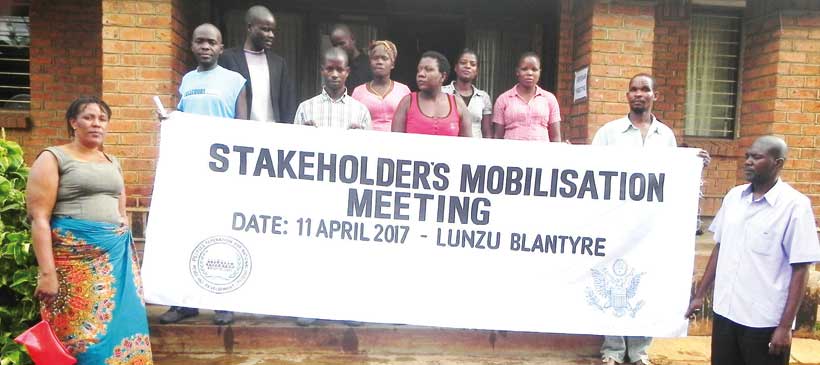
“Likewise, if we took heed of HIV and Aids messages, we would have avoided cases of preventable death. In most cases, we did not and Lunzu can bear witness to the fact that HIV and Aids are real because Lunzu, once a vibrant, must-stop trading centre, has borne the brunt of HIV and Aids. We have lost sons, daughters, brothers, sisters, parents, uncles, aunts, among others, to HIV and Aids,” Chaka tells Lunzu residents who have come to take part in deliberations marking the onset of a United States Embassy project titled ‘Expanding and Increasing Community Based Testing and Treatment in Hot Spots in Blantyre’.
True.
Lunzu has its fair share of graves filled by those who once loved that land but who, at the appointed time, died due to HIV and Aids-related illnesses.
Today, while some of the graves at Lunzu Trading Centre look imposing, having been painted or renovated by relatives, the truth is that down there, in the silent grave, those who were once productive citizens lie as piles of dust: Immovable, unshakeable, and robbed of any sense of being there at all.
Like HIV and Aids, this is reality— a reality born after 1981.
Not that, without HIV and Aids, people would still not die. They would still die, which is why the Chinese say “The falling leaf returns to the roots of the tree”; because there is always time when the human being, as the proverbial leaf, has to return to the root of the tree. The soil.
“But when death comes so fast, fuelled by pandemics such as HIV and Aids, that we lose count of our dead, we— as human beings— must sit down and strategise on how to deal with that.
And this is what we have done by bringing these influential people here [in Lunzu] to this stakeholders’ meeting. We, Pefenap and them, want to reach out to the vulnerable populations in Lunzu. These people, as residents, know the hot spots of HIV and Aids in Lunzu and can help us reach out to those who are still vulnerable,” Chaka says.
Maybe Chaka is skirting around the truth. Perhaps he does not want to single out groups— which has been one of the problems associated with HIV prevention interventions because, sometimes, cultural norms and sensitivities prevent people from pointing at wrongs in society.
There are problems with this arrangement. Even if we ignore the truth by skirting around HIV and Aids issues, the truth is that history is littered with cases of HIV and Aids-related deaths.
Even when the systematic oppression of the truth continues in efforts aimed at stemming HIV infections, the truth is that HIV and Aids still pluck productive people out of society, turning their greening life into a dry leaf that falls, fast and without any form of resistance, down to the ground.
Malawi can do better than this. At least that is the impression one gets from Senior Chief Malemia of Nsanje.
“Of course, it sometimes becomes a challenge to announce at a funeral that so and so died of HIV and Aids-related illnesses. But, sometimes, we have to hold the bull by the horns,” Senior Chief Malemia observes.
And, in the spirit of holding the bull by the horns, Chaka opens up, and says the project is targeting commercial sex workers in Lunzu and surrounding areas.
“We are targeting commercial sex workers (CSW). The truth is that CSWs in Malawi face high levels of discrimination and stigma when seeking HIV services, further increasing their vulnerability to HIV, including from police personnel when they seek victim support services,” Chaka says.
There is proof backing his assertion.
Information gathered at Kadidi Health Centre in Lunzu indicates that less than 2 percent of patients that were treated for sexually transmitted infections revealed being involved in sex work while less than 6 percent of people who accessed HIV testing in the preceding 12 months confirmed to be sex workers. Kadidi is the only free public health facility in the area.
“The situation is almost similar to that in other health facilities within Blantyre City. It is suggested that most of the women and girls involved in sex work shy away from public health facilities because of discrimination that they usually face from community members and even health workers in some instances. There is a great need, therefore, to expand and scale up HIV testing and treatment services among sex workers as a key population if Malawi is to achieve the 90:90:90 WHO target and one way of doing this is to take testing and treatment to places conducive to sex workers like hot spots,” Chaka says.
Chaka adds the project aims to increase uptake of HIV testing and treatment among key populations like sex workers, which he describes as key to achieving 90:90:90 World Health Organisation (WHO) targets.
He says Pefenap would increase testing and treatment options for CSWs by carrying out community-based HIV testing and treatment in Makata, Chirimba and Lunzu, which are some of the popular hot spots in Blantyre.
According to Health Minister, Peter Kumpalume, the government has scaled its efforts in fighting against HIV and Aids.
“We have done a lot in this regard, and we will continue doing so,” Kumpalume says.
WHO has identified CSWs as one of the key populations in the fight against HIV and Aids.
The Malawian HIV epidemic varies greatly across the country, with HIV prevalence in Southern regions of Malawi being twice as high as that in the Northern and Central regions, at 14.5 percent.
Additionally, HIV is found to be more prevalent in urban areas (17.4 percent) than rural areas of Malawi (9 percent), according to the Journal of the International Aids Society.
The 2013 Malawi Progress Report indicates that HIV prevalence among sex workers is as high as 71 percent (Malawi Ministry of Health (2014) ‘Malawi Progress Report for 2013).
Leave a Reply