
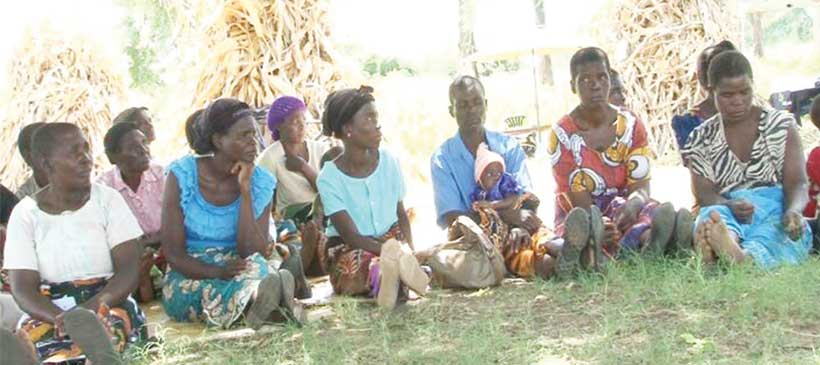
In a country where food security must transcend political and social interests, as its critical discourse is needed for a healthy population, farmers – particularly smallholder ones – must, perhaps, always be listened to.
Of course, they must always be properly guided.
They are at the epicentre of food security and every cob and pod they take home from the fields is an addition to statistics of harvests.
The Food and Agriculture Organisation (FAO) of the United Nations (UN) pays particular interest to efforts towards achieving food security, mainly in countries where the struggle is pathetically real.
That is why Sustainable Development Goal Number 2 (SDG 2) centres on ending hunger, achieving food security and improved nutrition and promoting sustainable agriculture.
There could be more than enough food produced to feed everyone, just as FAO observes, but the humanitarian need that a third of the Malawian population has been facing in the past three years or so simply tells us the fight for food security must continue with a firm resolve.
And experts agree that since food security must start at the lowest level of society, each community – perhaps each village – must be given the agriculture counsel suited to it.
In the same regard, they must also be allowed to choose the kind of crops or even variety that suits their environment. After all, that was the essence of the One Village One Product (Ovop) initiative.
In Salima’s Chinguluwe Extension Planning Area (EPA), farmers have been exposed to several crops and varieties, with yields sometimes being very unpredictable. The changing weather patterns might have been contributing to this but, perhaps, varieties too have played their roles.
“Salima is hot and when it comes to maize, which is our staple food, yields are unpredictable because we may have enough rains this year and not enough rains next year. But it seems now we have a variety that is suiting our environment,” says Steven Mkangeni, a smallholder farmer in the EPA.
Such sentiments of hope are shared by several farmers who have apparently been searching for a saviour as far as maize varieties are concerned.
“I cannot say that other varieties are completely bad. After all, we have been growing them and have been harvesting something. But at least, now we have a variety which I believe perfectly suits our hot weather,” Mkangeni adds.
His are not just words backed by nothing. He has a plot on which he decided to experiment whether Farmers Organisation Limited’s (FOL) maize varieties, MRI514 and MRI614, could be ideal for the area.
The crops have matured and he has an answer and he bragged about it when FOL organised a field day in the area in conjunction with the Ministry of Agriculture, Irrigation and Water Development and Total Land Care.
“Looking at the outcome, it is clear that MRI514 is the most suitable for Salima and other hot areas. It is disease- and drought-resistant. Most crops have failed to do well due to inadequate rains and an outbreak of maize diseases but this variety [MRI514] has managed to do well still,” Mkangeni boasts.
He adds: “Of course, the other variety [MRI614] is also good because it has also done well but if I compare it with MRI514, it is clear that the latter is the most suitable. I am expecting to harvest at least 20 50-kilogramme bags of maize from my quarter-acre.”
According to FAO, in SDG 2, food security is addressed as a complex condition requiring a holistic approach and involving a series of complementary actions targeting the access dimension of food security, the productivity and incomes of small-scale food producers and resilience of food production systems.
And Chinguluwe EPA Agriculture Extension Development Coordinator, Alice Kafunda, says with varieties that appeal to the area’s weather patterns, farmers obviously must have surpluses which they can then sell to boost their incomes.
“For instance, through the demonstration, we have seen how the two varieties perform and the farmers themselves have indicated that they are more convinced that MRI514 suits this environment.
“The message has been clear and those that have been part of the field day will obviously let others know that there is this variety which they can plant. Without the field day, farmers might have been in the dark regarding emerging technologies in agriculture,” says Kafunda.
She also indicates that Salima would have a higher yield this year because rains were not so bad but the district was affected by armyworms and crop diseases which have reduced production.
“It was rather difficult for us to quickly find out the right treatment of these pests and diseases. We would advise farmers to try a particular pesticide or fungicide but things still did not work. Still the crop production this year will be mildly higher than last year’s,” says Kafunda.
In fact, the ‘strange’ armyworms have affected crop yields everywhere across the country.
But FOL Seed Sales and Marketing Manager, Hannock Madeira, has an answer to the struggles that farmers in Salima have faced this season regarding protecting crops from pests and diseases.
“Apart from the two maize varieties, we also have pesticides that have helped a lot of farmers who used them in dealing with the armyworms. It is just unfortunate that some farmers in Salima did not have access to these pesticides,” says Madeira.
He adds: “As a business, we believe in responding to the needs of farmers.
That is why we thought of giving the farmer everything from planting to harvesting; in fact, to post-harvest care. The performance of MRI514 has clearly shown everyone that it is the ideal variety for this area.”
With the government and other stakeholders urging farmers to ensure they take care of their crops to avoid the post-harvest losses which are estimated to be around 40 percent, Madeira says FOL also believes that food security goes beyond a bumper harvest.
“That is why we also emphasise that farmers must always take care of their harvests using the most suitable means. As Farmers Organisation Limited, we have introduced an improved version of grain pesticide which we call Actellic Gold Dust,” says Madeira.
He admits that farmers had some reservations with the previous version because it had a lower residual effect and a longer window period.
“The feedback has helped us to come up with the new version. We are a farmers’ organisation and our heart is on making sure farmers are happy. That is how we can contribute to food security in the country,” Madeira adds.
But why did FOL think of introducing this new business port folio of maize seed, having mainly been in the pesticide and farm implements business for over 35 years?
“Because we are aware of emerging trends in agriculture and new technologies which must respond to effects of climate change, we had to go beyond one area,” says Madeira.
So, with several other seed companies operating in the country, with some having lost the trust of farmers due to counterfeit materials, the onus is on those who farm.
But, at the end, food security must be real and smallholder farmers must improve their socio-economic statuses. After all, gone are the days when agriculture was being seen as a business; it is now a business.
Leave a Reply