
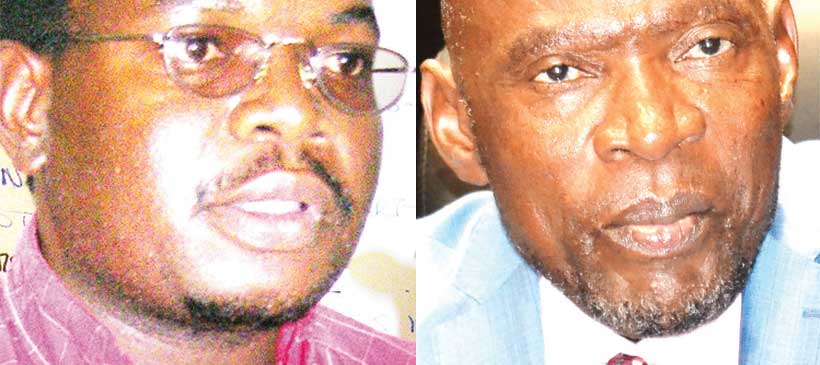
The ruling Democratic Progressive Party (DPP) has distanced itself from Simbi Phiri’s claims that he contributes funds to the party.
The opposition Malawi Congress Party (MCP), on the other hand, has acknowledged receiving financial support from the South Africa-based Malawian billionaire but has ruled out any hidden agenda.
Eyebrows have been raised on the relationship between the business magnate and the ruling DPP as well as the main opposition MCP following Simbi’s revelation that he has offered financial assistance to both parties.
Both President Peter Mutharika and Leader of the Opposition in Parliament Lazarus Chakwera attended the wedding of Simbi’s son, Ashani, in Mchinji in December last year.
DPP spokesperson Francis Kasaila on Wednesday said reports that the party has benefitted from Simbi’s financial resources “are news to the DPP” camp.
“I am not aware of any relationship between Mr Simbi and the DPP as a party. We are also getting such reports through the media. Maybe you, journalists, know better [than us] and can show us how much he has given our party but, as far as I know, he has not supported the party in any way,” Kasaila said.
MCP Deputy Secretary Eisenhowe Mkaka acknowledged that Simbi has offered some support to the party but ruled out any hidden agenda.
“Mr Simbi, just like many did in the 2014 elections, did help the MCP but his help had no conditions attached to it. We believe he did it out of goodwill for the party,” Mkaka said.
Simbi, who owns Khato Civils Limited, was awarded a whopping $500 million (about K358 billion) contract after a restricted tender process in a project aimed to tap water from Salima to Lilongwe.
The deal has stirred controversy after it has emerged that no feasibility study was done before Khato Limited and Lilongwe Water Board (LWB) entered into the deal.
Asked whether MCP would be favouring Khato Limited, in case it takes over power in 2019, Mkaka said: “The MCP government would work on merit. So he will qualify not because he associates or assists the party but because he meets the criteria and therefore qualifies.”
Khato Limited spokesperson Taonga Botolo could not be reached on his mobile phone when we sought Phiri’s side of the story.
Simbi recently invited a group of Malawian journalists to South Africa, where they toured Simbi’s business empire. The business magnate told the reporters that he has, at one point or another, funded the DPP and MCP.
A political analyst has observed that the absence of a Political Parties Act is fuelling ‘suspicious’ financing in political parties in the country and has warned that corruption and other ills may mushroom if nothing is done to address the problem.
Chancellor College-based political scientist Boniface Dulani said there are a number of individuals and companies that are secretly funding political parties with the aim of getting favours, especially from those in power, a development that compromises the position of political parties.
“What Simbi is doing is not illegal at all. He is allowed under the current arrangement because we do not have a Political Parties Act that would oblige them to declare their sources of funding. The absence of such an Act raises questions on whether political parties are not being compromised. The case of Simbi is [just] one [of such cases]. At least he has come in the open to declare that he supported the DPP and MCP but there are a lot of individuals and companies that are equally funding political parties without declaring [it],” Dulani observed.
Centre for Multiparty Democracy (CMD) Executive Director Kizito Tenthani, whose organisation is championing the cause of passing the political parties bill by Parliament, said the country’s laws are silent on private financing to political parties and, as such, political parties are not obliged to disclose their sources of funds, raising questions on parties’ adherence to principles of transparency and accountability.
“In my view, there is nothing wrong with political parties getting financing from the private sector or individuals. What is key is the disclosure of sources of funds, especially in cases of private financing. We have to configure our laws in such a way that we should enable political parties to solicit finances from the private sector. We have to ensure that political parties are able to disclose their sources of private finances. We also have to ensure that we are protecting companies and organisations that support political parties [to ensure] that they do not get victimised for their action,” Tenthani said.
Meanwhile, Attorney General Kalekeni Kaphale has told the media that he wants a review of some details of the contract and has already offered his legal opinion.
Finance Minister Goodall Gondwe also told our sister paper, The Daily Times, that the authorities will have to figure out how to deal with the issue of feasibility study since the contract for the multi-billion kwacha project was already entered into.
But the Finance Minister backed the manner in which the contract was entered into. He argued that contracts are sometimes awarded before feasibility studies are done.
“Certainly, we will have to do a review. What I mean is that we will have to deal with the question of feasibility study but I can assure you that elsewhere such cases do happen,” Gondwe said.
The Public Accounts Committee of Parliament has also rallied against the current form of the project and has demanded that an independent cost estimate be undertaken before proceeding with the project.
Earlier, LWB Chief Executive Officer Alfonso Chikuni said his office had agreed with the contractor that the feasibility study should be done after signing the contract.
Leave a Reply