
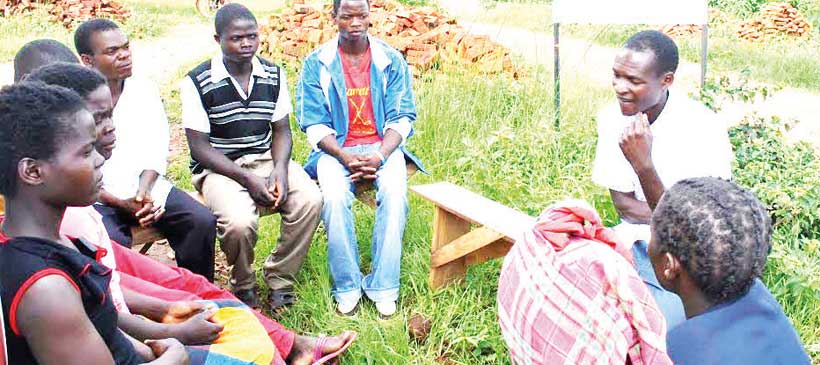
Four years ago, it was almost impossible in remote areas like Kasakula in Ntchisi to talk the youth into sexual reproductive health issues like family planning.
Telling the youth to adopt family planning methods was a delicate subject among conservative minds and religious fanatics here. Any form of education on sexuality was seen as a taboo.
This left many youths highly exposed to teenage pregnancies, early and child marriages, unsafe abortion complications and sexually transmitted infections like HIV and Aids.
But today, the story is different as scores of youths appear so determined to outgrow their risky past, shaping a new generation that tolerates dynamic approaches in responding to challenges affecting their sexual reproductive health (SRH).
In Zerezere Village, Traditional Authority (T/A) Chikho in Ntchisi, 29-year-old Saukirani Kapingasa knows the pressure that comes with having so many children within a short period of time.
“My wife and I had the burden of carrying the children wherever we went. There were too young to be left alone,” says Kapingasa, a father of three children born within a space of three years from 2012 to 2015.
With intense pressure exerted on the family to provide for the children, Kapingasa and his wife no longer need other children.
Ntchisi has had a fair share of problems with its adolescents. A walk through some selected villages brings one face to face with a litany of past cases about teenage pregnancies and early child marriages.
“Previously, it was difficult for people to adopt family planning like condom use, pills and other health-seeking behaviours because some cultural beliefs and religious principles discouraged that. But now there is change, many people, specifically the youth, feel they can no longer risk their lives,” says Doras Banda, a member of Kanola Church of Central African Presbyterian (CCAP) Youth Club in T/A Kasakula in the district.
All this thanks to an intervention by the Qadria Muslim Association Malawi (QMAM) called “Strengthening private-public partnership for sexual and reproductive health rights (SRHR) in Malawi”.
The project popularly known as N’zatonse in Chichewa is empowering adolescents, women of
childbearing age and duty bearers like traditional and religious leaders in acknowledging and accepting the sexual and reproductive health rights of individuals.
For the adolescents, the approach to reach them is through theatre for development (TFD), peer education and life skills training.
These approaches focus on youth empowerment in informed decision on SRH with emphasis placed on attending school, according to Banda.
“If the youth are educated, they can easily understand the dangers of overpopulation and adopt family planning methods,” she says.
The church has been a slippery ground to peddle messages of family planning. But the dangers to keep quiet on these matters are becoming real.
“As religious leaders, we also need a health population that can contribute to the development of the church. The poor health and death of mothers and young ones due to birth complications is affecting the church too. We are losing the flock,” says Pastor Jester Banda of Ndendere Gate of Heaven Church.
The engagement of the clergy through capacity building on SRH has resulted in the formation of pastors fraternal groupings as vehicles of SRH messages on the religious front.
Banda, who is also Chairperson of Chikho Pastors Fraternal, says they are using door-to-door visits, church and funeral sermons and other religious-related gatherings to raise awareness about family planning.
In terms of engaging the general community, N’zatonse project adopted the Star circle approach. Star means societies taking action for rights.
This is a participatory methodology for community mobilisation and empowerment in addressing issues of people living in poverty and exclusion.
Fifteen Star circles have been established in T/As of Kasakula, Chikho and Nthondo where N’zatonse is being implemented in Ntchisi. Their work involves building knowledge and skills for the youth and the rest of the people on SRH and related issues.
Janet Sadik of Mpheza Star Circle in T/A Nthondo says community members come together and look at challenges they are facing. In their case, the critical problems are often linked to SRHR.
“Overpopulation and deaths of mothers and young ones are the major problems here. These are attributed to a lack of awareness on family planning.
“Through the Star circles, we reach out to the youth, women and men with messages on the importance of adopting best practices towards achieving lower population growth rates,” says Sadik.
Despite the national total fertility rate declining from 6.3 to 5.7 children per woman in 2010, Ntchisi still recorded high levels of fertility above 6.7, according to the 2010 Malawi Demographic Health Survey.
With the total district population pegged at 212, 000, this translates to an average of seven children per family, a situation that is said to put pressure on resources.
Shortage of land due to overpopulation has resulted in an increase of land disputes in some areas like Kasakula, which has close to 20,000 people.
“Although there are no exact figures, the trend shows more cases of land disputes reported from most villages here,” says T/A Kasakula.
The chief believes that the long-term impact of the interventions will help in reversing the trend through established structures on knowledge empowerment in SRHR.
But the onus to get the best out of the knowledge gained lies with the communities themselves. Very often, sustaining adopted practices once a project phases out becomes a huge problem.
N’zatonse project, funded by KFW German to the tune of 200,000 euros, started in September 2014 and winds up in June this year.
N’zatonse Project Officer at QMAM Faith Mapemba hopes that communities will make use of the local structures to ensure continuity of the best practices.
“The project has been working closely with health extension workers and community leaders. We believe that these structures together with the existing by-laws in all areas will become handy in sustaining the best practices once the project ends,” says Mapemba.
Ntchisi District Health Office (DHO) is impressed with the overwhelming response from the youth in adopting family planning practices through demand created by N’zatonse, according to Pilirani Ulaya who is nurse and midwife technician at Ntchisi District Hospital.
Ulaya says the DHO is ready to sustain the practices and behaviours by making family planning services easily accessible at the district hospital, health centres and through outreach clinics.
“This is a behavioural practice any society cannot afford to lose. We want the youth to grow with it into their adulthood if we are to address the problem of overpopulation,” she says.
It is a wish for every nation to have a better adult generation that appreciates the real threats of overpopulation to development. This starts with investing knowledge in the youth to match their lifecycle stage through SRH information and services.
Leave a Reply