
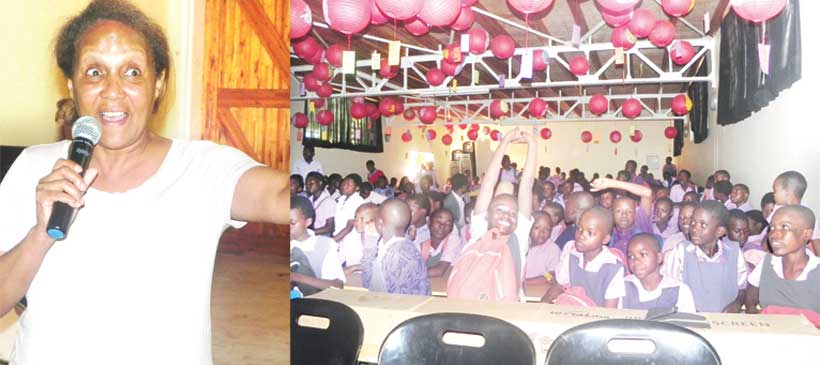
It is easy to dismiss Thoko, who is in primary school at Jaracara in Blantyre, as an ordinary 11-year-old girl.
It is only when you expose her to a local film, and ask her about her impressions of it, that you learn how sophisticated she is.
“Learners need to be of good behaviour, if they have to excel in their education. Again, school-going girls should not entertain thoughts of falling pregnant while pursuing their educational goals. They can do this by not falling pregnant in the first place. These are some of the things I have learned from the film, especially from ‘B’ella’, who is exemplary in the film,” Thoko says.
It is Wednesday afternoon in Blantyre and the Jacaranda Hall, which is full, bursts into noise as other students clap hands.
This was the case when learners in primary and secondary school at Jacaranda watched the screening of ‘B’ella, a film written by Tawonga Taddji Nkhonjera. It was produced by Based on Need-driven Grassroots Ownership (boNGO) organisation and shot by Blantyre-based Dikamawoko Arts Organisation.
It is ironic that, after its actual premiere in April 2014, it had been screened at eight international film festivals by 2016, and, yet, Malawian learners were yet to sample it and see how they could apply lessons learned from it in their education endeavours.
‘B’ella’ is more educational than entertaining, taking learners through the experiences of the protagonist, a 17-year old girl called ‘B’ella’, and how she navigates the challenges of peer pressure, sexual advances from her mathematics teacher and social ostracisation to achieve her goals in life.
“The film depicts her path to self-determination and showcases her family values, friendships and first love. ‘B’ella’ aims to champion girl empowerment by promoting self-assertiveness amongst girls and [it] has a predominantly female driven cast,” says boNGO Director, Tereza Mirovicova.
Initially, the film, which was touted as an awareness-raising film, was supposed to be introduced to learners in Malawian secondary schools in 2015, under the ‘B’ella in Malawi Schools Project’.
This, too, is ironic because screening in other countries started way back.
For example, screening of ‘B’ella’, under the ‘B’ella in European Schools Project’, started in Scotland after the film’s participation in the Africa in Motion Film Festival over a year ago.
Apart from promoting awareness-raising films, boNGO implements youth and adult education programmes, among them ‘The Happy Classrooms’ project, which has facilitated the painting of over 1,000 classrooms.
‘B’ella’ director, Tawonga Taddja Nkhonjera, expresses satisfaction with students’ feedback, saying the film is helping students understand that challenges are part of school life.
“Everyone faces challenges in the pursuit of their educational goals. The idea should be that what we lack should not pull us back but, rather, act as a source of inspiration to us. If we envy our classmates’ shoes, we should not feel distracted from our education goals but should work hard so that we may have our own shoes.
“Some of us feel less privileged when we see others eating bread at tea break. But such is life. Let us work hard in school. It is through hard work that you may be able to attain your goals,” Nkhonjera tells the Jacaranda learners.
Nkhonjera adds that, so far, the film has been screened in eight schools in Blantyre Rural and Urban. He says the goal is to reach out to 100 schools to buttress the message that, with determination, the girl-child can succeed against all odds.
Chimwemwe Mkwezalamba, who plays the character of the antagonist Kalilole in ‘B’ella’ was handy to answer questions from the learners.
“Why are you mean in the film?” One primary school learner asks.
“Because my director [Nkhonjera] told me to be mean!” says Mkwezalamba. “Otherwise, I am not mean in life. Actually, I found that role [of antagonist] challenging. In the end, I had to accept and I ended up learning a lot of things from the character of Kalilole”.
Jacaranda founder, Marie Da Silva, says ‘B’ella’ can help students break barriers and attain their goals in education.
“To begin with, not many films are produced by Malawians. The message [in such films] cannot be related to Malawians. But this film is different and goes a long way in encouraging those who are in school to work hard and achieve their goals,” says Da Silva.
Then, turning to the primary learners and secondary students, Da Silva says: “You can do anything that your heart desires”.
Jacaranda School has, itself, been involved in efforts aimed to promote education. It has, among other things, provided lamps to students at the institution in a bid to, according to Da Silva, help resource-constrained children study even at night.
Students also learn other life-saving skills. For example, the partnership between Jacaranda School for Orphans and a Kenyan non-state actor, Sustainable Development for All-Kenya (SDFA-Kenya), helped students learn the skills of turning kerosene lamps into solar powered-lamps.
In so doing, Malawi became one of the few countries in Africa to benefit from the iniative.
SDFA-Kenya projects coordinator, Amos Burudi Wemanga, indicates that, apart from Malawi, Uganda is another country that has benefitted from the initiative whose aim is to prop up the standard of living among Africa’s vulnerable communities.
“The problem in Africa is that most people think that formal employment is the only thing that matters in life. But Africa has more than enough resources,” Wemanga says.
Surely, there is more to education than ABC!
Leave a Reply