
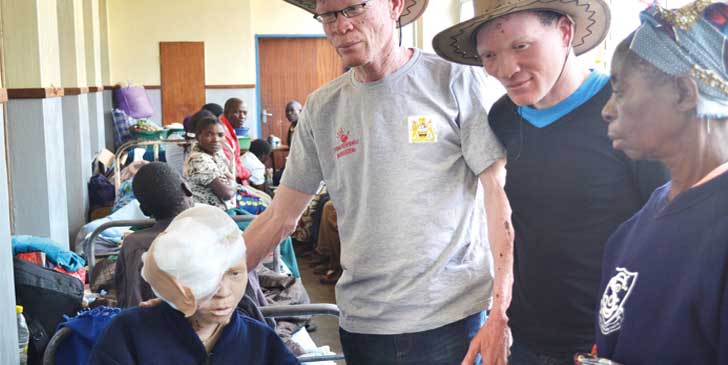
Peter Benson Chirwa, 27, has albinism, but despite being disadvantaged at school because of his condition, he was tops in his Malawi School Certificate of Education (MSCE) examinations – scoring nine points.
And in case some people may be sceptical about the child’s intelligence, he also used to excel in class throughout his primary school years, coming tops all the time.
Chirwa sat his MSCE examinations at Nkhotakota Secondary School in 2011 and initially wanted to go to university to study accountancy before he changed his mind.
“I changed my mind and chose to study medicine instead because of the way I was mistreated at Nkhotakota District Hospital when I went there with a skin problem while in Form Two,” Chirwa says.
He says: “The health worker who attended to me when I went there for the first time said I was a helpless case and just gave me GV paint. He showed no willingness to attend to me.
“I told the head teacher about the GV paint medication I had been given at the hospital. He felt sorry for me and said the GV paint would only aggravate the wound.
“When I went to the hospital again, the health worker gave me GV paint and said I should go away. I then stopped going to the hospital altogether.”
Unless he gets help, there is now uncertainty of Chirwa achieving his dream as he is lying in agony in hospital because of the same problem, a cancerous wound just above his right eye.
The sad thing is that the life-threatening would have been prevented if he had used recommended skin lotion and headgear while young for protection against ultraviolet light.
Albinism is derived from the Latin word albus, meaning ‘white’. It can occur in plants and animals.
In humans, albinism is as a result of a genetic disorder in which there is partial or total lack of the pigment melanin in the eyes, skin and hair that occurs in all populations.
Melanin, which gives human skin, hair and eyes their colour, also provides some protection against skin damage from the sun.
“I appeal to organisations and people of good will to help me get cured so that I can continue with education,” Chirwa told Mana from his bed at Kamuzu Central Hospital (KCH) in Lilongwe.
Recalling how the health worker at Nkhotakota District Hospital treated him with contempt because of his condition, he says his dream now was to be a doctor and make a difference in treating patients.
“Once I am cured, I want to study medicine and qualify as a doctor. I want to treat patients with compassion,” says Chirwa, who got distinctions in mathematics, physical science and English.
Dr Caroline Ngulube, a Medical Officer with Medical Aid Society of Malawi, says Squamous Cell Carcinoma (SCC) is a type of skin cancer most common among persons with albinism.
Ngulube stresses the need for persons with albinism to have access to a special skin cream and to wear protective clothing to avoid it.
“It affects skin cells and is caused by exposure to ultraviolet light. The cream is important as it protects the destruction of skin cells,” she says.
Ngulube says SCC can affect any part of the body “but the most common affected areas are the head and neck because of being exposed to sunlight.”
The prevalence of albinism in Malawi is unknown because of limited data on the population of persons with albinism. But albinism is visible across all ethnic groups in the country.
The Association of Persons with Albinism in Malawi (Apam) estimates that there are between 7,000 and 10,000 persons with albinism in Malawi, and tens of thousands on the continent.
Apam bemoans the fact that persons with albinism in the country have for years struggled to access skin lotion for protection against the sun.
“I earnestly ask government to provide sun blocks to persons with albinism through government health centres,” Apam President, Overstone Kondowe, says.
Kondowe says preventive medication should be offered freely to persons with albinism the way wheelchairs are provided to persons with disability without being paid for.
The skin cream in question costs about K15,000 for a 500ml tube, according to Kondowe. The price is far beyond the reach of the vast majority of persons with albinism in the country.
“Government should budget for the needs of persons with albinism. We are keen to know how much is in the budget for us [this year],” Kondowe told Mana when he visited Chirwa at the hospital on Sunday.
Kondowe, a graduate of the University of Malawi (Unima) who has albinism, says government should also introduce mobile clinics throughout the country for cancer screening of persons with albinism.
“The clinics would help detect early cancerous skin problems. Early detection and provision of skin lotion would have prevented this,” a visibly concerned Kondowe says, referring to Chirwa.
Earlier in 2012, Chirwa travelled to KCH for treatment when three men attacked him at the hospital roundabout around 5pm, robbing him of his possessions, including his MSCE certificate.
Malawi has in recent years seen a rise in attacks against persons with albinism. It is not clear if Chirwa’s assailants were common robbers or were after his life as is happening nowadays.
Following the incident and loss of his MSCE certificate, Chirwa failed to sit the Unima entrance examinations.
Kondowe and Apam General Secretary, Menard Zakaliya, were almost moved to tears as Chirwa recounted the problems he faced at school, including the difficulty of reading notes on the chalkboard.
Chirwa also spoke about how he excelled in class despite the fact that very often he had to deal with the stigma attached to being a person with albinism.
Kondowe, commenting on Chirwa’s performance in his MSCE examinations, says people like Chirwa who perform exceptionally well should be exempted from sitting university entrance examinations.
He calls on non-government organisations to play their part and assist in the procurement and distribution of the much-needed sunscreen lotion for persons with albinism.
Chirwa’s mother Veronica, 58, describes her son as a brilliant child who used to get the first position in class even when he was at primary school.
“He was always number one from Standard One to Eight,” says Veronica, of Mpamba Village in Senior Chief Kanyenda in Nkhotakota.
But she says her son, the fifth born in a family of four, badly needs assistance as “we are one of the poorest of the poor families in Malawi and can’t provide for his educational and health needs.”
“He does not have clothes and bedding. His father is at home and is too old work,” says Veronica, who is with her son at the hospital. “I beg people of good will to help my son.”
She says: “I have a daughter who also has albinism, but she does not perform better in class than her brother.”
Leave a Reply