
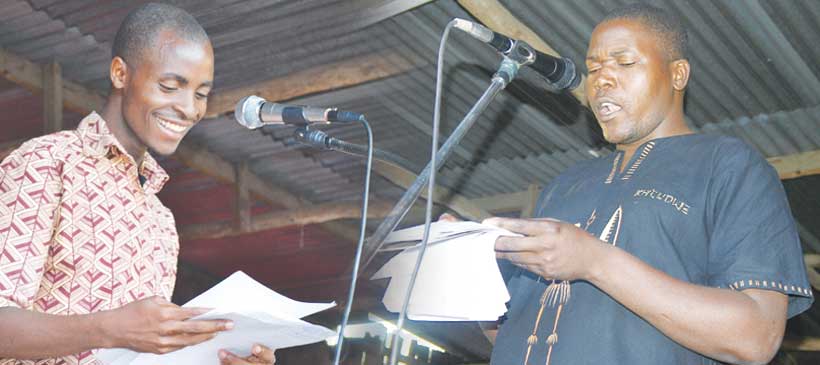
Poetry must be in full flower. On one part, poetry shows are highly patronised. On the other hand, radio programmes dedicated to poetry seem to be all over the place.
From the look of things, therefore, it is supposed to be a story of triumph.
However, as Poetry Association of Malawi president, Felix Njonjonjo Katsoka puts it, there is work to be done before poets can start accessing royalties.
“We have been holding discussions with the Copyright Society of Malawi (Cosoma) on the issue of royalties being paid to poets but it may be some time, maybe years, before we can talk of poets enjoying their talent by receiving royalties. We know that our friends, musicians, smile all the way to the bank because they get royalties and our hope is that we, too, will begin to enjoy similar benefits,” says Katsoka.
However, Katsoka does not blame anyone for the situation.
“It is not like stakeholders, including Cosoma, are not trying their best to iron things out. The thing is, the situation seems to be a bit complicated at the moment. We can only hope that, at some point, we will be able to iron these issues out,” says Katsoka.
The poet adds that the issue of poets generating money out of their creativity is compounded by the fact that the poetry association has no control over the use of poems belonging to its individual members.
“For example, we do not have control over the decision to air this, and not that, poem on radio stations. We do not even have a say on which poems are published in newspapers and magazines and this means it is the responsibility of individual poets to follow up on such issues.
“Again, when it comes to signing agreements, we, as an association, are not involved. His means we do not have the mandate to intervene when things go wrong in agreements between poets and contracting organisations,” says Katsoka.
Poet Hudson Chamasowa observes that poets do not often reap the benefits of their creativity, a trend he says is also rampant in cases of festivals.
Chamasowa cites his own case, saying, although he has performed at a number of festivals, including the recently-held Land of Poets, he cannot point at one thing as the fruit of his stage performances.
“I think we, poets, have to put our house in order first. We have to be organised. We need to ensure that there is continuity of programmes as well,” he says.
He says there is need to create a conducive environment for poets so that, like any other art, people can be able to live on poetry.
To reap from sweat
Cosoma senior licencing officer, Rosario Kamanga, says the situation poets find themselves in, when it comes to royalty payments, hinges on the fact that their situation is unique.
“We approach the issue of poets differently because, while musicians use what are called blanket licences since music is a common feature in broadcasting houses, and the musicians themselves are many, poets use transactional licences.
“A transactional licence is a licence that an individual author or creator offers to a broadcasting house or publisher, and the agreement is between the creator of the work and the institution or person using the artistic work. This is because poems are put in the same category as plays: they are featured during specific times. This is the reason a transactional licences have been common in terms of poetry,” says Kamanga.
Kamanga says, since poems are not played like music, it becomes difficult to use the blanket licence— which covers creators as groups and enables Cosoma to collect royalties on behalf of such groups— poets have been crying foul as they seek to have similar bragging rights to those enjoyed by musicians.
However, Kamanga is hopeful that the situation would improve once the amended Copyright Act is tabled in Parliament.
“We are hoping that, before the end of this year, the Copyright Act will be tabled in Parliament. We are actually hoping that it will be tabled before Parliament rises. The Act has provisions on, say, resell rights. This has been necessitated by the fact that, sometimes, a painter or artist’s work becomes famous when they die. So, whereas their artistic pieces used to fetch less, the works begin to fetch more,” he says.
However, Kamanga has no explanation as to why dead ‘creators’ are more famous when dead than when they are alive.
Does this mean, maybe, that Malawians love the dead?
“[Laughs] I do not know really, but maybe this happens because people begin to appreciate one’s artistic work when the author dies. That said, the amended Copyright Act will help us address the issue of resell rights,” says Kamanga.
Cases of dead authors or creators becoming famous in Malawi are common. For example, in the music industry, the late Paul Chaphuka made a name for himself after release the album ‘Ndichiritseni’ in the late 1990s.
But he was not there to perform the songs live; having robbed Malawi of his promising talent before Malawians could have the fullness of him.
Another musician, the late Evison Matafale, left Malawians with wonderful melodies, and it is not clear who may sell his rights should someone, somewhere, decide to buy the rights to his music.
In terms of poetry, however, it may be too early to talk about resell rights because the genre is treated as an after-thought.
But this is about to change, should Parliament pass the amended Copyright Act.
“Resell rights will tackle issues such as how long can the author hold on to the rights and what happens when someone [not the original author] wants sell the artistic works,” says Kamanga.
Of course, poets should fight for recognition— in terms of having access to royalties— before they can even talk of issues such as resell rights.
This means, while poets continue to enjoy the spotlight, their glamour is tempered by inadequate financial rewards.
For now, at least.
Leave a Reply