
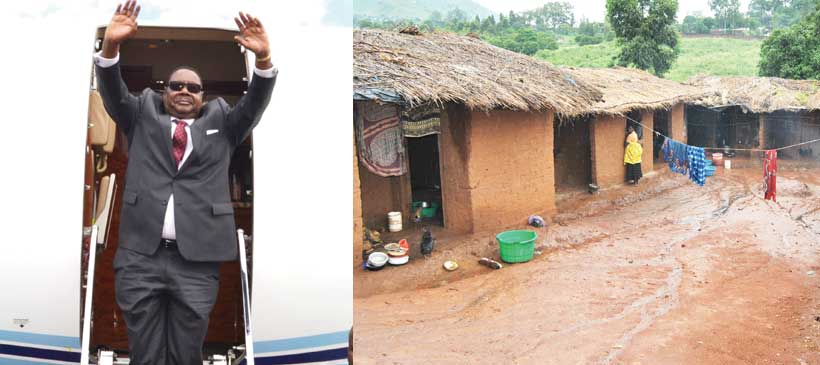
This write-up takes impetus from two distinguished Malawian essayists, Desmond Dudwa Phiri, commonly known as D.D. Phiri, and Sam Mpasu.
D.D. Phiri chronicles that when Malawi attained self-government in 1964, senior servants in the government told the then prime minister Hastings Kamuzu Banda that there were inadequate funds for running the government.
Banda reacted, he records, by ordering a 10-percent cut-off from his and his ministers’ salaries.
He also directed a freeze on the increments of the highest paid Malawian civil servants.
Besides, D.D. Phiri calls to mind during World War II photographs – captioned “The Royal Family is saving petrol due to wartime shortages” – of the British Royal Family on a trip travelling by horse-drawn coaches.
And one is obliged to think that such precedents and many more would guide the current Democratic Progressive Party (DPP) and President Peter Mutharika.
Economically and socially, Malawi is standing exactly where it was 52 years ago, and there are telling signs the country will stagnate economically in probably another 50 years from now.
A World Bank report of 2015, for example, testifies that poverty levels in Malawi remain high.
About 54 percent of the population lives below the poverty line of less than $1.90 a day.
The 2010/11 Integrated Household Survey (HIS) revealed that 24.5 percent of then population of 14 million were leaving in ultra-poverty a condition of extreme deprivation of human needs.
Rural populations had been the worst hit as rural ultra-poverty levels stood at 28.1 percent compared to urban ultra-poverty levels at 4.3 percent in the period of the survey.
Again, the Episcopal Conference of Malawi (ECM) recently released a statement.
ECM says in the statement: “It is disheartening and painful to think of our 6.5 million brothers and sisters who the Malawi Vulnerability Assessment Committee Report (Mvac, 2016) has indicated as needing humanitarian assistance for them to continue living a dignified life.”
It is due to this existing hunger that President Mutharika at a recent ‘development’ rally in Mulanje committed a classic case of verbal diarrhoea that is considered a product of ‘creativity’ or ‘wisdom’ that ran amok.
In his what Mrs Hillary Clinton sometime back called a “misspoken” indiscretion, the President urges the public to resort to some wild tubers (zitchetche) and mice (mbewa) as a staple to avert starvation owing to the food shortage besetting the country.
The elements aside, there are so many reasons for the country’s staggering under the weight of multifarious challenges such as severe and prevalent hunger as well as lack of direct budgetary support and soaring public debt that can be classified into structural, altitudinal and political.
Seriously, politically, since Malawi embraced multiparty politics in 1993, the country in presidents Bakili Muluzi, Bingu wa Mutharika and Joyce Banda (JB) has had not only a visionless democracy but a heartless ‘theft-o-cracy’.
To fortify their cult status, generated from one’s ego, a slow-on-the-uptake populace and fraudulent public institutions, the three leaders turn to glorifying themselves with vain titles and honorary papers.
Mpasu recounts that, in his second term, Muluzi “acquired an honorary doctorate, and another for his wife, to prop up his political standing. He ghostwrote a book to become an intellectual. He gave himself titles of ‘Atcheya’ and ‘Political Engineer’”.
In his second term, Bingu “boosted his self-confidence by acquiring the titles ‘Ngwazi’, ‘Chitsulo cha Njanji’ and ‘Professor’”.
JB did not want to be left behind.
So, during her tenure in office, the University of Jeonju in South Korea bestowed an honorary doctorate on her.
She did not even sense, so too her predecessors, that because it is not an academically or professionally earned paper, it can only be framed and hung on any wall of one’s choice, but not necessarily ‘worn on one’s forehead’, much less ‘attached to one’s name’.
Awhile, the populace celebrated after Mutharika and DPP took the reins of power from JB.
The sentiment across the sweeping ranks was that Mutharika and DPP’S second-coming would see Malawi sever its romance with mediocre leadership flourishing in the post-one-party years with the likes of Banda and Muluzi shamelessly wearing on their foreheads titles earned from honorary papers.
It was thought Mutharika, having lengthily walked the corridors of an institution of higher education, would not fall into obsessional desire to decorate himself with some honorary titles.
One could write about Mutharika’s, if that would not only serve to repeat clichés, marvelous qualifications and achievements in the academic world, and the academic admiration the President awakens in every country in the world.
Surprisingly Mutharika amid myriad economic challenges facing the country Friday flew out of the country on a chartered plane to Ethiopia where he had to be laced with an honorary academic paper.
So instead of finding long-term solutions to the problems rocking the country, the President and DPP government all can think about is to hit the skies and collect honorary papers and awards, perhaps an attempt to conceal their inefficiency.
Come to think of it, maybe the country needs to make holding of a doctorate diploma a requirement for the Office of the President.
But, as Mpasu reminds, some history has it that Emperor Haile Selassie of Ethiopia lost his throne because of such insensitiveness to people’s suffering.
At the time majority Ethiopians in the north of the country were dying from famine, he appeared on television cutting his 83rd birthday cake which had been baked in and was especially flown from Switzerland.
Leave a Reply