
Picture this scenario: You are 58 and for years, you and your family, have lived in a grass-thatched hut roughly measuring three metres by 2.5 metres.
Then, like in a dream, you find yourself living in an eight metres-by-six metres house, with corrugated iron roof, plastered, white-washed and well-cemented floor.
Then figure this other scenario: You are way above 90 living in a dilapidated grass-thatched house that leaks gallons of water every time it rains.
You cannot maintain the roof yearly because your rheumatic legs cannot carry you to it.
Then all of a sudden, you find yourself in a leak-free house because the new house has a corrugated iron roof, is plastered and white-washed, and has well-cemented floor.
The above scenarios are on-the-ground reflections of Medson Chiumia, 58, and his 94-year-old father, Standford Chiumia, both of Simon Chiumia Village, Traditional Authority Mzikubola in Mzimba District.
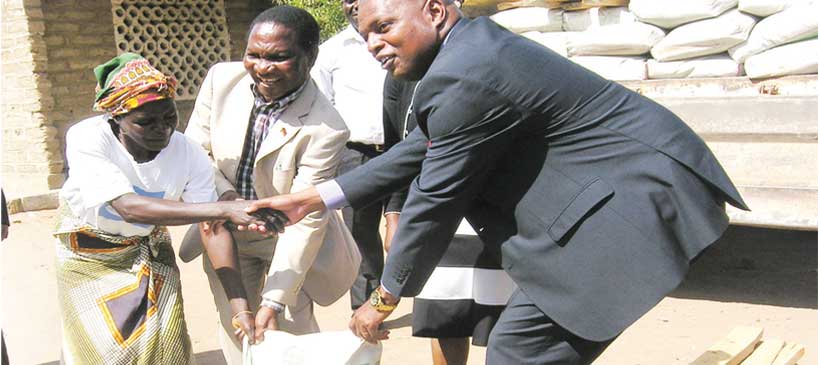
The two and their families have respectively graduated from their old leaking grass-thatched homes to modern homes courtesy of the Malawi Government’s Decent and Affordable Housing Subs idy Progr amme (DAHSP), popularly known as Malata-Cement Subsidy programme.
“The commencement of every rainy season used to keep me restless considering the condition my grass-thatched house was in, ” Standfor d explains.
“I could not manage to climb on the roof to carry out its maintenance works owing to my age and, as a result, we were highly inconvenienced by the rainwater that kept soaking all our belongings.”
The story is the same with Medson, who describes the year ly maintenance of the roof of his small hut as big challenge, especially at the time climate change has made suitable thatching grass difficult-to-find.
“I still haven’t come to terms with the reality that I now own a decent home like this one: it’s like a dream and I’m really excited,” Medson says.
The improvement of the Chiumias’ new houses cost around K450,000 each and with the subsidy arrangement, the beneficiaries will have to pay back half of the amount each over five years.
To Standford, paying back the loan is no challenge at all as he, like Medson, relies on agricultural produce from their nearby dambo land.
Standford says: “Don’t let my age fool you: God willing, I will be around for longer than one would anticipate and I’ll pay back the loan. The beauty of it is that it’s spread over five years – that’s affordable.
“Even if I fail to pay back on my own, I have got people who would assist me except that they could not afford to raise all the money for a decent house at one goal.”
The Chiumias say they shall forever be thankful to government for initiating the programme, which, they say, has completely changed their lives.
“A decent home is a source of happiness, especially during rainy season,” Medson says.
“Leaking houses are less dignifying; we are happy and thankful that we have left all that behind.”
The Chiumias are just some of the many beneficiaries who are now enjoying the fruits of DAHSP in Mzimba South.
According to Rural Housing Officer for Mzimba South, Ida Sinda, the programme is targeting 339 beneficiaries in five constituencies, namely Mzimba Liwerezi, Mzimba South, Mzimba South West, Mzimba South East and Mzimba Solola.
Two hundred-seventy-one beneficiaries of the 339 in Mzimba South have their houses improved, according to Sinda, while the remainder is in the process of getting materials from the programme.
“The programme has been welcomed with excitement and it is really transforming the lives of people,” Sinda says.
“The selection process of the beneficiaries was entirely left in the hands of the people themselves and traditional leaders, so we did not have challenges there.”
Mmbelwa District Council, which comprises Mzimba South and Mzimba North, has 642 targeted houses but total number of targeted houses in the North is 2, 475.
Out of this figure, 1,950 houses are under improvement, according to the Northern Region Rural Housing Officer, Orphin Thera.
Thera says the implementation of the programme in the region’s six districts of Chitipa, Karonga, Rumphi, Mmbelwa, Nkhata Bay and Likoma is very successful and that there is more demand for improved houses.
“The beneficiaries are very appreciative and they find the terms of loan repayment very soft and affordable,” Thera says.
“Simple calculations of the loan of K225,000 with a simple interest of 10 percent for five years suggest that beneficiaries will have to be paying K3,900 per month on average – which is, indeed, affordable.”
DAHSP targets to support 15,440 beneficiaries countrywide – 80 in each constituency in all the 193 constituencies per annum in five years.
Out of the targeted figure, the programme has 14,475 houses under improvement on subsidised loan component per annum and construction of 965 houses on grant component per annum, according to Director of Administration responsible for Housing Services in the Ministry of Lands, Housing and Urban Development, Veronica Chidothi.
She, however, says the construction of the houses on grant component is yet to start upon availability of funds but out of the 14,475 houses, about 10,271 houses (representing 71 percent) are being upgraded with over 3,280 houses completed and occupied.
“There has been high expectation from the programme from the time it was approved,” Chidothi says.
“The implementation of the programme has been more successful than we expected; it was a new concept altogether with no precedent and we started on a blank page.”
Chidothi hails all the district councils, which, she says, are used as conduits in implementing DAHSP with the help of Housing Development Groups, chiefs and communities.
She adds that there is growing demand for decent houses in the communities where DAHSP has been implemented.
“At first, people thought it was just one of those far-fetched ideas and that it would never come to fruition,” she continues, “But now having seen it being implemented on the ground, there is growing peer pressure.”
She further anticipates the repayment of the loans not to be a problem given how the beneficiaries have welcomed the programme and also given the growing demand from other prospective beneficiaries within the communities awaiting benefits from the revolving fund.
Parliament approved K7bn for DAHSP in the 2015/16 Financial Year but the figure was revised downwards to K5.5bn out of which the actual funding received to date is K4.3bn, according to Chidothi.
“With this funding, the programme has managed to make payments to over 85 percent suppliers of building materials and over 10,270 houses are being upgraded: these are remarkable achievements,” she explains.
The Cement-Malata Subsidy Programme is rolling.
With 15,440 decent houses every year across the country for five years, one thing is, perhaps, certain: the programme will not only leave the likes of Chiumias smiling, but it will also take the country steps up the national development ladder
Leave a Reply