
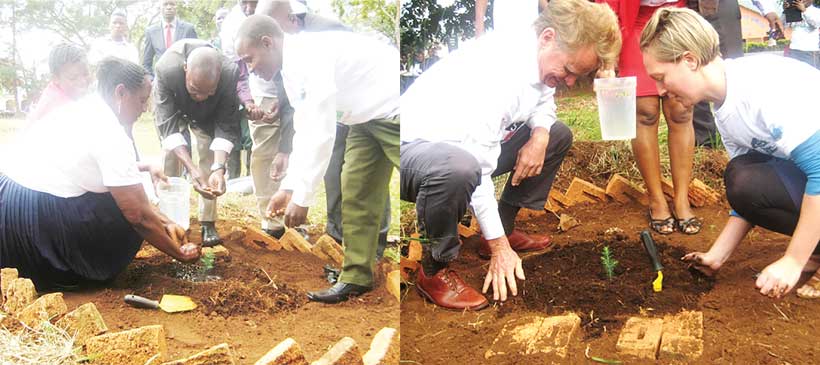
Southern Africa is home to the prestigious Widdringtonia which is a genus of coniferous trees in the Cypressaceae (Cypress) Family.
This pride comes in four species namely Widdringtonia Cedarbergensis (Clan William cypress) endemic to Cedarberg Mountains of South Africa, Scharzii (Willowmore cypress) endemic to Baviaanskloof and Kouga in the same country, Whytei (Mulanje Cypress) endemic to Mulanje Mountain in Malawi, and Nodiflora (Mountain cypress) which is shared across the regions where the first three species are found.
Apart from having its own species endemic to her, Malawi happens to have the best Cypress among the four, as this species is considered most valuable due to its availability in larger sizes than the rest.
It is against this background (and other additional facts) that Malawi declared Widdringtonia Whytei popularly and mistakenly known by the locals as Mulanje cedar the country’s pride – its national tree, in 1984
By the time Malawi declared this Cypress a national tree, the iconic species overwhelmed Mulanje Mountain; covering a total land size of 1,462 hectares of the mountain.
On top of that, there are also other places which are not documented in Malawi’s history of cypresses, where the tree existed even before the end of the country’s colonization. These places included Zomba Plateau where the Cypress is believed to have been planted by British colonialists who sourced its seedlings from its original home, the Mulanje Mountain.
However, despite Mulanje Cypress (Cedar) being the national tree for Malawi and having been known to be existent since 1907, Malawians continue to live in mysteries over the regeneration of the tree that acts as home to many other living organisms, while growing to heights of 40-50 metres.
A common belief among locals, especially in Mulanje and Phalombe is that the tree grows naturally and that no man can succeed in the adventures of trying to replenish it scientifically.
“Cedar is planted by God, and God alone replenishes it. Since my birth, I have seen no man who planted a single tree that has gained height and health at my watch,” explained one leader, who for the sake of safety opted not to be mentioned.
He added that he and his subjects fully understand that plans and initiatives put by the government on the replenishment of Cedar on the mountain are nothing but government and non-governmental organizations’ tricks to reap donor money, as it is clear that cedar cannot be replanted by humans.
It is common knowledge which has been socially and religiously passed on from generation to generation that even children of the current century do not have the guts to question it, but rather store it safely.
Save the belief among most citizens, over the years the National Tree has faced challenges denying it growth and replenishment. The challenges include; wildfires, pests and diseases, colonization by other invasive species and illegal logging by the very same citizens who have never bothered to venture into replenishing the tree, while holding on to some hope that heavens takes care of it.
Sabotage in protecting the iconic tree
In 2000 government, using a World Bank Loan established the Mulanje Mountain Conservation Trust (MMCT), mandating it to conserve natural resources on the mountain, with a main focus on the indigenous tree – Mulanje Cedar.
Executive Director for MMCT Carl Bruessow and fellow staff at the Trust have fresh memories of hardships that the organization has faced over the years, while trying to fulfill its government-given mandate on the mountain.
Over the past five years, MMCT offices in Mulanje have been sealed by a local group termed concerned citizens and managers of the Trust received death threats.
“They wanted MMCT out and the mandate of protecting the mountain and all the nature on it to be given to the citizens. They argued that MMCT has done nothing but allowing a few people to rob the mountain of its treasure, hence the Trust was not useful after at all” recalls Bruessow.
He, however, disputes the allegations, shifting the blame to “some greedy people who bypass legal checks put in place to regulate the harvest of Mulanje Cedar for the sake of their personal enrichment”.
While the tussles and squabbles unfolded before the public, in the year 2013, the valuable species appeared on the International Union for Conservation of Nature (IUCN) red list. This meant that with no quick measures put in place to protect it, the species could very soon become extinct.
A serious threat on the species
As of January 2016, information from the IUCN website indicated that due to various factors surrounding lack of protection and abuses, Mulanje Cypress is only a step away from extinction.
The IUCN estimates that Widdringtonia whytei covered only 845 hectares of Mulanje Mountain by the last assessment of 2013; adding that while still facing the four main enemies; illegal logging, frequent wild fires, lack of regeneration and exotic pests, the tree is likely to face a decline of more than 80 percent towards extinction as we reach 2030.
In 2014, through a survey Mulanje Mountain Conservation Trust realised that there were no more Cedar trees on the mountain that reached the height of 50 metres and diameters of two metres as it used to be in the days the tree was declared national.
“There were a total of 63,609 standing trees of the Cedar, of which 25,609 were but dead and dry due to wildfires and other causes of premature death” reads part of the survey results.
Meanwhile, still believing in the ‘god-replenishment’ theory, citizens continue to put the Cypress at risk with increased cases of illegal logging being filed at the police and Magistrate’s Courts and tonnes of illegally harvested cedar products being confiscated.
This situation in 2015 forced the government to engage the Malawi Defence Force to sweep off all harvesters from the mountain and other hills in the country, in order to arrest deforestation and destruction of the national pride.
However with eyes on the broader picture, Bruessow is very positive that a big chunk of the Cedar from Mulanje Mountain is legally harvested by a few individuals who have permits to do so, at the expense of the whole Malawian population.
He alleges that some people with strong political backing have full rights to simply harvest too much than they should.
“This scenario in some way frustrates local people living around Mulanje Mountain thereby leading to more damage on cedar, because the people feel that someone wants to get all the cedar from the mountain and benefit from it on their own without sharing with them when they actually are the ones closer to the source,” explained Bruessow.
Is the belief simply a misconception?
Even though a good percentage of Malawians have held on to the belief that Mulanje Cedar cannot be planted by humans, over the years the scientific community and natural resources researchers in the country have gone beyond to unearth what is believed to be evidence of possible human replenishment of the genus at some time in history.
A recent research by the Forest Research Institute of Malawi (FRIM) revealed that a lot of plantation of the mystified Cypress was done at Zomba Plateau during the World War II period of 1940 – 1945, significantly quashing fears that the tree is replenished only by the hand of God.
Acting Director for FRIM, Tembo Chanyenga argues that on its own the presence of Mulanje Cedar at Zomba Plateau is a conclusive piece of evidence that the tree can be planted by human beings, as it was definitely transferred from its original home.
Additionally, seedlings developed in nurseries at FRIM premises in Zomba have proved to grow faster in environments similar to the ones on some parts of the Mulanje Mountain where a lot of Cedar trees used to be seen in the past.
Leave a Reply