
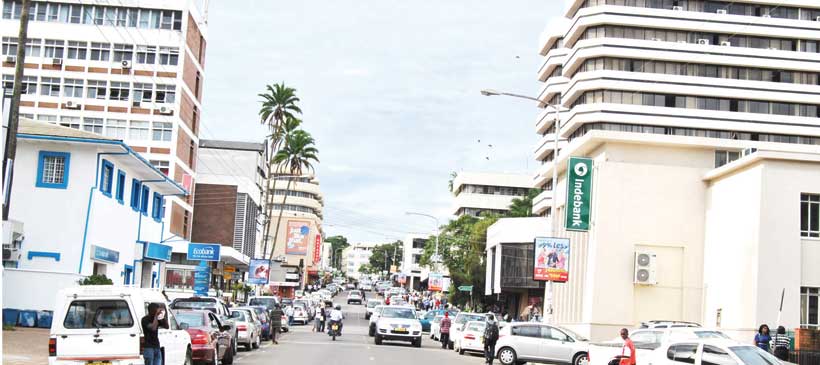

For over two months now, Arnold Chiwaya, has been going to the Blantyre Labour Office hoping to get a job.
Each morning, Chiwaya, a Malawi School Certificate of Education holder, leaves his wife and two children in Bangwe around six o’clock and walks to Ginnery Corner to try his luck.
“I come here looking for any job. All I need is money to take care of my family,” Chiwaya said.
Since completing his secondary education in 2002, Chiwaya has never secured any permanent employment. He survives on piece works.
“I have worked in construction sites, as a minibus conductor and as a garden boy. I am also good at landscaping,” he says.
Narrating his story, Chiwaya says he could not continue on with studies because tertiary education in Malawi is extremely expensive.
He says his single mother could not afford to pay his tuition and take care of his four siblings.
“Education, especially tertiary education, has become a thing for the rich. The poor cannot afford hundreds of thousands or even millions of kwacha needed to access tertiary,” Chiwaya said.
Chiwaya is just an example of Malawian youths that are struggling to get access to tertiary education in recent years following the withdrawal of government sponsorship in universities, teachers colleges and technical colleges.
Today, newspapers are full of stories of brainy students on the verge of withdrawing from college due to lack of money.
Just recently, a Malawi Polytechnic student, Damison Jame, had to be accommodated by security guards after failing to find money for accommodation in the commercial capital.
“Life is becoming unbearable. I am spending many nights with security guards and money for food is also a challenge,” Jame, a 24-year-old Geological Engineering student said.
But while critical sectors such as education and health are struggling due to lack of financial resources, government has set aside K182. 9 billion to pay as interest for public debt.
Finance Minister, Goodall Gondwe, announced when he presented the national budget in Parliament two weeks ago that for the 2018/19 financial year, interest payment bill has been projected at K182.9 billion, representing 3.4 percent of the Goss Domestic Product (GDP) or 12.19 percent of the national budget.
He said of the K182.9 billion, K14.3 billion is interest on foreign debt while K168.6 billion is interest for domestic debt.
As at December 2017, Malawi’s public debt stood at K2.7 trillion or 55 percent of the Gross Domestic Product (GDP) of which K1.466 trillion or 29 percent of the GDP were foreign debts while domestic debt accounted for K1.285 trillion or 26 percent of GDP.
This year, Capital Hill intends to borrow K242.9 billion to finance its operations from July 1 to June 30, 2019 of which K176.1 billion will be borrowed on the domestic front while K66.8 percent will be foreign debt.
 The proposed K182.9 billion is enough to finance the education budget at K166 billion which could leave Treasury with K16.9 billion change, more than enough to finance all the youth development programmes in the budget.
Former Economics Association of Malawi (Ecama) President, Henry Kachaje, said though borrowing is not always bad, it is worrying to observe that the country is borrowing for consumption.
Kachaje said it could have been encouraging if Malawi was borrowing to boost productive capacities, rather than consumption.
He said the high amount of money needed to repay the loans would reduce government’s fiscal space to undertake critical operations.
International Monetary Fund (IMF) Resident Representative, Jack Ree, described the amount earmarked for debt repayment as mind boggling.
“Of course, the size of the interest bill is mind-boggling. And as you noted, the domestic debt accounts for the bulk this bill. This reflects the fact that interest rates in kwacha is far higher than those in dollar, renminbi, or euro.
The silver lining, however, is that kwacha interest rates have made a steep decent since this disinflation cycle began about two years ago—which means that interest bill is lower for the same amount of borrowing. That said, domestic debt has also built up a very rapidly since 2012. However, the fiscal framework underpinning the ECF program envisages to reduce the domestic debt-to-GDP ratio from 22.5 percent in 2017 to 16.6 percent in 2022,” Ree said.
Equally concerned with growing levels of borrowing is Malawi’s cash cow, the private sector, which indicated through its mouthpiece the Malawi Confederation of Chambers of Commerce and Industry (MCCCI) its discontent with Goodall’s financial balancing act.
“Also of concern to the private sector is domestic borrowing which the budget statement alluded is going to rise by K176 billion due to diminished foreign borrowing. This is a very worrying trend for the private sector considering that Malawi is already above the 20 percent threshold for domestic borrowing.
“This is likely to influence an upsurge in the interest rates and crowd out private sector capital. The money that would be borrowed by government if also not used for productive purposes will further push up inflation rates,” says MCCCI in its post-budget review.
Investment management and advisory firm, Nico Asset Managers, says it is concerned with the failure by the finance minister explain as to how it plans to diminish government debt.
Nico Asset Managers says, in the 2017/18 budget speech, Gondwe continually emphasized the need to exercise prudence in expenditure.
According to Nico, the simultaneous decrease in recurrent expenditure and increase in development expenditure gave assurance that fiscal consolidation is not merely a song and that government was very much committed to having a development-oriented budget as opposed to a consumption budget.
“However, presenting the budget, the minister of finance didn’t succinctly explain as to how governments plan to lessen the debt. We are happy that measures to increase revenue like a hike in user fees and tax administration and policy reforms have been considered.
“However, we feel that the continued rise in government debt as reflected in the interest expense could have a counter effect on those reforms,” reads part of Nico Asset Managers’ weekly market report for week-ended May 18.
This is not the first time for Capital Hill to find itself in a precarious situation where debt interest has to overshadow everything else.
Around 2006, Malawi had to be forgiven all her debts under the Multilateral Debt Relief Initiative after public debt sprouted astronomically.
So unless authorities at Capital Hill check their appetite for borrowing or use borrowed money for production purposes rather than consumption, Malawians like Chiwaya and Jame will continue to struggle to get basic necessities such as education.
Leave a Reply