
Malawi National Human Development Report 2015 emphasises that constraints to access to health care in the country are represented by inadequate health facilities and distance to health facilities.
And people in Group Village Mlima, Traditional Authority Bwananyambi in Mangochi realise that health is wealth. They realise that health is the basis for job productivity, the capacity to learn in school and the capability to grow intellectually, physically and emotionally.
But they tell Times Group’s WANANGWA CHAFULUMIRA how government – in the country with limited hospitals and the health centres not always within reach of all people in some districts – has condemned them to the early graves despite their unwillingness to die needlessly.
20-year wait for decision – Councillor Clement Dzimbiri
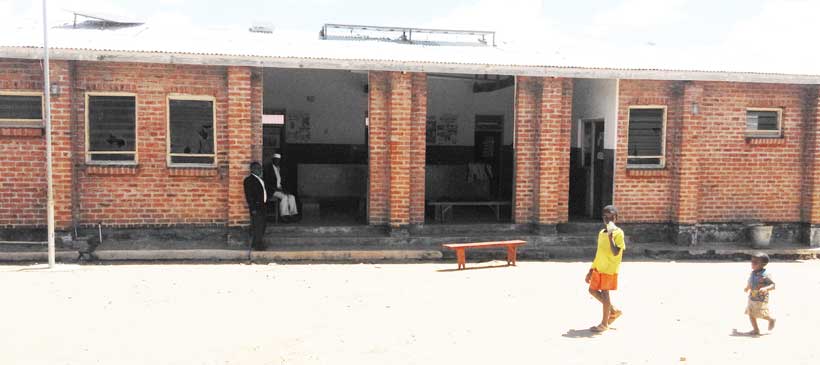
It was in 1995 when communities around this Chipunga Ward in Mangochi South Constituency started constructing Mbalama Health Centre through Masaf 1 project.
The health centre with three medical personnel houses was completed in 1997.
Since then, however, the facility is yet to be opened.
We have been consulting and pleading with the Ministry of Health for all these years but all we get are incomprehensible responses such as the facility awaits a code number – whatever that means.
Lack of a health facility in this area is problematic and contributes to child and maternal mortality as well as people dying of curable diseases.
The nearest health facility is Mkumba Health Centre at 27 kilometres from here. Or else patients are referred to 56-kilometre-away Mulibwanji Community Hospital.
The terrain challenges also are such that nearest health centres are not easily accessible to people, especially during the rainy season which coincidentally is the peak period for some diseases such as malaria.
Pregnant women mostly face greater challenge to travel long distances and some end up delivering along the way and sometimes give up going to the health facility in the first place.
Many people in the area cannot grow enough food to feed their families, so they usually go to bed hungry.
Their malnutrition makes them susceptible to a variety of nutrient deficiency disorders which are often fatal.
And the relationship between good health and development cannot be overstressed.
So we ask government to consider opening Mbalama Health Centre so that communities around the facility can access health services without difficulty and live meaningful existence.
People dying without need – Emelia Robeni
Section 30 of the Constitution says development, which includes enjoyment of economic, social, cultural and political development, is a right for all, and that government shall take all necessary measures to ensure this right is enjoyed by all.
Section 13 of the same Constitution makes it clear that government shall aim at eradicating social injustices and inequalities by providing for national policies in areas such as, among others, gender equality, nutrition, health, environment, rural life, education, people with disability, children and good governance.
But 41-year-old Emelia Robeni feels that government takes the fulfilment of the national policies enshrined in the two sections as an out-of-benevolence conduct not its responsibility.
I remember one day in 2015 a 45-year-old Ndombolombo of Group Village Mbalama suffered from what we suspect was either diarrhoea or cholera.
The community could not afford to collect enough money to take him to the hospital.
To cut costs, we opted to take him to Mselema Trading Centre on a bicycle so that we board a lift to the hospital from there. It is eight kilometres from Mbalama to the trading centre.
Unfortunately, Ndombolombo died on our way to Mselema. He left behind seven children and a wife.
In the same year and mobility circumstances, we lost Majidu Sasamala of Group Village Mlima to ‘malaria’. Majidu is survived by three children and a wife.
Distance to health facilities is also cause for high mortality among children.
Only this year in March, four children died on their way to the hospital.
We thank Iceda for constructing a maternity wing, waiting house, mortuary and two more houses for medical personnel at the health centre. They have also pledged to renovate the old structures to convince government to open the facility.
We just hope upon completion of these works, government will listen to our cry and open the facility.
Hard to believe – Group Village Head Mlima
Eighty percent of Malawi population live in rural areas where the majority depends on rain-fed subsistence farming. But poverty and inequality in the country remain distinct although there are claims of some improvements.
In fact, a larger section of the countryside remains untouched by any semblance of development as do the poor souls etching out a patchy livelihood from it 53 years after independence.
We do not understand why government does not open this facility.
Truly, why should government deny us an opportunity we have sweated for and let us die unnecessarily?
Some people in my area have not seen a health worker their entire lives.
They may use herbal medicines and traditional healers which are accessible and cheaper than deciding to take a long and expensive journey to the nearest health centre.
There are expectant mothers who give up going to the health facility and end up delivering with traditional birth attendants, which although catering for the existing gaps in as far as medical care is concerned is risky.
It is not the right thing for government to arrest development for people who have put scores of leaders into positions of political influence and power through their sacrifice of everything they hold dear.
Yet, in my area today, many people die of curable diseases and extreme poverty every day.
Take it from me, I would be happy to help my people eliminate needles deaths and free them from poor health and poverty once and for all.
Authority’s voice
Mangochi District Health Officer Dr Willam Peno confirms that the facility, 20 years after its completion, is not yet opened.
He says this has been the case because no one was posted to work there.
He says another contributing factor is that the facility was initially earmarked for health post operations but this was later changed to upgrade it to become a fully operational health centre.
“There is lots of demand for health services in that area, that’s why you have seen some constructions taking place there. We are upgrading it to become a health centre with a maternity wing.”
Peno assures that the facility may be opened this year but he is not sure of the exact month.
But disease and mortality have been on record as agents that negate development both directly and indirectly.
Surely, the anguish of disease and premature death should make disease control a central preoccupation of all societies and motivate the inclusion of health among the basic human rights enshrined in the international law.
Yet communities around Mbalama Health Centre The health centre with three medical personnel houses was completed in 1997simply have to hope and wait as they die needlessly.
Leave a Reply