
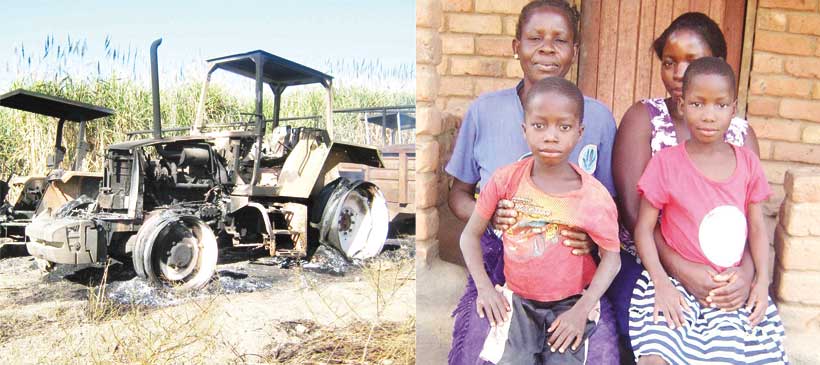
As some smallholder sugarcane out growers in Nkhotakota District continue to swim in glory after reaping the fruits of being part of a group, one scheme has left the family of the late John Phiri in tears.
As their colleagues are driving posh cars and sending children to high schools, courtesy of sugarcane cultivation, the Phiri family is not sure about what the future holds for the deceased’s two children.
It is now over 10 years since the government introduced sugar cane pivot irrigation system schemes in the northern part of Nkhotakota, with an aim of developing smallholder sugarcane farmers.
However, Phiri’s family has no kind words for the project, which has left them with permanent scars.
The Phiri family lost their influential son John, following scuffles that ensued between police and a grouping of some villagers calling itself Mkhuto, which refused to surrender land to the project.
Under the project, the government wanted to relocate those who were living and farming in the targeted areas so that it could pave the way for a pivot system of irrigation. The farmers were told that they would repossess the land.
Jaston, brother to the late John, recalls one fateful morning in November 2010 when a police officer’s live bullet hit the chest of John as the law enforcers attempted to scare away irate villagers who were against implementation of the project.
John died on the spot and left behind two children— nine-year-old Esnart and seven-year-old Ernest.
Mayiness Manda, the deceased’s wife, has fond memories of John, who she describes as a “loving husband and father”.
“John was a responsible husband who cared for his family. He made sure that his family lacked nothing and his departure has negatively affected us. I feel more sorry for the children than myself. They have to get educated but I do not know where the money will come from,” Manda says.
As she mourns her late husband, the wife can find solace in the fact that she has found a lover. As a married woman, she seeks solace in her new husband’s reassuring words and warm arms.
But what about the children, who have to live without a father?
“The children stay with me,” says Janet Banda, the children’s grandmother.
But the children are not the only ones who miss John. His brothers are still in shock.
“He was the pillar of our family after we lost our father. Why did the police shoot dead our brother?” Jaston demands an answer.
The Phiri family is one of the two families that lost their loved ones. Others sustained injuries in fights that ensued between those who were in support of, and those who were against, sugarcane irrigation system project.
Under the Green Belt Initiative, the government obtained a loan from the African Development Bank in 2004. The project was aimed at rolling out a multimillion dollar project aimed at developing land for sugar cane irrigation system schemes in traditional authorities Kanyenda and Kasitu in the district’s northern part.
But the project faced strong resistance as most villagers refused to surrender their pieces of land for project implementation. With some chiefs giving their nod to the project, even against the wishes of their subjects, the inevitable happened: Conflict.
It is this conflict that culminated in the loss of two lives, that of John and Stick Nyolosa.
But the government went on to implement the project and establish three pivot irrigation system schemes of Kazilira, Kasitu and Liwaladzi.
Dwangwa Cane Growers Trust (DCGT) acting Executive Secretary, Charles Kandiona, acknowledges that the project has not achieved its intended purpose.
“Despite some success stories registered by the project, our main challenge has been [that of ] conflicts over land ownership. Villagers were refusing to surrender their pieces of land, a development that culminated in some pieces of the targeted land not being developed.
“My hope is that, with new land laws, people will be able to lease their land, have title deeds and willingly cede it to the trust for sugarcane [cultivation] development,” Kandiona says.
In the second edition of the 2016 National Irrigation Policy and Development Strategy (NIPDS), the government, through the Ministry of Agriculture, Irrigation and Water Development, is aiming at developing the irrigation sector.
It estimates that, out of 4,078, 621 hectares, roughly104,6342 hectares have been developed for irrigation purposes, representing 25 percent of the land that has potential for farming.
“There is also need to view irrigation in the broad context of national development so that it contributes to the socio-economic advancement of the population,” reads part of the policy document.
It says the overall goal of NIPDS is to contribute to sustainable national economic growth and development through enhanced agricultural production and productivity.
But, despite putting in place sound policies, less is being done to convince farmers such as those in Nkhotakota to join sugarcane schemes— a typical case of good intentions gone bad.
Leave a Reply