
Tobacco production is a risk, farmers should no longer take seriously in Malawi. Erratic weather conditions and plummeting market prices have left the economy on a wobbly backbone. Tobacco farmers have always seen the situation change for the worse.
Meanwhile, calls are rife for farmers to substitute the leaf with other crops such as legumes that are equally profitable, and for farmers who hid the call earlier on have succeeded.
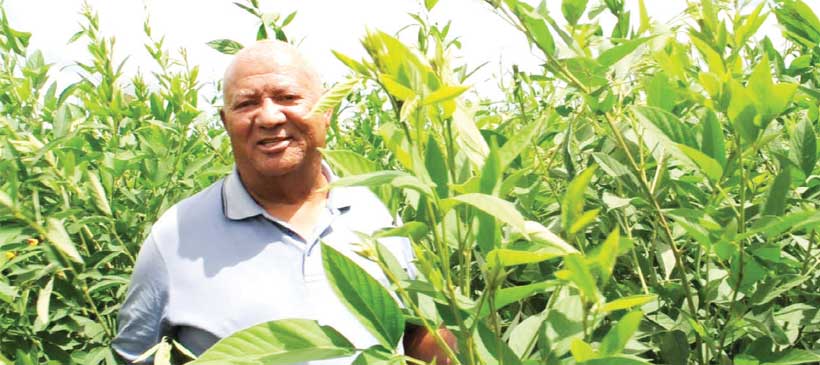
Kenneth Jameson, a former tobacco farmer from Mangochi District is one such farmer. For him pigeon peas has proved to be a perfect replacement for tobacco.
“I was a tobacco farmer for 25 years and I had to endure stress. The thing with tobacco is that it is associated with high input costs and no guarantees on output because with the current rainfall instability yields are always low,” he said.
After 14 years of pigeon pea production, Jameson, a beneficiary of the Irish Aid funded Malawi Seed Improvement and Development Project (MSIDP), which is championed by the International Crop Research Institute for Semi-Arid-Tropics (Icrisat) Malawi, has not only found a new green gold in the crop, but also an agent of development in his community.
His seven houses, which he constructed out of pigeon pea seed production, have become a solution to a housing problem for school teachers in his community.
“Decent housing is a big problem in our area. As a result, we have had an acute shortage of teachers as many were declining to teach at our primary school. After observing this problem, I used proceeds from pigeon pea production to construct these houses that are being occupied by the teachers and police officers in our area at a near-free rental fee,” he said.
MSIDP project manager Patrick Okori said: “Icrisat aims to unlock productivity as a mechanism of stimulating food security and incomes of smallholder based agriculture. To do so, Icrisat aims to address a critical gap in the economy, which is access to improved seed”.
Currently, the organisation has two other initiatives aimed at improving availability of legume seed in the country, including the Feed the Future Malawi Improved Seed Systems and Technologies (Misst) project, which is being implemented with funding from the United States Agency for Development (USaid).
While the long term goal is to enhance the availability of improved seed, especially legumes in Malawi, such project have transformed the lives of many small scale and large scale farmers like Jameson.
Edwin Kalengama, another beneficiary of Icrisat Malawi initiatives towards legume seed security in Malawi, now owns a motorbike, a good house and a number of other assets, all thanks to pigeon pea production.
Kalengama, a member of a farmers group under a McKnight Foundation funded initiative to improve availability of improved pigeon pea seed in Malawi multiplies pigeon pea seed for Icrisat Malawi under contract farming, an opportunity, which he said is a dream come true.
“Seed multiplication requires knowledge and resources that are in most cases only available to large scale farmers as a result it was always considered an opportunity for large scale farmers only. But when Icrisat came and trained us we are now seed multipliers and it pays a lot,” he said.
Meanwhile, Icrisat Malawi through the Misst project have setup thousands of demonstration field across the project’s zone of influence which includes Mchinji, Lilongwe, Dedza, Ntcheu, Balaka, Machinga and Mangochi, as well as Blantyre Rural, Chikwawa and Nsanje districts which form the secondary zones of influence. The demonstration fields have been setup as a means of increasing adoption of improved varieties and teach farmer technologies that would help improve yields.
While demand for tobacco is falling following the World Health Organisation (WHO) Framework Convention on Tobacco Control (FTCT), a treaty which aims to reduce production and marketing of tobacco related products world over, demand for pigeon pea is shooting above the roof on the world market.
There is an immerse demand for pigeon pea in India such that Malawi cannot meet its own demand for the crop despite being the world’s largest producer. Pigeon pea-based meals are fast becoming popular among the middle class Indians. Legumes have become the main raw-material for expensive and popular dishes in Indian hotels and eateries.
Malawian farmers need to accept that there is no more gold at the “tobacco mines”. Government and farmers need to shift attention to legumes such as pigeon pea, whose viability as the country’s foreign exchange earner is further emphasised by the fact that it is easy to produce. No fertiliser is required and most importantly it can stand the unstable rainfall patterns that have come with climate change.
Leave a Reply