
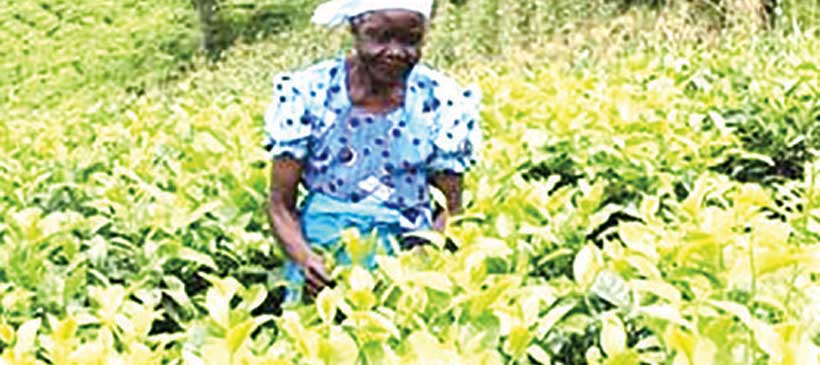
She is in her early 80s but still strong to cultivate for her survival.
Alife Gwaza is one such an admirable old woman whose life if emulated could help bring change to some quarters of our society.
Born in 1936, Gwaza has nine grandchildren from her six children.
She is a primary school dropout but a well-known farmer in Ngomani Village, Traditional Authority (TA) Thomas in Thyolo. She said ever since she was born, farming has been her life.
Even before she got married some 40 years ago, her family was into serious farming. Today, Gwaza, who, if not for her hardworking spirit, could have been a renowned street beggar but now she lives a happy life.
She owns three hectares of which one hectare has a tea plantation while the remaining two is where she grows her maize each and every year for food.
However, for the many years she has been doing her farming, Gwaza says very little was realised.
One of the biggest challenges she noted contributed to her poor yield is lack of finances to purchase farm inputs, especially fertiliser to apply on her infertile land.
Though some tea estate companies within the area offered her an opportunity to get fertiliser on credit, her income was a major threat. Gwaza could only get few bags usually one bag for Urea and NPK and split them for her tea and maize gardens.
“You can imagine that as big as the farm is but I could only afford two bags of fertiliser. This was far beyond what is recommended and no wonder I had a poor yield every year,” she says.
The many challenges Gwaza faced never weakened her hardworking spirit; she stayed focused and never allowed herself to jump into the streets.
“I feel so sorry for some people, particularly men of my age who have abandoned their fields and are busy asking for help in the streets. We need to change that altitude and teach our children and grandchildren that hardworking pays and that the only way we can develop this nation is by playing our meaningful and productive roles,” Gwaza says, emphasising that no matter how troubled she will be, but never will she stretch her hands in the street.
Malawi is an agro-based country, with most of its people being farmers. However, the country’s farming system leaves a lot to be desired as it is far away from reach.
To register success, there is a lot that needs to be done starting with the farmers themselves.
Among others, there is need for easy access and provision of farm inputs, presence of readily available markets of agricultural produce and introduction of the mechanised system of farming replacing the colonial or hoe system.
Though the Malawi government is trying to change the whole agricultural system by, among others, running the green belt initiative, introducing Farm Input Subsidy Programme that is benefiting a few poor Malawians and advocating mechanised farming through the purchase of tractors, it is just a drop in the lake.
For the first time, Gwaza expects a bumper yield this year, as she hopes to harvest over 100 bags of maize and 2,600 kg of tea all courtesy of her urine which she had harvested for almost two weeks.
She says early last year an organisation called Cooperative Enterprise Pathways for Economic and Environmental Sustainability in Malawi Project (Cepeesm) that works with cooperatives in the country organised a manure-making training which she attended by sending her child.
“I belong to Mtendere tea growers cooperative and when I heard about the training and coupled with the challenges I was facing, I did not hesitate but send my son since I could not walk. Through the training, I knew that God has answered my prayer,” she says
During the training, cooperative members were told to make organic fertiliser by mixing 10 kg of ashes, 20 kg dung and 20 kg of maize bran and five liters of water.
However, for a finished process, five kg of Urea or five litres of urine and five kg of NPK is required to be added to come up with the two different types of fertilisers.
Gwaza only had K2,600 to buy five kg of NPK but since she was supposed to make Urea fertiliser, she opted to use her urine.
“During the training, my friends were told that in case they don’t have money to purchase Urea chemical fertiliser, they can use urine (harvested in the morning) to add on the samples.
“I said to myself I am the Urea for my farm, so I had to urinate every morning until the required amounts were reached. Using the urine, I managed to make eight bags of Urea and NPK which I applied in my field,” she says.
The fertiliser which is gaining popularity and known by many as Mbeya fertiliser could be an answer to many Malawian farmers if well publicised and utilised.
According to the Department of Agriculture, organic fertiliser is regarded important as it released its nutrients slower and consistently than that of chemical and deters the likelihood of a boom-and-bust pattern.
A researcher at Chitedze Agriculture Research Station Kesbel Kaonga says by applying organic fertiliser, soil nutrients that are already on the grounds are mobilised, which wastes much less while lowering the density of nutrients.
He says organic fertilisers make the soil moisture optimal and this reduces moisture stress and benefit the crop growth and the fertiliser also prevents soil erosion.
“In Malawi, application of organic manure is done in a small scale but there are more benefits if implemented and one of them being that organic fertiliser improves soil structure,” Konga says.
Cepeesm Project Manager John Mulangeni says the aim of training farmers in manure making was to cut short of their expenses and improve harvest.
He says the project has four components and one such component is environmental sustainability and waste management where he says the manure making skills.
“We believe in empowering the poor by, among other things, providing them with skills that will bring change in their lives. As Cepeesm, we noted that many members of our cooperatives were struggling to manage their agriculture systems, particularly because they could not afford the fertiliser for their fields,” Mulangeni says.
Cepeesm is a successor project of support cooperative Malawi programme funded by the Scottish government.
National Coordinator for Malawi Federation of Cooperatives Charles Kayesa, a mother body of all cooperative unions in Malawi, commends Cepeesm for carrying out programmes that benefited cooperative members.
“I am greatly impressed with what I have seen here, Malawians can now bid farewell to chemical fertiliser. As a country, we can now save huge sums of money that were being channelled to subsidy program,” he says.
Gwaza expects to have as many bags as possible this year some of which she will sale to those in need of the fertiliser.
Leave a Reply