
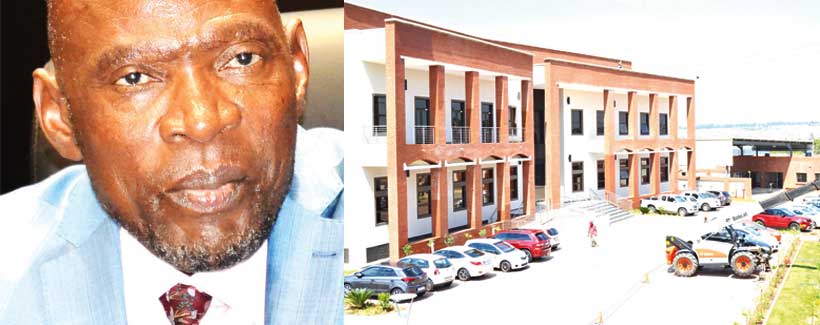
It takes one step for the ordinary to fly above the mediocre, but several miles to hit an extraordinary mark. Probably that is the path trodden by South Africa-based Malawian business mogul, Simbi Phiri.
The name has come into the limelight in Malawi after Simbi’s Khato Civils signed a $500 million (approximately K358 billion) deal with the Malawi Government to pump water from Lake Malawi to Lilongwe City.
Overnight, he turns out to be a news maker for funding local political parties, including allegations by the media in South Africa that he “attempted to smuggle” about $886 million to Botswana. The rest the courts have settled.
Fusing his business calibre with screaming headlines, coupled with social media venom spat at him, one wonders whether Phiri is a myth.
In one of those rare journalistic assignments, this reporter, accompanied by eight other local journalists, last week made it to Phiri’s South Africa hub. Mission was to zero in on the character and explore some projects he is running there.
Who is Simbi Phiri?
Clad in khaki nylon fabric shorts, with a red and dark blue stripped golf shirt and some brown sandals on his feet, the man I thought was an allegory welcomed the team to his magnificent home in Johannesburg.
I set about understanding the man, his upbringing as well as philosophy.
Simbi the rejected stone
Who is Simbi Phiri? This is an obvious question which turned out to be thought provoking.
“Ndine munthu ndithu (I am a human being),” he whispers before having a sip from his glass of wine, followed by a pause and a moment of silence. He then bursts into stitches, provoking the journalists to follow suit.
“I was born to a Malawian father and my mother is from Botswana. I am a true Malawian from Nkhoma in Lilongwe,” he says.
Born 54 years ago, Phiri recounts that he had a tough time in life. For example, upon the death of his father and mother, he was disowned by the maternal and paternal sides on the premise of customs.
“When we got back to Nkhoma from Botswana, that is when we secured land in Mchinji where I built my house,” he says.
A father of three, all male, Phiri is married to a Zimbabwean and he says he is a strong believer in tribal and racial tolerance.
Money and power
His philosophy over money may not be distinct. Like most people of his calibre, he believes that “money does not bring happiness, but what you do with it does”.
His approach and discipline towards it, however, have made him rise up the wealth ladder.
Phiri has over the years not only positioned himself as one of Africa’s construction moguls, but as an affluent and power to reckon with, too.
He has been accused of funding political parties, mainly those on the government side in all countries he is operating in.
“We have supported political parties here in South Africa but I don’t harbour political ambitions whatsoever. Let me tell you; you cannot do a project in an environment without knowing the technocrats, the politicians and the community. These are stakeholders and they are in different levels, we have to engage,” he says.
To him, there is nothing wrong with building connections, saying: “I don’t think that should be a wrong thing to do. If that should be [the case], then I should cease to live as a human being”.
Back home, Simbi has been on newspaper pages for directly funding the main opposition Malawi Congress Party as well as the ruling Democratic Progressive Party (DPP).
“I have helped the Malawi Congress Party and the DPP when they came to ask. I don’t take money on my shoulders. I always help [out] when I am asked to,” he boasts.
“What is being wealthy, really? We have some little money we have realised through hard work over the years. It is that money that we manage,” he says.
Lake Malawi – Lilongwe water project
Amid controversy rocking the multi-million dollar project to pump water from Lake Malawi to Lilongwe, his construction, engineering and infrastructure development consortium, Khato Civils and South Zambezi, have gone ahead with the first phase of the project.
Simbi says he has been engaged in designing, equipment mobilisation and site reservation works under the tutelage of its client, the Lilongwe Water Board (LWB).
According to the tender documents which we have seen, the project is expected to be implemented within the stipulated period of 730 days.
However, controversy has still clung to the deal like an unwanted piece of cloth.
“There is a clear indication [of what we have to do], according to what we know. This was a closed tender process which is legitimate and legal. Lilongwe Water Board chose closed tender because they knew which companies could do the job.
“They wanted to find competence on price, methodology and in terms of their scope layout. They laid out a scope indicating what they wanted us to do and we responded according to that,” he says.
The business has invested in two cutting-edge Tesmec Trenchers that, in a day, are able to dig two kilometre trenches for laying pipes. Each is worth about $2 million.
Media reports indicate that the project entails a steel pipeline that stretches over 130 kilometres and will have three big pump stations and three reservoirs.
What is in Bid Documents
According to the documents prepared by Office of the Director of Public Procurement, which Malawi News has seen, Sinohydro did not furnish, as part of bid document, a Bid Security on an amount not less than $1million.
They also did not provide evidence of ownership of the specific equipment specified in the bidding documents.
Mota-Engil lost it on the account that they did not provide Technical Bid and Price Bid separately and also failed to provide evidence of ownership of specific equipment.
Khato was appointed because of its 15-year experience in similar projects, and after satisfying all bid requirements.
On the issue of Environmental Impact Assessment (EIA), Phiri said engineering and infrastructure will follow already structured servitudes.
He says there are structured paths for pipelines for the project between the two districts in line with the government’s plan.
Simbi says construction of other structures, including water reservoirs may, however, require an expanded radius, hence the need to review the plan.
He said, currently, the firm is also in talks with its client, LWB, over modalities of compensating the affected communities.
Simbi’s diction, the courage and wealth amassed tells a story of one African character who has been able to fuse fortune, fate and effort for the common good.
Responding to calls for a feasibility study for the project, he says there are already structured servitudes in line with the government plan through which the project will run.
“We are currently in talks with the client, Lilongwe Water Board over modalities of compensating the affected communities.”
Personal story
Phiri went through the corridors of Nkhoma Primary School in Lilongwe before proceeding to St John Bosco Secondary School.
“I then studied some few engineering courses in Botswana,” he says without giving vivid details; “to me what matters more is the knowledge acquired than the papers offered.”
In the pursuit for greener pastures after years of toil and labour, he landed in South Africa. There, lady fortune smiled at him and he joined LET Construction Company, one of South Africa’s then biggest engineering and construction firms, which he raised to stardom in no time. In no time, he became one of the directors and shareholders.
He worked with the firm for about 15 years as he harboured the ambition of going solo, which led to the establishment of Khato Civils and South Zambezi consortium.
“The two firms have this far concentrated heavily in water and sanitation projects where I have won big government tenders within the continent,” he boasts.
Phiri says tenders the firms have been winning have ranged from R2 billion to R6 billion.
Khato Civils construction equipment alone is valued at over R3 billion.
Over the years, the firm has not only rose to be among top five construction firms in South Africa but has also made inroads into other African economies including Ghana and Botswana.
“We are also vying for a water project in Botswana worth about 6.5 billion pula and [we are] also penetrating the Ghanaian market [specialising in] water and sanitation projects,” he says.
The Botswana scam and corruption accusations
As a public character on the rise to becoming one of Africa’s business moguls to reckon with, Phiri’s movement are always on the spot check. Recent media reports accuse Phiri of attempting to siphon millions of United States Dollars from South Africa to Botswana.
“Of all crimes why money laundering?” questions Phiri in amusement. Why not drug dealing or human trafficking? I am not a thief; I have never stolen in my life.”
He says the accusations border on family feud, saying: “I was placed under investigations by the Botswana government but no charges have been laid against me”.
What he rates as insinuations and innuendoes made it into the mainstream media in both Malawi and South Africa.
“I have a dollar account in Botswana and a Euro account, it is allowed. I have saved this money for a long time. There has never been money found in my car at any point on my trips to Botswana. By the way, if money is found at the border, they confiscate and not freeze it,” he says.
He says all the money he has worked for is in his account.
Leave a Reply