
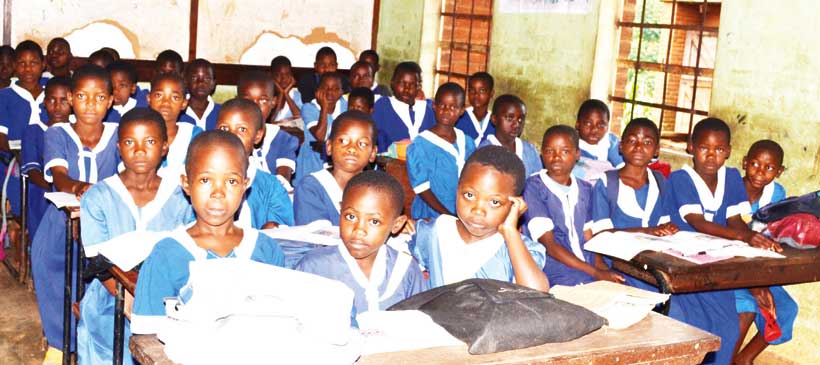
For most parents in rural areas of the country, they want to rescue young girls from early marriages but it has been a very daunting task to them.
Many point to poverty as the major reason and probably the most convenient scapegoat too.
But very often poverty just becomes another veil covering a pure act of running away from responsibilities. Apparently, many parents lack the courage and honesty to own up their mistakes of failing to provide enough for their children.
Going around many villages in Ntchisi in the Central Region, one comes across numerous tales of child brides forced into marriage.
While many girls succumb to this pressure, others find courage to wade off this threat to their life and push for possible bright future.
Nineteen-year-old Doreen Petro of Tchite Village in Traditional Authority (T/A) Kasakula is one of them. At 16, Petro was forced into an early marriage by her parents. She dropped out of school in Standard eight at Kasakula Primary school.
But one youth group came to her rescue.
“The members approached and advised me on the dangers of marrying young. They inspired me and I decided to tell my parents that I was no longer interested,” Petro says.
With support from well-wishers and partially from her parents, Petro is now a Form One student at Kasakula Secondary School.
In Chinkwasale Village in T/A Nthondo, another girl celebrates going back to school. She is 18-year-old Maness Kamtukulo.
After getting pregnant while in Standard Seven at Mtsiro Primary School in the area, Kamtukulo faced the potential threat of an early marriage. But she defied the popular expectation and managed to sail through the tidal wave of ridicule from her village folks.
“They laughed at me. Friends at school mocked me, saying that I was done. But after three years, I am the one in school while the rest of them dropped out,” she says.
Both Petro and Kamtukulo thank the community and religious groupings like youth clubs, churches and even mother groups that are working tirelessly to end this vice in their areas.
Kanola Youth Club is one of the groups bailing out young girls from early marriages in Kasakula.
“We use theatre for development and peer-to-peer interactions in informing parents and girls about the dangers of child marriages,” says 21-year-old Florence Chiputula, peer educator for the youth club.
They even go further by convincing willing girls to withdraw from marriage. Seven girls have been rescued since the initiative began in 2014, according to Chiputula.
The group’s work also looks beyond early marriages by even addressing welfare challenges of girls in their homes.
In Mitawa Village in the same area, the club rescued a 12-year-old girl from sexual abuse.
“The mother was forcing the girl to have sex with the young brother to the girl’s stepfather as a way of mentoring her how to serve a man.
“The chief summoned the mother and fined her with a goat. The girl is now living with her grandmother,” Chiputula says.
Rendering support in saving a girl-child from early marriages and other harmful practices is the church.
One intervention is by putting a break in officiating marriages involving underage couples.
“We crosscheck with our registers to establish their date of births. If they have not reached the legal age, we stop the marriage,” says Flavius Dambe of Kayoyo Anglican Church in T/A Nthondo in the same district.
Such cases are often referred to chiefs in line with the by-laws related to child marriages. One recent case was of a girl who was six months young from the legal age of 18.
“We stopped the process until such time when she is mature enough. Fortunately, they waited for the six months and now they are together,” Dambe says.
Recently, Parliament passed an amendment to the constitution that outlaws marriages involving girls below 18 years and Dambe views the church has a big role to play in ensuring that the spirit within this legal framework prevails.
The efforts by the youth groups, the church together with traditional leaders and ordinary community members in Ntchisi draw strength from capacity building they receive from the Quadria Muslim Association of Malawi (Qmam).
On behalf of the Malawian Government through the Ministry of Health, Qmam is part of a non-governmental organisations (NGOs) consortium implementing a project called Strengthening Private-Public Partnerships for Sexual and Reproductive Health Rights (SRHR) Malawi, popularly known as N’zatonse, under the lead of Population Services International.
The programme is financed by the German Government through KfW with a total volume of EUR 26.5 million (about K206 billion). The programme, launched in 2013, will continue in its current form until at least the end of 2017.
The project is currently active in Blantyre, Dedza, Likoma, Machinga, Mwanza, Mzimba, Neno, Ntcheu, Ntchisi, Thyolo, and Rumphi.
In Ntchisi, the project operates in T/As Kasakula, Chikho and Nthondo.
Monitoring, Evaluation and Learning Officer for N’zatonse at Qmam Hakeema Gulani says within the broader goal of promoting access to and use of high-quality services in SRH, N’zatonse focuses on eliminating practices that compromise SRHR of adolescents.
“Early and child marriage is one of those practices. In Ntchisi, this practice leads to early childbirths which often result in high rates of birth complications and deaths among teen mothers,” Gulani says.
N’zatonse uses a multi-pronged approach to inform people about their family planning and health options, and to provide them with access to those options.
On the one hand, the programme recruits existing health centres to participate in the Tunza brand as part of social franchising. Clinic staff receives additional training and resources, with a special emphasis on youth-friendly service delivery.
On the other hand, mobile outreach clinics and community-based distribution agents operate in areas not serviced by existing health centres and hospitals. These mobile services also pay special attention to the needs of young patients.
PSI as leader of the NGO-consortium supplements these core activities with numerous additional interventions, such as radio and social media engagement, youth clubs and community sensitisation sessions.
The project also empowers adolescents in making informed decisions and choices of when to marry or have children.
No place in the three areas is progress so evident than in Nthondo area.
Out of 133 cumulative cases of child marriages recorded between August 2014 and December 2016, 68 were dissolved, according to Kenneth Malikebu, Child Protection Officer in Nthondo under the Social Welfare Office.
Out of the 68, 12 managed to go back to school.
But it has not been plain sailing for Malikebu and his lieutenants in Nthondo. The remaining 65 cases remain unsolved.
“We attempted to separate some of them. But they got back together and run away to other places. Sadly, it was discovered that their parents had approved and even helped them elope,” Malikebu says.
But this does not dampen the positive progress made and Malikebu is hopeful and the future looks rosy as people’s mindset change for the better.
Leave a Reply