
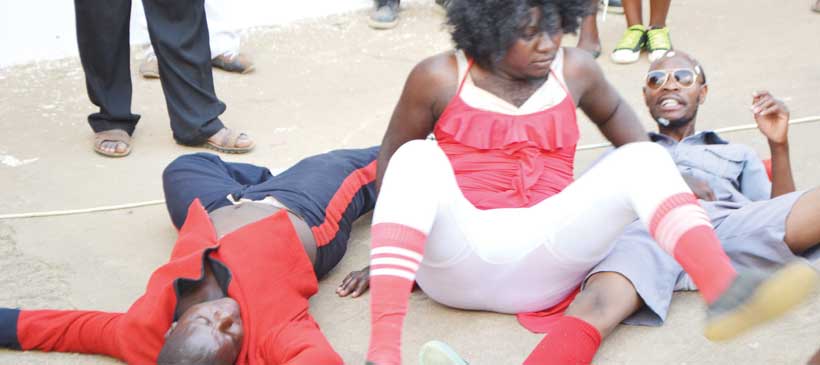
Nyasa Big Bullets Supporters Committee and their Board of Trustees have, after many twists and turns bordering on sheer comedy, agreed to disagree. At least for now.
On paper, the supporters are unhappy with the manner which the trustees want to commercialise the team they [supporters]have always claimed to own by virtue of it having been born from the community.
Bullets are expected to hold Executive Committee elections which the trustees view as the starting point for commercialisation.
To advance the commercialisation, the trustees insisted on scrapping off Treasurer and General Secretary positions and hire full-time qualified secretariat staff.
After the Lilongwe meeting, trustees General Secretary, Jim Kalua, insisted that they agreed that the only positions to be competed for were of Chairperson, Vice- Chairperson and Publicity Secretary.
“We have agreed to streamline some positions in the Executive Committee. We already recruited an administrator and, by March 1, we will also employ an accountant. Employed staff will be more dedicated than volunteers,” Kalua told The Daily Times edition of February 27 2017.
The supporters challenged the trustees’ decision saying it was made at an illegal gathering in Lilongwe.
The fans said it is only decisions from an annual general meeting that are binding.
Nyasa Manufacturing Company (NMC) reacted by suspending the K500 million sponsorship deal before the fans issued an ultimatum to the company to pay off the players’ February salaries or sever the sponsorship contract.
In the latest twist to the saga, the fans apologised to NMC during a meeting held on Wednesday afternoon at Kamuzu Stadium in Blantyre. It is a circus to say the least.
The problem is that Malawi football still runs as a pastime, with only two clubs having full time employees and the rest being administered by volunteers.
Even Super League of Malawi has very few full-time employees. The rest were elected.
Elsewhere, football has evolved through commercialization.
Teams now operate like business entities.
Football commercialisation can happen through structuring clubs as corporations, membership clubs or a mixed structure.
A corporate business approach is present at the non-membership club and an approach that focuses on building a traditional football identity at the membership club, states essay.utwente.nl.
However, commercialisation has always faced resistance from fans, an article on the website explained.
“In modern day football, commercialisation is required for clubs in order to stay financially competitive, though football fans are regularly discontented with how the cultures of their clubs are changing due to this development,” the article adds.
“The mixed club showed a midway strategy. Furthermore, it was observed that the membership club had a higher satisfaction rate among its fan base than the non-membership club. The mixed club had an intermediate fan satisfaction level.”
Back home, in the deeper scheme of things, the real issue is that Bullets fans think NMC want to eventually own the team.
Bullets, for all their massive fan base, operate like a social football team without clear legal ownership.
Records at the Ministry of Justice show that Bullets have over the years been registered under five owners including Bullets Holdings Limited and Cifu Investments.
The fans chase away every owner who does not run the team in a manner which pleases them.
As a result, Bullets remain without pillars of good governance no legal ownership and no proper structure of a professional club.
Efforts to embark on a membership registration drive have often hit a blank wall. From an estimated fan base of four million, Bullets cannot register even 1,000 fans, a finance committee report for 2015/16 indicates.
“The exercise started three months ago. So far only 191 supporters in different categories have registered,” reads in part the report which was tabled during an extraordinary general meeting on July 31, 2016 in Lilongwe.
It is for this reason that Bullets remain poor. To quote Bullets’ former general secretary, Kelvin Moyo, the team operates at a loss as the sponsorship annual allocation of K100 million from NMC and gate collections barely meet operational expenses.
Super League of Malawi (Sulom) President, Innocent Botoman, during the week said his body was disturbed by the chaos rocking the Bullets ship and called on warring factions to bury the hatchet.
“There is need to have a structure that is trusted by the sponsor,” Botoman insisted.
Stakeholders at Bullets need to bang heads and find a better way of commercialising the club. Going forward, Bullets fans and, indeed all supporters must be sensitised for them to buy into the commercialisation idea.
Going commercial is not negotiable for Malawi football. It is the only way to run a club in the 21st century.
Leave a Reply