
It takes a long and winding road to reach Group Village Head Mwangata in Traditional Authority (T/A) Somba in Blantyre.
In fact, to reach the village it takes a person at least one good hour on foot from Chadzunda Trading Centre.
What impresses me along the way is nature’s beauty of natural trees around the area despite high levels of deforestation in most areas across the country.
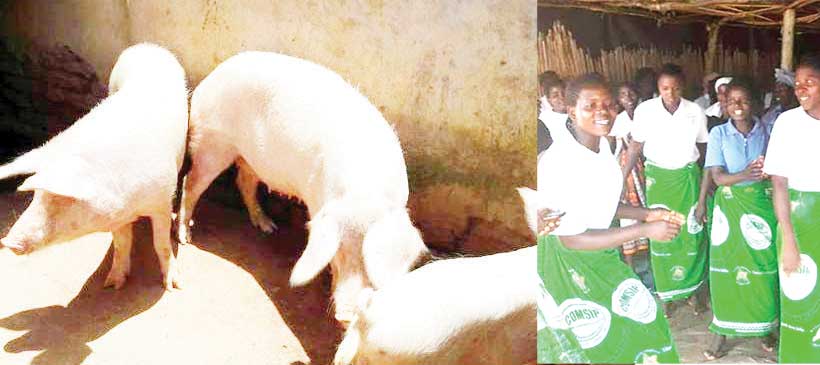
Still in wonderland, I suddenly find myself in Mwangata Village in midst of villagers clad in uniformed attire singing: “Sim’dzasiya kukhala membala wa Mtikita Cooperative, chikondi cha COMSIP x 2 (I shall not stop being a member of Mtikita Cooperative, we have witnessed the love of Comsip).”
Noting my bewilderment, one woman approaches me and narrates and testifies what the Community Savings and Investment Promotion (Comsip) programme has done to their lives through Mtikita Comsip Cooperative.
Bertha Khumula, 34, says it all began in 2010 when she was identified as one of the beneficiaries for Public Works Programme (PWP), a short-term, labour-intensive employment opportunity for poor households.
“Through the public works programme, I got money every two weeks and later was advised to form a cooperative using the money as capital together with other villagers. We came up with the name: Mtikita Comsip Cooperative,” she reflects.
“Under Mtikita, we practise pig farming and through the cooperative, I have managed to build a three-bedroom house and I also have goats and I am able to pay school fees for my Form Three child,” she boasts.
Through Mtikita Comsip Corporative, Khumula, who is a divorcee, is able to fend for herself and her family without facing any problems unlike in the past when she had problems sourcing the next meal to put on the table.
According to Khumula, her life changed when she joined Mtikita Cooperative under Comsip programme, a public works project funded by the World Bank.
Mtikita cooperative has 40 members out of which 36 are women and six are men. Its vision is to continue improving the livelihoods of rural Malawians.
Task Team Leader for Masaf 4 Project Colin Andrews hails Blantyre-based Mtikita Comsip Cooperative Society Limited for bringing socio-economic changes in the community.
Andrews, who is part of the World Bank team assigned to assess performance of the Masaf 4 Project, says they are satisfied that Comsip groups like Mtikita are improving people’s livelihoods.
The group started with K81,000 as savings but six years later the group ventured into piggery farming. The business is said to have boosted its savings to over K2.8 million. In addition, members have also established their own businesses.
“What stands out here at Mtikita is Comsip’s support of providing people with an opportunity to establish their own businesses which Comsip supports. I am impressed with the success stories from the community and the fact that more women are participating,” Andrews says.
He assures the community that the World Bank will continue to bankroll the project that started in 2014 and ends in 2019.
Director of Operations for Local Development Fund (LDF) Paul Chipeta says the Masaf 4 Project is funded to the tune of $177 million with three components: PWP, Social Cash Transfer and Livelihoods and Skills Development which is Comsip.
“I am contented to see the lives of ordinary Malawians improving through the services offered by Comsip. The work on the ground is great and, because of that, I wanted to assure the people of Malawi that Comsip shall continue to deliver as expected,” he says.
Through funding from the World Bank and under the Livelihood and Life Skill Development Programme, Comsip is implementing a number of projects which include nutrition and health, value chain addition and economic empowerment.
According to Comsip Operations Manager Susan Kondowe, there are 262 registered cooperative groups with a membership of about 128,000 in the country.
Kondowe says communities have a crucial role to play in complementing government’s efforts in rural development, saying since the organisation started organising cooperatives in rural areas, there are more people who are effectively contributing to the social economic development of the country.
Moreover, according to Kondowe, cooperatives have promoted the culture of savings and investment among the poor and have eased access to financial services.
“We have seen great improvements in the lives of people working in cooperatives as a lot of them are now economically empowered and this is the way to go as a country. We will provide all the necessary support to the cooperatives while at the same time register as many as possible,” Kondowe says.
She says the aim of the cooperatives is to uplift the lives of people like Bertha Khumula from their economic hardships.
On 25 September 2015, countries including Malawi adopted a set of United Nations goals (Sustainable Development Goals – SDGs) to end poverty, protect the planet and ensure prosperity for all as part of a new sustainable development agenda.
Each goal has specific targets to be achieved over the next 15 years.
Sustainable Development Goal 5 challenges countries to achieve gender equality and empower all women and girls like Khumula.
The SDGs seek to change the course of the 21st century, addressing key challenges such as poverty, inequality and violence against women.
Women have a critical role to play in all of the SDGs, with many targets specifically recognising women’s equality and empowerment as both the objective, and as part of the solution.
Goal 5 is known as the standalone gender goal because it is dedicated to achieving these ends.
According to the Hunger Project, empowering women to be key change agents is an essential element to achieving the end of hunger and poverty.
It is estimated that about 52 percent of the Malawi’s population is comprised of women and gender inequality is still high.
Numerous problems rural women and girls face today can be tackled if they are provided with small grants and equipped with basic business skills as evidenced by Khumula.
It is believed that if rural women and girls are empowered economically, Malawi will see a reduction in problems like early pregnancies, forced marriages and other violations against women as they stem from poverty.
Southern African Research and Documentation Centre says southern African countries have experienced rapid shifts in gender equality and women’s empowerment processes in the last decade.
The rapid shifts have been catalysed by the framework for reference provided by the Beijing Declaration and Platform for Action (BDPFA) and the 1997 Sadc Declaration on Gender and Development.
Like Khumula, women in Malawi and across the globe need to be provided with the necessary bridge like Comsip cooperatives to rescue them from the doldrums of poverty to economic empowerment.
Leave a Reply