
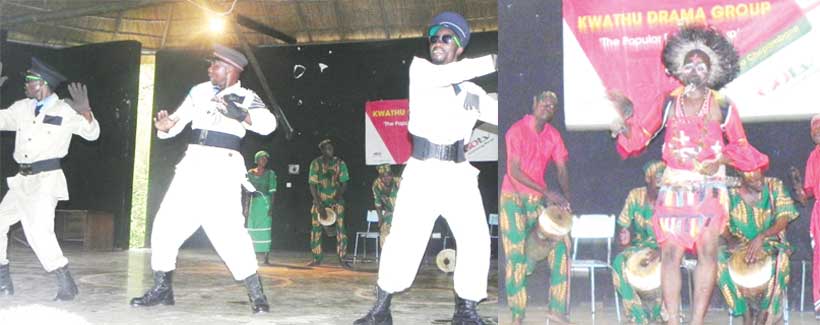
It takes very little fire to make a great deal of smoke on the traditional dances arena these days, or so Judges Dance Troupe makes it appear.
If Sunday events at the Blantyre Cultural Centre (BCC) are anything to go by, there is a place for cultural dances in Malawians’ hearts, although the space reserved for the cultural dances is not half so large as that reserved for foreign music, sports, drama, films and netball— foreign endeavours that have become so dear to the hearts of uncritical Malawians.
But on show at BCC was the fact that Judges Cultural Troupe is a tide; a tide that, having probably turned, continues to rise.
When the troupe took to BCC’s poorly-lit stage, it was the patrons’ hearts that lit more than BCC’s two incandescent bulbs. Which is strange because, in the first place, the Electricity Supply Corporation of Malawi has been replacing incandescent bulbs with LED bulbs, but a government facility cannot take the lead and still uses out-of-date bulbs.
In the second place, it was strange that the patrons warmed up to Judges Cultural Troupe’s moves when the main act was Kwathu Drama Group. The dance troupe did not take long elevate to patrons’ feelings with a sweet sensation. The troupe impressed in many ways than one, as it delivered its message through word of mouth (in terms of singing), legs (in terms of dance moves), hands. When Judges Cultural Troupe were, for example, performing Chisamba from Kasungu, it could be noted that when the dancers’ right leg turned left, the right hand turned right— which speaks volumes about the kind of drilling the dancers are subjected to.
The dancers, who were well armed with costume, offered the patrons a ‘delicacy’ of Chisamba, a dance well-known in districts such as Kasungu in the Central Region. They sung:
Ku Kasungu kuli mtengo
Mtengo wa Kachere
Bwera
Bwera udzawone...
This is where one needs to be well-versed with traditional dances performed in different parts of the country. For, without that background, it is impossible to realise that Judges Cultural Troupe was singing about Malawi’s first president, Ngwazi Dr. Hastings Kamuzu Banda.
There is a tree in Kasungu, a tree that once served as a ‘classroom’ for the Ngwazi. That tree is a metaphor for a humble beginning; a beginning from which the Ngwazi created greatness.
From that tree [which is in Mtunthama], the Ngwazi went on an academic journey that took him to university; a journey whose PHD-stage earned the Ngwazi the title of doctor.
Judges Cultural Troupe leaders must have studied widely to express such a history in so little words. In so doing, they proved that song and dance can be used as vehicles of messages. Songs and dance are a transmission belt; passing historical information stored by the old generation through [dance and song] to the new generation.
Oh, how Judges Dance Troupe travels through dance and song! From Kasungu and other Chisamba-addicted districts, it was the turn of Ngaliba dance, a dance common among the Yao on Malawi.
When boys and girls go for initiation, a Ngaliba [male counsellor] or Nankungwi (in case of girls) is entrusted with the task of mending the winding ways of those undergoing initiation, getting them ready for the responsibilities of adulthood.
At the end of the song, a Ngaliba from the dance troupe even imitated the act of grabbing a child from among the patrons. This is what the Ngalibas do in the village, after ‘conniving’ with parents of a child who has to be initiated.
Likwata, a dance common in Zomba and other Southern Region Districts, was soon thrown into the picture too.
In Zomba, Chiradzulu, Phalombe, Mulanje, Thyolo, Likwata is like a water: loved or hated, but not despised.
Just like Mganda, which depends on a batcha (big drum), not many people can escape its allure.
However, Mganda has, over the years, become ‘corrupted’ as some Central Region dancers do it their own way, others going as far as incorporating Malipenga aspects into it.
But Judges Cultural Troupe gave the patrons Mganda the Blantyre-way. Which, in other words, means Blantyre has concocted its own version of Mganda and, in so doing, put at risk a legacy that has spanned centuries. Beni had its turn on the BCC stage, too.
Beni is a dance invented by those who fought in the World Wars. The dancers’ costume imitates that of soldiers, replete with a law-enforcement-like cap. It is common in Mangochi and Machinga.
Kazukuta is another dance Judges Cultural Troupe has perfected. In Kasungu, women sing such songs as:
Kuyenda usiku ndaleka ine
Kuyenda usiku ndaleka ine
Ndaona
It was nice seeing parents, who had children in tow, clapping hands to the dance moves.
Tradition is coming back into the national psyche.
Dance troupes in Malawi
Malawi has a dance troupe, Kwacha, but dependence on funding from the government means the group’s outings are rare. This has created a gap which other dance troupes are exploiting.
It must have been after observing this gap that some Malawians, having studied the music scene for years, launched dance troupes full of the high hopes of success.
However, an ailing economy has meant some dance troupes have foundered, or merely hibernated, on their voyage.
That said, the wreck of others, most notably Judges Cultural Troupe, Chichiri Village Cultural Troupe and Dygo from Blantyre, continue to float and entertain people with moves only Malawi can offer.
And, according to Dygo Dance Troupe consultant, Dyson Gonthi, coming up with dance moves is not like writing a story hastily,.
Those who set out for the dancing arena with no thought beyond the few Kwacha the dances might bring are bound to fail, Gonthi enthuses.
“To begin with, an individual needs to immerse oneself in knowledge about cultural dances from different parts of the country. This includes understanding the costume, too. For example, you cannot talk of Gulewamkulu [mask dance] and think of a decent attire or suit. That is contrary to the concept of Gulewamkulu, which is something that stays and lives in the bush.
“But, knowing that it is impossible for one individual to know everything, a dance troupe needs to have someone from the area the dance is celebrated. For example, if we are talking of Malipenga, one needs to find someone from Nkhata-Bay of Nkhota-kota, someone who understands the dance, and all is set for a performance,” Gonthi said.
However, according to Gonthi, dance troupes have not been sailing with a fair wind, a challenge he attributes to economic woes.
“For example, we [Dygo Dance Group] have only had three outings this year. We were engaged when the government was dealing with the issue of land bills, and at an international meeting in Blantyre, among the three outings we had. Otherwise, economic problems have meant we have not been as active,” Gonthi said.
Dances, cultural troupes
Cultural troupes have become the in-thing. For example, Cambodian Cultural Dance Troupe is not a new name in the United States of America. Savary Dean fled war-torn Cambodia in the late 1970s, and formed the Cambodian Cultural Dance Troupe at the age of 56. It has been playing in the US ever since.
In addition, India has its own dance troupes, most notably the traditional dance troupe, MoruSapera Dance. The group visited Malawi in May 2014, while on its way to the Harare International Festival Arts (HIFA).
According to Ivy Roberts, a Doctoral student at Virginia Commonwealth University studying media studies and cultural history, “dance is a form of art, a language, and an evolving cultural expression”.
She indicates that there are two dominant types of traditional dances.
“Two of the oldest forms of dance that exist in many cultures are the circle dance and line dance. These two simple formations date back to the earliest times when people started forming together into social groups. Circle and line dances evolved over the centuries, taking on different functions in cultures across the world as they developed.
“Circle dancing was most widespread in Eastern and Central Europe. In the hora, from the Greek for ‘dance,’ for example, dancers hold each other’s hands while spinning in a circle. It has been a traditional dance during weddings and festivals in Romania and Moldova for centuries.
“Line dances are also commonly found in traditional societies of Europe and the Middle East. Ireland, for example, shows some of the oldest and most elaborately developed dance and music folk culture. Step dancing is a traditional and ancient Irish custom. Dancers maintain a stiff upper body while performing quick movements of the legs and feet. Linked to Irish folk culture through legends and myth, it evolved over the centuries to become a popular and recognizable icon of Celtic culture,” Ivy writes on www.study.com.
Leave a Reply