
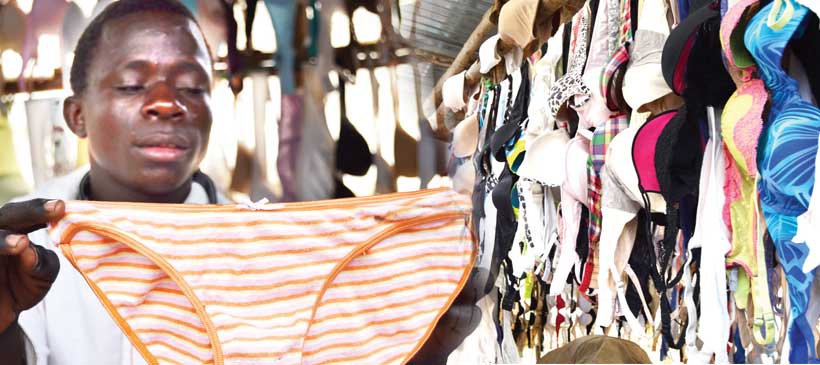
When it comes to underwear, every so often it requires some daring, conviction and affection for one to lay a hand on another person’s used one.
A mere feeling that it has been already used by someone makes it imaginary stained.
A snap check, however, in almost all the markets of Malawi shows that one commodity is vividly common – second-hand clothes with used underwear part of the constituent.
Known as kafa ulaya, literally meaning clothes of the dead whites, in Nigeria and roupa da calamidade, for clothing of the calamity in Mozambique, the clothes stormed African Markets as early as 1970’s.
In Malawi, they are commonly known as kaunjika, which connotes clothes placed in a heap.
They are clothes worn in developed countries, especially those from North America and Europe, and China but donated by their first owners to charity shops who eventually sell them to mostly African countries.
I visited one of the biggest markets in southern Malawi, Limbe in Blantyre and spotted all sorts of second-hand clothes such as jackets, pairs of trousers, shirts, T-shirts, pairs of socks and so forth.
And, yes, underwear – underpants and bras – are there.
But do people really wear second-hand underwear?
I trained my eyes on a man who was busy rummaging through a pile of used boxer shorts, probably looking for the best.
And I got the answer: People do really wear used underwear.
So I pushed myself through a crowd of consumers and got hold of him. As I persuaded to take his picture, I asked him: “Do you really feel comfortable wearing underwear that was once used by a person you have no idea of?”
“Firstly, my name is Kingsley Dandaula (not a police officer), of course, I have no problem buying underwear from a second-hand market. Reasons are that they are cheap and durable as compared to those one can buy from a shop. Secondly, I believe once the underwear is washed, you are safe and be assured of uniqueness,” with a broad smile, Dandaula says.
According to the consumers I had a chat with, the minimum price for used underwear (ladies’ or men’s) is K200 (US$0.3).
Making rounds in some Blantyre City shops, on average, new underwear for a grown-up is pegged at K800 ($1.1).
A World Bank report of 2015 testifies that poverty levels in Malawi remain high.
About 54 percent of the population lives below the poverty line of less than US$1.90 (K1,350) a day.
The 2010/11 Integrated Household Survey (HIS) revealed that 24.5 percent of then population of 14 million were leaving in ultra-poverty a condition of extreme deprivation of human needs.
Rural populations had been the worst hit as rural ultra-poverty levels stood at 28.1 percent compared to urban ultra-poverty levels at 4.3 percent in the period of the survey.
So it explains why majority are flocking to used underwear.
A seasoned second-hand clothes vendor, Ellen Hau, gives a real insight into used underwear business.
Hau says her venturing into selling used underwear was a result of a small survey on second-hand clothes that are making a killing on the market.
“I have been in the second-hand clothes business since 1987. I used to sell T-shirts and assorted clothes for under-five children. Lately, there has been an influx of the merchandise on the market, so I had to identify clothes that aren’t common, hence my selling used underwear and boxer shorts,” she says.
Although most of the vendors I talked to concur with her and speak highly of the trade, Hau rues the coming in of several players into the business as well as the intrusion of the Chinese into clothes business in Africa.
But, health-wise, how safe are people wearing used underwear?
Professor of Epidemiology and Public Health at the University of Malawi’s College of Medicine, Adamson Muula, says it is unethical to wear underwear that was once used by another person but assures of safety.
“There are few diseases that may occur, and these are skin diseases that can happen, often caused by a fungus. But even then, if you wash the clothes and iron them and the hygiene is good, it is very unlikely that a person can catch diseases by wearing second-hand underwear.
“Still on the same, it’s just that we are culturally and socially built with the mindset that a person should use their own underwear, and once you are done with it, it should not be given to anybody. It is for this reason that we should be concerned but health-wise, they may not be a problem if washed and ironed,” he says.
Perhaps it is high time you also got yours from a second-hand market just as I did at Limbe Market.
Leave a Reply