
Imagine a world full of illiterate citizens. A world filled with illiterate heads of state, Members of Parliament, ministers and all those key positions you can think of.
How would it be like? If it is difficult for you to imagine at universal or national level, narrow it down to an individual. Imagine you were illiterate or less literate, unable to read this article, unable to read newspapers, books, Facebook posts, tweets; unable to read and write SMS and WhatsApp messages; unable to calculate your monthly wages, bills, expenses and so on. Would you enjoy it? I guess not.
If you were able to imagine, you must be literate. You are able to read and write. You are able to add up numbers. For most Malawians however, what you imagined is their state of being. They cannot ably read or write, let alone calculate.
Illiteracy and low literacy is costly to both an individual and the society in which the individual lives. The consequences of illiteracy are many and harmful in several respects. As well as affecting the illiterate individuals themselves in their daily lives and often jeopardising their future, this scourge has a significant effect on society, both socially and economically.
According to Literacy Foundation – Words of Hope, the consequences of illiteracy on individuals and society include limited ability to obtain and understand essential information, lower income, lower-quality jobs, reduced access to life-long learning and professional development, precarious financial position, little value is given to education and reading within the family and this often leads to intergenerational transmission of illiteracy, low self-esteem, which can lead to lack of confidence, and negative impact on health among others.
Without the basic tools necessary for achieving their goals, individuals without an adequate level of literacy cannot be involved fully and on a completely equal basis in social and economical development.
If Malawi could count the cost of illiteracy, it should be much higher than you can imagine. If we were to narrow it down to economic loss resulting from illiteracy and low literacy levels, Malawi has lost a lot more. Being an agricultural-based economy, Malawi’s 30 percent of the gross domestic product (GDP) comes from agriculture. Smallholder farmers command 70 percent out of the 30.
With national illiteracy rate pegged at 38 percent, it is common knowledge that a majority of them are smallholder farmers as illiteracy is more prevalent in rural areas. Illiteracy is higher for women (56%) than men according to a 2004 Data for rural literacy by National Statistical Office. Illiteracy makes it difficult for smallholder farmers to fully adopt and implement all the necessary good agricultural practices for them to realise potential yields per hectare. Knowledge gap makes it difficult for most of them to appreciate the value of using certified seed, using organic manure, adopting climate smart agriculture technologies, and so many other important technologies and activities for increased productivity. As a result, they yield way below the potential yield per hectare.
Due to limited knowledge, even investments in programmes like Farm Input Subsidy Programme (Fisp) have brought in so little return on investment as the knowledge gap prevents most beneficiaries from properly utilising the provided inputs. Some do not follow the recommended plant spacing and plant population; as such, the inputs like fertiliser and seed are not properly utilised.
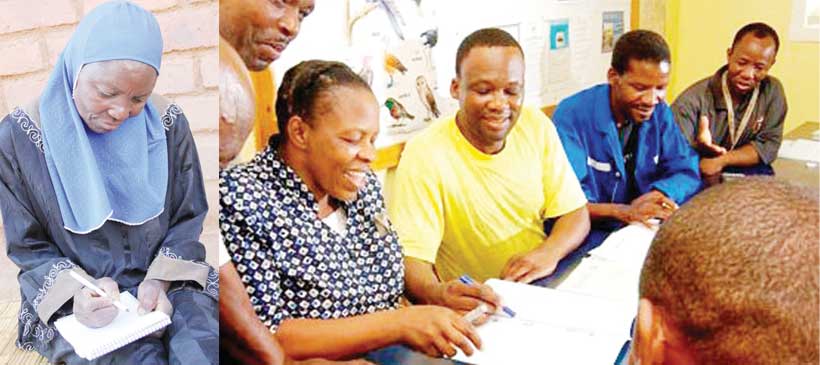
Realising that this challenge has devastating effects on individuals, families, communities as well as the nation, National Smallholder Farmers’ Association of Malawi (Nasfam) embarked on an adult literacy programme where its 164,000-plus members have an opportunity to learn basic literacy and numeracy skills for advancement of their farming business as one way of improving their livelihood.
“It was in 2003 when we decided to embark on adult literacy programme across Malawi in 19 districts. We noticed a gap in knowledge transfer during our farming business training sessions as well as extension service. Low literacy levels was the barring factor and leaving it unaddressed meant failure for other key components in our service delivery,” says Elles Kwanjana, Head of Capacity Building and Community Development Programme at Nasfam.
“To this day, we have trained more than 37,000 smallholder farmers, mostly women in all the three regions of Malawi. So far, we are happy with the fruits of the programme.”
This year, Nasfam has graduated over 1,800 students from Thyolo, Mulanje and Phalombe. Kwanjana attributes the success that most smallholder farmers are experiencing today to the adult literacy programme which has been made possible with funding from the Egmont Trust in the United Kingdom (UK) as well as the Government of Norway through the Norwegian Embassy in Malawi.
She says the knowledge attained has helped most smallholder farmers come to terms with modern farming technologies, which was difficult before, resulting in improved yields.
To conquer with Kwanjana, David Ali, Assistant District Agriculture Development Officer for Phalombe, says Phalombe is one of the districts where his office has encountered challenges in information transfer as most people did not go far with their primary school education.
Ali says: “We have had difficulties working with most farmers on technology transfer because most of them have literacy challenges. But now that gap is narrowing as Nasfam continues to provide adult literacy lessons in the district.”
He adds that “literacy helps farmers calculate the required inputs, plant spacing, the expected yields, price setting and ability to account for household expenditures.”
Adding on the impact of knowledge on agriculture, Kwanjana says: “As Nasfam, we promote farming as a business. We want farmers to take all the necessary steps in production for them to achieve both increased quantities and quality. These two are key to increased income and food security at household level. With enhanced understanding, today our members are able to adopt new farming technologies with less difficulty.”
Kwanjana says the numeracy skills they teach the farmers have also liberated them from exploitation by merciless traders.
“Those that have gone through the literacy lessons now know the exact weight of their produce – they are able to read the scale. They also know prevailing market prices. This has given them the bargaining power. The knowledge also helps them plan for their farming business as they are taught on how to develop a basic farming business plan.”
One of the beneficiaries of adult literacy is Jennifer Mamboya, a smallholder farmer from Nkhotakota.
Born in 1963, Mamboya never attended formal education. It was a difficult period for her until 2013 when she registered for adult literacy lessons implemented by Nasfam in the area.
“I could attend farming business trainings but never understood the content. I could not comprehend the required plant spacing let alone drawing a basic business plan for my farming business. These things were difficult to comprehend until I began literacy and numeracy lessons organised by Nasfam,” Mamboya says.
So what has changed in Mamboya’s life to this day?
“Adult literacy has empowered my life. I am now producing more from my farming business. In addition, I am able to negotiate better prices for my produce. As a result, it has also become easier to feed, clothe and pay school fees for my seven children,” she says.
Apart from the farming business aspect, the literacy programme has also helped learners to effectively and actively participate in other social activities within their communities.
“The literacy programmes provide room for self-awareness. We could see each participant becoming more active in their communities. The knowledge they attained made them more confident such that most of them are now community and farmer leaders in their various districts. With the programme, more women have been empowered to participate meaningfully in farming business and farmer groups leadership roles,” Kwanjana says.
What if such efforts were duplicated and intensified? Would it make smallholder farmers contribute more to the national GDP? Would it make them more resilient to climate change shocks? Would it make national investments like Fisp more profitable?
Maybe all these are just probabilities but one certain thing is that it would make Malawi a more literate nation well placed for social and economic advancement.
Leave a Reply