
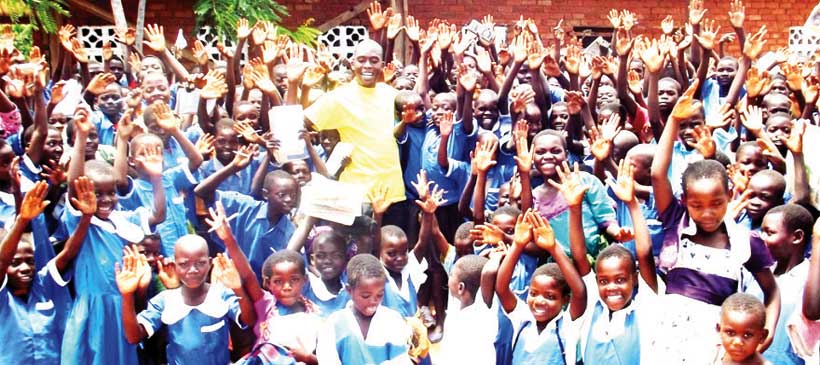
The future of the school feeding programmes hangs in the balance as the Ministry of Education, Science and Technology continues to rely on donor support for the programme and has so far failed to upscale it as per presidential directive of 2007.
A 2015 / 16 report titled ‘Piloting a sustainable model for home grown school meals in Malawi’ by the Foundation for Irrigation and Sustainable Development (FISD) says apart from not meeting that presidential directive, the programme risks derailing as the government keeps banking on donors for its sustainability.
“A significant challenge to these programmes is that they are externally funded and start and stop based on whether there is donor funding,” reads the report in part.
Statistics at the ministry indicate that so far the programme has benefited 2,308 schools out of 5,600 public primary schools, reaching a total of 2, 236, 000 learners thus far.
Currently, the World Food Programme, Seibo Maria, DFID and Mary’s Meals are some of the organisations running the programme in the country’s schools.
Last year, the World Food Programme which currently is running the programme in 715 schools across 13 most food insecure districts in the country aiding over 842,000 primary and pre-primary learners was faced with uncertainty as it struggled to raise up to US$5.2 million required to maintain the programme from November and March 2016.
Education Secretary for the Livingstonia Synod of the CCAP Timothy Nyasulu said continued donor dependence for the programme is disastrous.
He said government needs to show commitment and invest in the programme as that it is its responsibility.
He said failure of the programme would expose more learners in schools to hunger and would aggravate drop outs and early pregnancies among girls.
“How long can we depend on donors on food? How do you expect someone outside to feed children in your own house? It’s high time we had local initiatives to support such programmes,” he said, urging the ministry to put in place deliberate measures to fund the programme.
Government insists however that it is working on increasing the number of schools where the programme is implemented, according to Albert Saka, Chief Education Officer in the ministry’s School Health, Nutrition and HIV and Aids Department.
Saka was speaking at the launch of a Seibo Maria-funded school feeding programme at Kabuku Primary School in Mzimba. The programme is set to reach out to 12 schools in the district.
And while admitting failure in its quest to roll out the programme to all primary schools in the country, spokesperson for the Ministry of Education Manfred Ndovi blamed the situation on funding woes the ministry is facing.
He disclosed that the ministry’s allocation to the programme has even dwindled over the years from K 200 million per year that used to be allocated for the purpose.
“For the schools that are benefiting from the programme tremendous strides have been registered in terms of reduction in the dropout rate and absenteeism among learners but financial hiccups have derailed our plan to roll out the programme to more schools,” he said.
Asked whether the programme is sustainable with the donor funding it is currently running on, Ndovi said the ministry is making efforts to ensure that communities around beneficiary schools take over supply of food materials to keep the programme going
Leave a Reply