
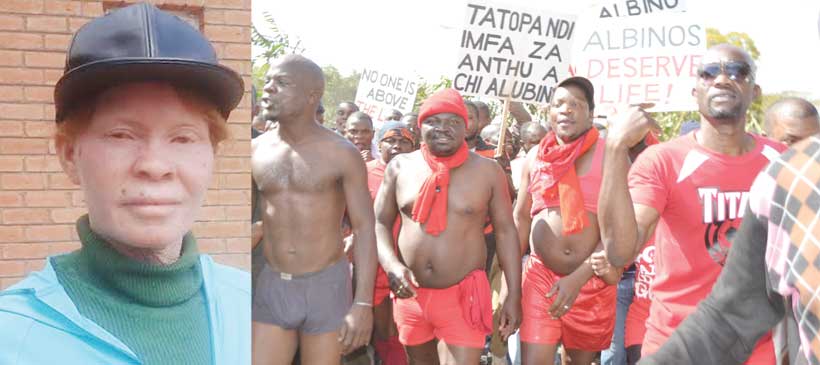
Metaphorically, darkness is mostly associated with evil.
To Stafelo Mvula, the metaphor has become reality.
The 34-year-old woman with albinism and employee of Mzuzu University (Mzuni) says, with a steep upsurge in killings and abductions of people with albinism in the country, she considers the night the scariest part of every day she lives.
“Unknown people knock on my door at night and that scares me. I ignore them thinking that if they are indeed serious, they will show up the following morning but they never do,” Mvula says.
The mother of three, who lives in Area One B in Mzuzu, was part of a march Mzuni students organised on June 22 against attacks of people with albinism.
Amnesty International (AI) in the report We are Not Animals to be Hunted or Sold says Malawi has experienced a sharp increase in human rights abuses against people with albinism including abductions, killings and grave robberies by individuals and criminal gangs since November 2014.
At least 18 people were killed and five abducted and are still missing, says the report.
People with albinism are being targeted for their body parts, due to the belief that the parts have magical powers that bring good luck.
However, recently in the National Assembly in Lilongwe Minister of Justice and Constitutional Affairs Samuel Tembenu, when he tabled the just passed Penal Code (Amendment) Bill that aims to stop the maiming, killing and abduction of people with albinism, chided the leading global human watchdog over the report, saying the remarks in the report were made out of ignorance.
Mvula, born to a family of seven, three of which are people with albinisms, was the only person with albinism among close to a thousand Mzuni learners who recently organised a march against lack of personal security of people with albinism and flimsy steps that government is taking in taming the killings of this vulnerable group.
In their two-paged petitioned to President Peter Mutharika and Parliament, the students, among others, asked if government would considerer arming albinos with guns for personal security.
Mvula agrees and says it is not a secret that persons with albinism do not have sufficient self-defence such that she U-turned from her ambition of indulging in any form of business apart from her work.
She says every activity that would make her go home after 5pm is objectionable to her and it goes against her decision to never arrive at home in the dark.
Even her employer, she says, allows her to knock off in a time so that she reaches home before it gets dark.
“I always rush back home after work and wait for my fate in the presence of my children. I made it a point that if I am a target for the killings, then it would better be while I am with my family and not anywhere else.
“People with albinism lack personal security. They cannot do any form of business and positively contribute to the development of the country because of the prevailing killings,” she says.
Mvula says the fear of being killed spills over to during day, particularly on her way to work.
She says the about five-kilometre journey she treks on every working day in the morning to Mzuni triggers fear considering unknown thoughts people ahead and behind her may harbour.
“I am always very watchful of who is ahead and behind me. Mornings are unlike evenings since it is hard to travel in groups on my way to work,” she says.
Mvula says though police have taken steps to offer protection through a gathering of persons with albinism that regularly meets in Mzuzu, they have failed to protect the victims.
She, however, is sceptical about the option to equip people with albinism with guns.
“I would prefer someone guarding me and not handling the gun myself because I can’t. Nights are always a nightmare to me and having someone guarding me would offer solace in this case,” says Mvula, who takes care of her sister who also lives with albinism.
AI, in the report published in June this year, says although senior government officials, including Mutharika, have publicly condemned the attacks against people with albinism and announced a number of measures, the measures have failed to stop the violence.
“Offer effective protections for people with albinism. Protect their right to life and right to personal security, in accordance with Malawi’s international human rights obligations and commitments. Resource the police to adequately and investigate crimes related to albinism and bring to justice the perpetrators of albinism-related crimes,” reads in part the report AI submitted to the President.
But Mzuni Students Representative Council President Wazamazama Kataku says Mutharika should ensure that people with albinism legitimately own guns they can use in self-defence in case of any attacks.
He says the Mutharika administration should stop addressing symptoms of what he describes as a crisis.
“In any form of business situation, supply goes with demand. We need to identify where demand is and who is propelling the market. This problem is rapidly and steadily taking away the recognition of Warm Heart of Africa that our country used to enjoy internationally.
“Malawi Police Service is failing to use its professional duty of maintaining law and order in this country in the case of people with albinism. Government should consider bringing in soldiers to control the attacks,” Katatu says.
Church of Central Africa Presbyterian (CCAP) Livingstonia Synod’s Church and Society Project Manager for Local Governance Project Kolezi Phiri says the measures that the country will be putting in place on the matter should respect the country’s fundamental rights.
“There have been calls for death sentence for those involved in the brutal acts but that is wrong considering that one of the fundamental principles in the country’s supreme law is the right to life for everybody. The fact that one has violated the rights over persons with albinism should not blur us from the very principles that govern us.
“I am not saying these people [perpetrators] should not be punished but our actions should respect the principles that govern the country,” Phiri says.
Ironically, Mvula believes death sentence is the only means to end the killings.
“Though there are rights to life for everyone, I don’t think it is OK to let a killer live. I feel it is only in the people with albinism killings that issues of rights are arising. A death sentence would end the vice once and for all,” Mvula says.
Democratic Progressive Party parliamentarian for Mulanje South and comedian Bon Kalindo, popularly known by his stage name Winiko, recently staged ‘naked’ demonstrations in Lilongwe to push for enactment of stiffer penalties such as death sentence for perpetrators of abuse and discrimination against people with albinism.
The Federation of Disability Organisations in Malawi Programmes Assistant Mtendere Malemia calls on government to declare gruesome killings and abductions of people with albinism a national crisis.
“When people are losing lives, it is something serious and this, to us, calls for total protection and unrelenting support for all persons with albinism.
“The situation constitutes a national crisis declaration considering its escalation but as a disability organisation body in Malawi, we cannot condone killings on top of other killings. That will be in total violation of our own rights,” Malemia says.
Livingstonia Synod’s Church and Society Executive Director Moses Mkandawire expresses reservations on arming people with albinism with guns, noting it has the potential of compromising the country’s peace.
According to Association of People with Albinism in Malawi, the country has a population of about 7,000 to 10,000 people living with albinism.
Leave a Reply