
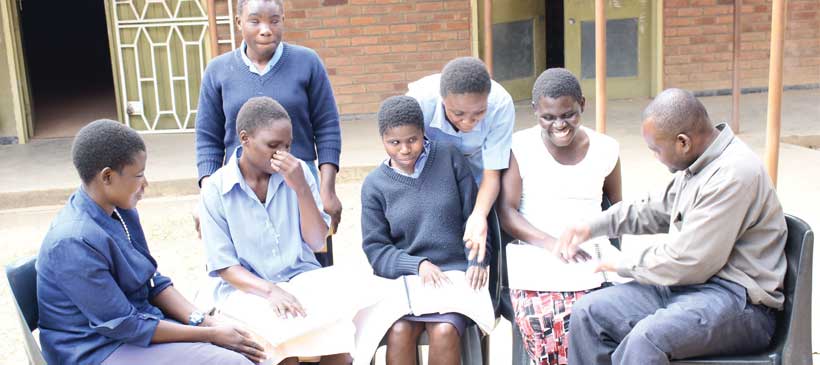
All is well that ends well! An old adage that inspires Mercy Phiri, a visually impaired student at Lilongwe Girls Secondary School, who was recently among 219 graduating students, says.
Perhaps it kept ringing in her as she received her academic testimonial on June11, 2016.
In an educational system characterised by myriad challenges, especially to the physically challenged, Mercy says it is a dream come true to finish four years in secondary school.
“Reaching this far, it is a memorable time that will go a long way in my life, it is a dream come true and it took hard work and perseverance to come this far,” Mercy says.
Mercy’s educational journey started in 2005 when she enrolled at Chilanga Integrated Primary School then Chilanga School for the Blind in Kasungu.
She says adjusting to the school programmes was not easy as most of the classmates did not understand her and felt she is different from them leading to discrimination at times.
However, strong will to learn helped her settle quickly. Her parents and teachers played an important role as well.
Having learnt for a term in Standard Three, she was promoted to Standard Four due to her outstanding performance.
In 2011, she sat for Primary School Leaving Certificate of Education (PSLCE) examinations while in Standard Seven and was selected to Lilongwe Girls Secondary School.
“Throughout my primary school education, I was in the same class with regular learners and most of the activities favoured regular learners but I worked hard with other students that were physically challenged,” Mercy says.
Mary Pezengu, Mercy’s classmate, says excelling in an inclusive education (IE) system is not easy as visually impaired learners wait to be dictated what is written on the chalkboard for them to type.
Mary observes that some teachers draw diagrams on the chalkboard without proper explanation, thereby leaving out the visually impaired.
“Use of pronouns such as ‘this’ and ‘that’ as if we were able to see makes our learning very difficult, much as diagrams are transformed and we are allocated more time when taking examinations,” Mary says.
Like Chilanga Integrated Primary School, Lilongwe Girls, a national government secondary school, is implementing the Ministry of Education, Science and Technology policy of IE that promotes learning of the physically challenged together with regular learners.
The school yearly enrolls special needs students and in 2015-2016 academic year, it enrolled 14 with visual impairment, hearing impairment and learning difficulties.
According to the school’s Deputy Head teacher Ireen Ngozo, a lot needs to be done to effectively deliver and support special needs students that have diverse challenges.
Ngozo explains that the students require special teaching and learning materials such as braille paper and embosser for the visually impaired while the hearing impaired use hearing aids that are very expensive and the school cannot provide.
The resource centre at the school that has five trained special needs teachers heavily relies on donations from well-wishers to operate.
“As a school, we are trying our best to support them by encouraging teachers to help them outside normal class time and we also urge their peers to help them when they need assistance,” Ngozo says.
She says, in most schools, the infrastructure is disability-unfriendly as initial designs did not take into consideration the physically challenged.
The deputy head teacher says though communication is a prerequisite in the teaching and learning process, most teachers lack knowledge on how to communicate with special needs students.
Des p i t e the school organising in-service training for all teachers in learning how to handle learners of diverse learning abilities, the challenges continue as such exercises are infrequent due to resource constraints.
Sinkanako Banda, a history and Bible knowledge teacher who teaches in an inclusive class and is visually impaired himself, says the country is yet to get to IE.
“What we are doing in our schools is what I call integrated education, there are a lot of problems that impede learning among the physically challenged, hence not fit to be called inclusive education,” Banda says.
Banda, who has gone against all odds in IE to attain a Bachelor’s degree in Education from the University of Malawi’s Chancellor College, says the country’s educational system is survival-of-the-fittest.
“A new curriculum was introduced in secondary schools in this academic year, yet no single braille material has been produced to help in the teaching and learning process of the visually impaired, that is a joke,” Banda says.
He emphasises that IE demands that teachers use teaching, learning and assessment methods that are responsive to the needs of all learners in the classroom.
In Form One, there are four students that have hearing impairment and the school has only one sign language teacher who stands in front with a subject teacher communicating with the students in the course of a lesson.
Sign language teacher Annie Kabuluzi says a lot of resources need to be channelled in IE programmes to help the special needs learners.
Kabuluzi says the teaching and learning materials that are in most learning institutions are obsolete such that do not accommodate special needs students nowadays
“All teachers should have the basics of special needs students so that they can easily assist them during the delivery of classroom work. For instance, in sign language, we do not use verbs and due to lack of knowledge, they mark them wrong during national examinations,” Kabuluzi says.
She adds that it is time the school curriculum were reviewed in a way that it will reflect what is in a society in which it is going to be used.
Another specialist teacher in visual impairment Feston Kamwaza is optimistic that with passage of time and enough support, IE is the best way to improve socialisation within the teaching and learning environment.
“Inclusive education bridges the gap between physically challenged and regular students that is deep-rooted in most communities as both sides learn social dynamics,” Kamwaza says.
He says work done by special needs students can effectively be handled by specialist teachers who understand the language so that there is fairness in awarding marks.
Mathematics teacher Grace Kalolo agrees with Kamwaza that teaching the visually impaired and those with hearing impairment is not easy.
“Mathematics has no notes and to make special needs students follow calculations, we take a lot of effort in the absence of specialised training,” Kalolo laments.
She says there are some students that have potential to do very well but because the teachers do not know how to help them, their abilities are put to waste.
Realising that government alone cannot address challenges in the provision of quality education to all, some non-governmental organisations have partnered with government to reduce problems facing IE.
Save the Children Malawi is implementing a project aimed at alleviating challenges besetting IE by training special needs teachers in IE and case management in a diverse classroom setting.
The project that started in August 2015 is on a pilot phase in Mangochi with 119 schools, Lilongwe Urban in 13 schools and Mzimba South in 121 schools.
Through the initiative, user-friendly toilets are constructed to accommodate different physical challenges.
Plan Malawi through “Because am a Girl” campaign has rolled out activities that are helping girls remain in school and the physically challenged are at the heart of it.
Wheelchairs, school uniforms and teaching and learning materials have been distributed in some areas in the country apart from using role models during the campaign to motivate the girls.
Within the international human rights discourse, girls are assigned their rights by virtue of being women or children through the Convention to Eliminate all Forms of Discrimination against Women (Cedaw) and the Convention on the Rights of the Child (CRS).
Under CRS, three of the four main categories of rights that are most relevant to adolescent girls are rights to protection, development through education and participation.
Unless the multitude of challenges IE faces are addressed, the physically challenged will remain excluded in an inclusive class, yet school is a place that prepares the citizenry into productive society in the country.
Leave a Reply