
In Malawi, wildlife conservation has always been riddled with animosity and sour relations between staff and surrounding communities living within protected areas’ peripheral.
This is because enforcement has always been considered as the only option to manage fauna with little participation of the local populace living nearby.
The rift is what has led to massive poaching of fauna and encroachment, among many other challenges, as locals feel excluded in the process of collaborative management.
This has led to some animals getting extinct, as they are hunted for commercial purposes such as elephants for their ivory.
Rampant cases of subsistence poaching have also resulted in drastic decline of certain antelopes and loss of key protected species of trees.
However in Nkhotakota Wildlife Reserve, the country’s biggest reserve, a new approach of community participation and engagement that gives ownership to the people is currently reaping positive results.
African Parks, who now manages the reserve, has put up a robust extension and education network that is working with the communities in four districts, namely Mzimba, Nkhotakota, Ntchisi and Kasungu that share the reserve.
At the helm of the local community participation is Nkhotakota Wildlife Reserve Association (Nawira), an umbrella body which oversees all the zonal committees at each Traditional Authority (T/A) level.
So far, local chiefs that have functional zonal committees include T/As Kanyenda, Mwadzama and Mphonde and Senior Chief Malengachanzi, in Nkhotakota. In Ntchisi, they are Nthondo and Chilowoko while in Kasungu it is Wimbe and Senior Chief Kapelula and then finally Khosolo in Mzimba.
Nawira is a community-based organisation established as a contact point in engaging the community in conservation partnership.
As a legal entity, Nawira has a board of trustees, an executive committee, zone committees at T/A level and natural resources committees at village level. These are spread out all around the reserve under the patronage of T/As in the four districts within a radius of five kilometres.
Nawira Chairperson James Sadalaka points out that the prevalence of these natural resource communities play a key role in safeguarding the reserve and prevent wildlife crimes.
It is al l the zonal committees and natural resources committees that are safeguarding the reserve resources and reporting any cases related to wildlife crime.
“It is our wish to ensure we put all these in a binding agreement through a memorandum of understanding between the association and African Parks,” Sadalaka says in an interview.
Intensive awareness and secured shelter
Currently, a major animal res tocking exercise is under way; it was preceded by an intensive peripheral community engagement after African Parks took over the reserve in July last year as part of the Public Private Partnership agreement with government for 25 years.
It is hoped that with massive investment, the reserve can self-sustain its operations in future through revenue generation.
“We have had good working partnership with African Parks together with the local people. They are managing the reserve. So far, a number of activities have been done in consultation with the local people,” says T/A Mphonde in the district, adding: “They brought the issue of restocking extinct species so that we have a more balanced ecosystem.”
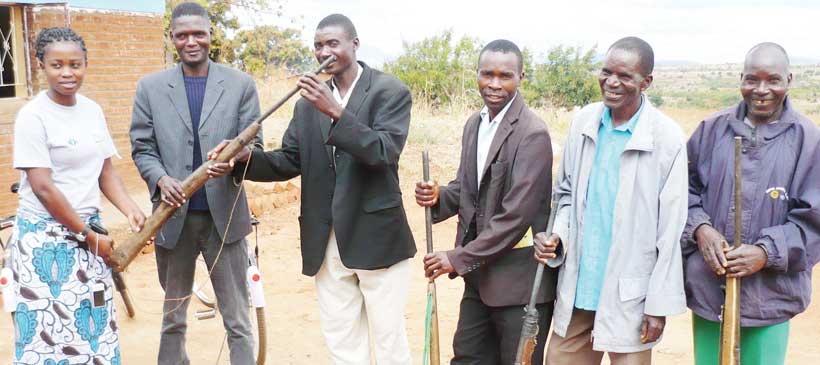
Mphonde’s words are corroborated by Senior Chief Kapelula on the western side on the reserve, where poaching was a routine activity. Today, the local people are now handing over man-made firearms used in poaching of wildlife.
“The current agreement with African Parks is that we are now working with a team of extension workers who live with us here in the village. So far, we have cultivated very good working partnership with them. We now realised the huge potential that eco-tourism can bring to local communities living around the reserve boundary after learning the Majete Wildlife Reserve experience,” Senior Chief Kapelula explains.
In Majete, communities have been trained in income-generating activities including managing a communal village lodge inside the reserve.
During the visit in Kapelula area, poachers who used to hunt animals handed over firearms to the police during a function that was witnessed by the media. The current agreement is that African Parks has offered amnesty to all those who have traps and firearms to hand them over as a spirit of good gesture to enhance good working partnership.
In return, they are being given a bounty of K2, 500 as a token of appreciation.
In enhancing community engagement, African Parks wil l help surrounding communities in local infrastructure support such as schools blocks, bridges, roads, school bursaries and income-generating activities such as beekeeping, mushroom processing, juice making and livestock pass-on programme to rear goats in villages.
“By rearing goats, we can no longer have the appetite to go and hunt wild animals being introduced in the reserve. This is a great bargain that we can get as communities that are living along the peripheral of the reserve,” the chief says.
Kapelula Zone Chairperson Christopher Kwenda observes that there is strengthened extension work with communities so much that those that dug pits as traps for animals are going back to bury those pits in the reserve.
“We have so far buried over 45 pit traps for elephants. This is a commendable initiative in a community considered of hard-core poachers,” said Kwenda says.
Re-introducing new animals
African Parks in collaboration with the Department of National Parks and Wildlife has commenced the largest elephant translocation in human history funded by the Dutch Lottery.
Liwonde and Majete protected areas are now considered as source population for elephants. Given the size of these two protected areas and the available natural resources, both parks are almost near to their ecological carrying capacity with approximately 400 and 800 elephants in Majete and Liwonde respectively.
The result has been high cases of human-elephant conflict, especially in Liwonde and habitat degradation in both sites as the Jumbos savage whatever flora they can forage for survival.
These animals will be well secured now as a new fence is already under construction.
“No wonder that we are now able to hand over man-made guns that used to kill animals like elephants,” Senior Chief Malengachanzi says.
Choice of holding pen of animals
According to Park Manager Samuel Kamoto, the site was identified after observing that it had water, shelter and food for the animals.
But more importantly they considered the proximity of the landing site accessibility to the road. This they did considering the heavy trucks that are carrying the animals to be able to align the doors with the entrance of the holding pen.
“Elephants started arriving and we let them inside the holding pen so that they can rest and regroup as social beings and families. This enables the animals to settle down first other than just letting them out, which confuses them,” Kamoto says on the sidelines of the holding pen inside the reserve.
In his reaction to the development, Senior Lecturer in Ecology and Wildlife at Lilongwe University of Agriculture and Natural Resources John Kazembe says the move was a viable option considering the fact that Liwonde National Park is small.
He adds that being a small park, the elephants had the potential to change the habitat and hence became a menace to surrounding communities.
“Elephant herds should be moved into the reserve at intervals so that the ecosystem is not overwhelmed by a one-off relocation,” Kazembe says.
A few decades ago, around 1,500 elephants roamed Malawi’s biggest wildlife reserve but now only a few herds totalling about 100 remain. The park is now poised to be revitalizsed and serve as a critical elephant sanctuary for wildlife population nationwide.
As we went to press, an additional 102 waterbucks plus a herd of 14 elephants had so far been brought into the reserve.
Nkhotakota Reserve covers 1,800 km sq (180,000ha) and boosts of miombo woodlands and afro-montane forest clocking the Chipata Mountain on the border with Ntchisi.
Leave a Reply