
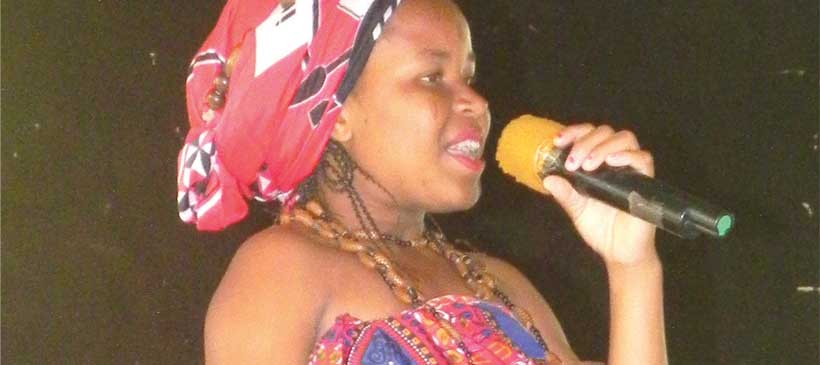
Elasticity of themes was a dominant feature, as established poets came face to face with the country’s new breed of poets at the Blantyre Cultural Centre on a sunny Sunday afternoon.
The event was the annual Land of Poets Festival held under the theme ‘Poetry: Expanding Wisdom, Deepening Knowledge’.
Once again, as has become an annual norm, poets from different hamlets declared a state, namely ‘The Land of Poets’, within the nation state of Malawi and got away with it.
It , therefore, came as no surprise that there was no Malawi Police Service officer present, an indication, perhaps, that the ‘government’ accepts the establishment of a state-within-a-state.
But, even without police presence, peace was the sub-theme to the poetic plot.
Among other poets, Frank Naligonje recited two poems, ‘Don’t bless the wedding’ and ‘A to Z’, tackling issues such as attacks on albinos and the unacceptability of minority rights in Malawi, and left the stage to Yohane Pangani.
Pangani took on bachelors in ‘Ma batchala a ku Malawi’, in which the persona slams the self-inflicted pain endured by local bachelors. A bachelor’s simple approach to life, the persona enthuses, is not a matter of choice; it is a compromised position borne out of circumstances.
Martin Matandika had his chance, too, reciting one poem before Lukia Chikopa dished out two poems, including ‘Mwamuna ndi mbalame’. ‘Mwamuna ndi mbalame’ depicts the character of a male persona as a fragile human being who is often guilty of inflicting unintentional pain due to his shaky, if not foolish, nature.
Yankho Seunda, Germany-born Richard Schuster, Synoden Tembo, Esnart Tambala, Raphael Sitima, Hudson Chamasowa, Benedicto Wokomaatani Malunga were some of the poets who shined under the roof of the grass-thatched stage.
Chairperson for the Land of Poets Festival, Hoffman Aipira, described this year’s festival as a success by drawing parallels between this year’s and last year’s festival.
“This year’s event, as compared to last year’s, was well patronised. Last year’s festival was affected by the fact that it was organised on July 6 [Independence Day],” said Aipira.
However, Aipira fell on his own sword when he admitted that there was need to involve poets from lands far and wide next year.
The most notable foreign poet at this year’s festival was Richard Schuster from Germany. He recited two poems, one in German and the other in English, before a rather passive audience.
“We look forward to having a number of foreign poets next year. This was the missing link this year,” said Aipira.
However, while observing that the positive aspect about the Land of Poets Festival is that it has become a fixture on the national calendar, poet Hudson Chamasowa did not mince words about challenges associated with the event.
“I have performed at various festivals in Malawi and, I must say, I am yet to see any importance attached to the Land of Poets Festival. One of the factors is lack of preparation. The organisers themselves, the Poetry Association of Malawi, are not organised. The association used to be vibrant when we had the late O’brien Nazombe , who introduced Chitsinda cha Ndakatulo.
“But, since his death, the Poetry Association of Malawi has never organised Chitsinda cha Ndakatulo. That’s the disorganization I am referring to. Yes, we organise Land of Poets festivals, where we meet once a year, but our house is shattered and we cannot expect things to work. We need to be organised,” said Chamasowa.
Whatever the case, it was clear, when darkness brought the festival to an end, that there were no conquering heroes and heroines at the Land of Poets Festival.
The spoken-word poets and written-word poets who recited their hearts and emotions out on the day simply concentrated on doing their part and humbly disappeared into the anonymity of the crowd.
Leave a Reply