
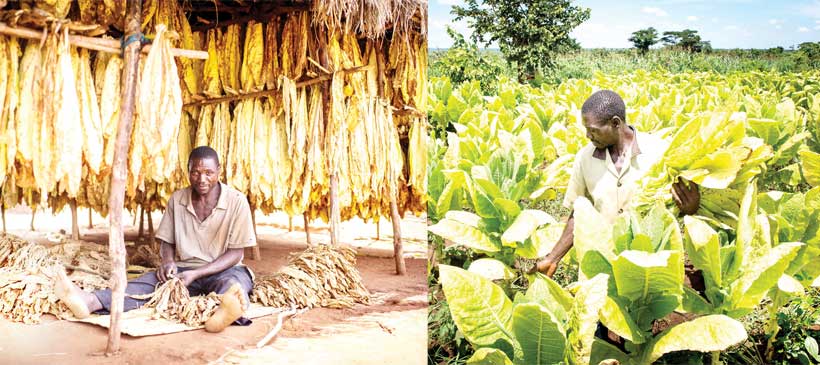
Malawi’s efforts to break its chronic dependency on its tobacco industry are struggling to get off the ground, report Collins Mtika and Marius Münstermann
He doesn’t smoke, but Erisa Chisenga will have absorbed as much nicotine as a chain smoker by the end of the day. It’s harvest season, and the tobacco plants are shoulder-high on Chisenga’s field. He plucks it leaf by leaf until nothing but the bare stems remain.
Every day, he toils in his field of a hundred square metres — his hectare of hope. He entered the industry five years ago in the expectation of a better life for himself, his wife and five children.
Chisenga is one of the 400 000 tobacco farmers in Malawi, the world’s most tobacco-dependent country. Seventy-five percent of the population relies directly or indirectly on the tawny leaf.
He is under contract to Alliance One, one of the world’s largest raw tobacco merchants. Its main customers are Philip Morris (Marlboro) and British American Tobacco (Lucky Strike).
The farmers receive the inputs for cultivation on credit. The tricky part comes when they have to pay back their loans, as few Malawians smoke and the bulk of the tobacco is exported.
This is a time when large amounts of money flow into Malawi and the currency appreciates against the dollar – meaning that the farmers must repay more than they originally borrowed. They lose much of their expected profit, while the companies benefit.
Labour costs in such a labour-intense sector are enormous — only once in five years of growing tobacco has Chisenga made a small profit.
Minister of Finance Goodall Gondwe says tobacco is “highly political” and that the hurly-burly of the sales season cannot belie the fact that the country needs to break its dependency on it.
“The times of tobacco are doomed,” Gondwe warned. He was referring to the steady drop in global consumption because of the anti-smoking lobby and declining orders for the Malawian product, which has made the buyers more selective.
The NGO Unfair Tobacco estimates that an additional 750 000 people could be fed, if food was grown on Malawi’s tobacco farms.
But paradoxically, one of the key aid initiatives is working with the tobacco industry, despite its claims to be promoting food security.
The goal of the New Alliance for Food Security and Nutrition (NAFSN) — initiated in 2012 by the G8, the club of the world’s wealthiest industrial nations — is to lift 50-million people out of poverty in 11 African countries within 10 years through public private partnerships (PPPs).
It brings together the G8 member states with a who’s who of multinational business: Nestlé, Heineken, Coca-Cola, Bayer, Syngenta, Monsanto, Standard Bank.
They plan to invest more than $11-billion up to 2022, kick-starting a “green revolution”. In Malawi, the initiative is intended to help 1.7-million people, a tenth of the population.
But among the companies aboard the NAFSN initiative in Malawi are the tobacco merchants
Alliance One — the company Chisenga supplies — and Limbe Leaf, a subsidiary of Universal Corporation, another global giant.
Together these companies buy and process up to 90 percent of Malawi’s annual tobacco harvest.
In cooperation with the NAFSN they want to expand their business. Alliance One wants to fund private tobacco research and to acquire new land, doubling its estates from a current 61 000 to 121 000 hectares.
Ronald Ngwira, leaf production manager at Alliance One argues that the solution is “(agricultural) diversification with tobacco”.
“Are we a tobacco company or are we a food company?” he asks. He says that the company provides farmers with seed, fertiliser and pesticide for maize as well as tobacco – although all inputs come in the form of loans.
Implementing the New Alliance initiative in Malawi is the European Union. Yet the German EU delegate, Maria Heubuch of the Greens party, recently urged the EU to halt its support to NAFSN in Malawi, arguing that the cooperation with tobacco companies is one of the initiative’s “worst failings”.
Heubuch sharply questions the ability of mega- PPPs such as the NAFSN to contribute to poverty reduction and food security, saying the poorest communities risk bearing the brunt of social and environmental risks associated with it.
In an interview, she said she regards the New Alliance as “a door-opener for multinationals”.
She pointed out that the companies’ business practices are highly opaque. Their “letters of intent” were not accessible to the public or delegates of the European Parliament like Heubuch herself, making it hard to keep track of their investments.
She added that in cases, the companies’ initial intention to support local people has shifted into something different. One example is Mpatsa Farms which aimed to grow rice, cotton, soya and maize under NAFSN but later “stopped and channelled resources to tobacco farming”, according to the New Alliance’s 2014 progress report.
However, the German government continues to support the NAFSN, injecting a cool 500-million euros (R8.5-billion) in 2013.
The Germans have assigned the Association for International Cooperation (GIZ) to help wean Malawian farmers from tobacco growing.
GIZ regards itself as the partner of the private sector, with its Malawi director, Matthias Rompel, dropping phrases such as: “Agriculture needs to become agro- business”.
“We can help the economy without having to deal too much with the government,” Rompel says.
GIZ is about to set up a “green innovation centre” at the Agriculture Research and Extension Trust (ARET), which was founded by the Malawian government and the Tobacco Association of Malawi to develop new tobacco strains and teach farmers how to grow tobacco.
Rompel insists that GIZ is not working with the tobacco industry, while the Malawi government has designated ARET as a core institution for the implementation of its new National Export Strategy, which calls on farmers to grow oil seed crops.
ARET has committed itself to its new “Diversification Strategic Plan” aimed at fostering alternatives to tobacco.
But doubts persist. ARET’s “key consultations” with representatives of various industries included talks with Japan Tobacco International and local tobacco market leaders Limbe Leaf and Alliance One.
It is against this background that Laura Graen of Unfair Tobacco complains that “the tobacco industry has hijacked the term ‘diversification’ and re-coined it for its own purposes”.
Among the “weaknesses” of its diversification efforts, ARET itself lists: “Biasness (sic) on tobacco (that) will negatively affect the efforts to actively engage itself on other high-value crops”.
Tobacco continues to be central to ARET’s finances. Malawi’s tobacco farmers are required to contribute one percent of their income to ARET, and its diversification plan identifies over-dependence on the tobacco levy as “another weakness”.
A document dealing with the GIZ’s cooperation with ARET bluntly states that “ARET is financed by tobacco sales”.
In a poor country with persistent budget woes, there are no easy alternatives. “Sourcing funds for research and extension in tobacco from most traditional funding agencies is almost impossible,” notes the diversification strategy.
Last year GIZ invested 140 000 euros in ARET and plans to put in a further 200 000 euros this year. Originally intended to end next year, the support programme is to be extended until 2019.
A good portion of the money, according to GIZ statistics, has been used to train ARET’s staff in how to grow oil seed crops. Yet only 5 percent of ARET’s 40 staff members have been trained in this area so far.
Reality check with our tobacco farmer Chisenga. He agrees that it would be better to grow something other than tobacco, but adds: “What we need is cash.”
This year Alliance One bought Chisenga’s tobacco harvest at one US dollar per kilogramme. This was worse than making no profit — Chisenga failed to repay the loan and sank into debt.
With the substitution programme struggling to take off, tobacco remains his best bet. Somehow, he’ll have to keep his hopes up until next season.
Leave a Reply