
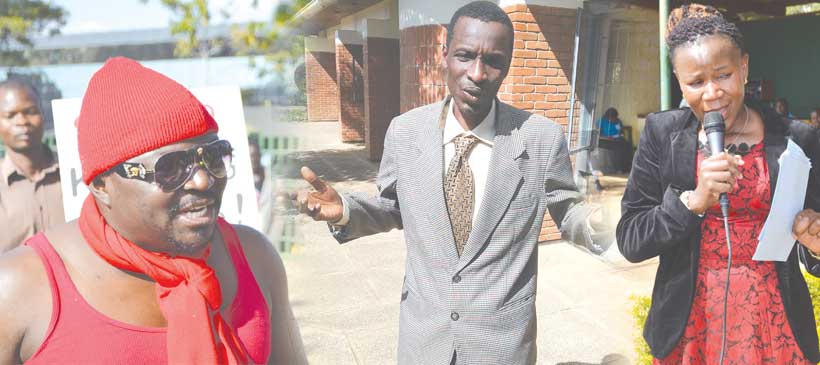
Battered by reality, shaped by the environment and wary of the unknown, it has been predictably easy for artists to fall into the trap of thinking inside the box of the familiar.
So, musician Billy Kaunda waxes lyric about how the world misses the departed in ‘Kumidima’, playwright and actor Charles Mphoka reflects on what is sending women to their early graves in the collaboration ‘Amayi akuferanji’, Skeffa Chimoto composes a song tackling issues related to the killing of people with albinism — one of the social ills affecting Malawans– and life goes on.
Save for Lucius Banda, who sometimes tackles issues from the ‘front’ by relating to issues that might happen in a futuristic world, it is clear that reality shapes much of the content in local artists’ works.
And, even when the artist becomes futuristic — as in Lucius Banda’s ‘Wandithawa’ , a song in which the persona decries failure to pop the marriage question to someone so dear to the heart — it is still clear that the persona’s futuristic outlook is shaped by experince.
So, in a way, it is still difficult to divorce the past from the future.
Of course, some short story writers such as Aubrey Chinguwo and Steven Kumalonje have tried to be futuristic in some of their pieces, and have tackled imaginary issues and characters in the setting of worlds and time far from this material time. But, even then, the focus has not been on events 200 years from now. Instead, the focus is within the next 50 years or so — as if the authors want to be there and watch the things they have referred to in their pieces unfold, right before their eyes.
This leads to the question: by focusing too much on experience, other than futuristic perceptions in relating to the present, are artists not failing in fulfilling their prophetic role of nipping some of society’s ills in the bud before they actually happen? Could someone, flying on the kite of futuristic thinking, not have ‘foreseen’ social injustices such as the killing of albinos in their imaginary world and helped tame the same?
Creative writer Jonathan Mbuna feels that it is possible to tackle issues using the futuristic aproach, but observes that the ordinary Malawian enjoys reading, say, short stories that have semblances of reality.
Mbuna says readers identify easily with something that strikes a familiar chord in them.
“To a greater extent, a creative writer tries to be real. The aim [of being real] is to help people relate with the issues being addressed,” says Mbuna.
However, the experienced writer adds that some Malawian and African writers have left a mark on people’s minds when it comes to futuristic writing but observes that some readers feel that such writings are more abstract than believable.
“Let me say, in the first place, that Malawian writers can do it. In fact, we have others who have done it. Shadreck Chikoti has done this well through his science fiction
Muthi Mhlema also does it well. In Kenya, we can talk of Ngugi wa Thiong’o. So, it is not something that is out of the question.
“But, then, a typical Malawian literature lover may relate very well to a piece of art that resonates with reality. For example, they may appreciate writings that relate to, say, the experiences of people with albinism than, say, science fiction. This said, we can do it if we want and I see nothing hindering a Malawian writer exploring that area,” adds Mbuna.
He argues that the limited number of creative writers who are into futuristic writing should not be interpreted as failure, in terms of playing a futuristic role, but, rather, a question of taste and the quest to reflect societal norms.
Social critic
Musicians Union of Malawi president, Reverend Chimwemwe Mhango, who recently led musicians in condemning the killing of people with albinism, says the musician would become irrelevant if he lets obsession with the future close his eyes to present realities.
“The artist plays a key role in shaping society, for good or worse, and the responsible artist should never lose sight of this responsibility. Of course, the artist is free but there cannot be any aspect of responsibility when an artist watches injustices such as those being perpetrated against people with the condition of albinism and does nothing about it.
“Musicians can play a significant role in tackling social issues. This is the reason the union led musicians in joining the nation to condemn what is happening in our society through music,” says Mhango, who led musicians such as Skeffa Chimoto in fighting for the cause of people with albinism.
Mhango, therefore, says participation in causes that relate to issues taking place in society does not translate into the artist’s failure to be futurist, saying artists reflect on the environment that nurtures them.
“And, currently, the so-called environment is not conducive to our friends with the condition of albinism. We cannot talk of the future, then, because the very future of our fellow human beings is in jeopardy,” he says.
Chimoto, who condemns the atrocities being committed against those with the condition of albinism, feels that the relevance of an artist is well appreciated when the artistic does not lose sight of what is taking place around them at any point in time.
He says it is the musician’s ability to sense the spirit of the times that makes them relevant, or irrelevant, in and to society. He says, in the spirit of first-things-first, an artist cannot focus on the future while respect for human rights, like a dry piece of wood, burns around them.
This is a view shared by Culture Minister, Grace Chiumia, who feels that artists can play the futuristic role of shaping society by speaking out on issues affecting society today.
“In fact, by addressing issues such as the killing of people with albinism right now, artists such as musicians are playing a role in shaping society in the sense that the next generation will know and appreciate the fact that, culturally and otherwise, there is no reason for one human being to harm the other.
“So, to me, artists can shape society in so many ways. The more an artist relates to issues affecting society, the more real they become in the eyes of the people. Creativity can be used in so many ways in our culture, and I am happy that artists in Malawi are sensitive to issues that apply in our context, as opposed to future contexts we may not relate to,” says Chiumia.
The problem, though, is that, often, context and outside-the-box thinking do not seem to relate. Is it a surprise, therefore, that no creative writer and artist seems to have ‘seen’ the current situation and imaginatively nip it in the bud? But, maybe, some things are meant to be tackled as they literally, and not literary, come
Leave a Reply