
The 2015/16 National Budget has been slashed from K929.7 billion to K906 billion amid government’s failure to meet revenue collection targets in the first half of the financial year.
The downward slash by K23.7 billion squeezes government to make cuts in various areas including suspension of filling vacancies in the civil service and reduction of the civil service.
Government will also scale down perks including travel, vehicle and fuel entitlements for the Cabinet and others and that the funding of Other Recurrent Transactions (ORT) to ministries, will not be against the original approved budgetary allocations but against the revised budgetary allocations which the House will approved.
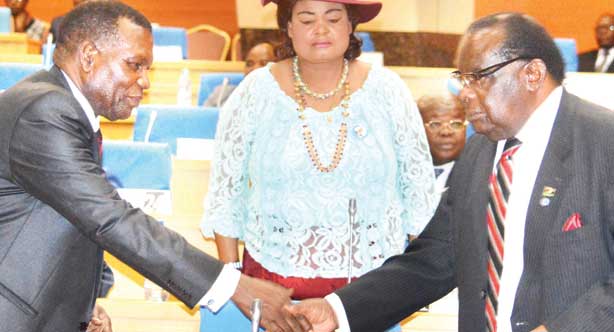
Presenting the revised budget, Minister of Finance and Economic Development, Goodall Gondwe, whose statement lasted for almost 30 minutes and was interrupted by a faulty public address system for some five minutes, admitted that the economy was still passing through turbulent times.
“I regret that we have not yet established a stable macroeconomic environment in which low inflation and interest rates prevail, and where the variability of the exchange rate is narrow and predictable,” said Gondwe.
He said the recurrent expenditure that was targeted at K358 billion, under performed by K20.9 billion down to K337.2 billion.
“Although this reduction is explained by the fact that half of the targeted expenditure on Fisp of K35.7 billion was not paid for, a sizeable amount of just under K3.0 billion was in fact saved due to fiscal measures that were taken to ensure the needed fiscal prudence,” he added.
Gondwe said total revenue and grants that were targeted at K386.1 billion at the end of the first half of the 2015/16 financial year were under-collected by K50.8 billion. He said domestic revenues that were targeted at K312.4 billion also fell short of the amount by K12.7 billion down to K299.7 billion. He said the Value Added Tax underperformed considerably by K5.6 billion. In parallel, grants performed even worse where the target of K75.3 billion was under performed by K36.5 billion, less than half the targeted amount.
Gondwe said inflation has remained high since 2012.
“The House is aware that since the shock devaluation of 2012, when prices shot up from 11 percent to 23 percent, inflation has stubbornly remained high; apart from a short period between May 2014 to April 2015 when inflation decelerated to 18.2 percent. Thereafter, it has kept on crawling up to 24.9 percent in December 2015 to be the highest in Sadc,” he said.
He added: “Last month’s decline of the rate of inflation to 23.5 percent is a welcome sign of light at the end of the tunnel. In general, however, the rate has remained high at an average of 23 percent during the period in question. In the circumstances, interest rates have also remained high, with the policy interest rate at the Reserve Bank of Malawi remaining for a long time at 25 percent, and lately increased further back to 27.4 percent. In tandem, prime lending interest rates at commercial banks have also remained painfully high.”
Gondwe further lamented: “Therefore in our case, the consequence of a loss of forex subsequent to donor withdrawal of budget support and the dwindling of tobacco export earnings, has been a continuous depreciating exchange rate. Between May 2012 and May 2014, the rate depreciated by 215 percent from K165 to K520 per US$ and 52 percent between June 2015 and December 2015.”
Gondwe then announced four points of action that government would take to stabilise the economy. He said government would reward good prices to smallholder farmers to produce leguminous crops to increase foreign exchange from the exportation of the crops.
He also said Treasury has empowered Agricultural Development Marketing Corporation (Admarc) to procure another large consignment of 50,000 metric tonnes of maize from Tanzania.
Regarding possibilities of food shortage during the coming harvest season, Gondwe said government plans of rehabilitating irrigation schemes to enable farmers to double food production is a serious and practical solution to unfavourable climatic conditions.
“It has also been designed that over and above the rehabilitation of irrigation schemes that provide large tracks of irrigable land, the Greenbelt irrigation infrastructure particularly in Salima, should be used by smallholder farmers to produce crops twice a year regardless of whether conditions permit or not. It is intended that this programme should be supplemented by large estates that have agreed to produce irrigated food crops which the Government could buy and Admarc could sell at subsidised prices. The 2016/17 budget will carry the needed funds for this programme,” he said.
The last strategy, Gondwe announced, was that government has embarked on a radical fiscal adjustment that aims at ultimately covering recurrent expenditure of the budget with domestic resources leaving only the bulk of the development part of the budget to be covered by external resources.
“The aim is to progressively eliminate Government domestic borrowing that fuels inflationary pressures,” he said.
Leave a Reply